
Ask any experienced day trader about their absolute worst days in the market. They won’t tell you about a flawed strategy or a bad indicator. Instead, they’ll tell you about that one brutal trade where they let their emotions take over, completely ignored their plan, and watched a massive chunk of their trading capital vanish in minutes.
When you get into active retail trading—whether you're scalping fast-moving crypto assets or monitoring heavy volume on Indian equities like Tata Steel or the Nifty 50—your winning percentage matters way less than your risk management.
If you want to survive the markets long enough to actually make a consistent monthly profit, you need a strict safeguard. Enter The 2% Rule.
What Actually is the 2% Rule?
The core concept is simple: You never risk more than 2% of your total trading account value on any single trade.
Pay close attention to the wording here. This does not mean you only buy ₹1,000 worth of a stock if you have a ₹50,000 account. It means that if the trade moves against you and hits your hard stop-loss, the total financial damage to your capital is strictly limited to 2%.
Let’s look at the math: If your total trading pool on an app like Groww is ₹50,000, 2% of that capital is exactly ₹1,000. No matter how incredibly confident you feel about a chart setup, your maximum loss on that specific position cannot exceed ₹1,000.
Why This is a Math Lifesaver
A lot of beginners make the mistake of risking 10%, 20%, or even 50% of their money on a single "sure thing" trade. The math behind losing capital is incredibly brutal because recovering gets progressively harder the deeper you dig yourself in:
If you lose 10% of your account, you need an 11% gain just to get back to your starting balance.
If you lose 50% of your account, you need a massive 100% gain just to break even.
By keeping your maximum risk capped strictly at 2% per trade, you can endure a brutal streak of 5 losing trades in a row and still have roughly 90% of your capital completely intact. It gives you the staying power to learn from your mistakes without blowing up your account.
Pairing the Rule with a 1:2 Risk-to-Reward Ratio
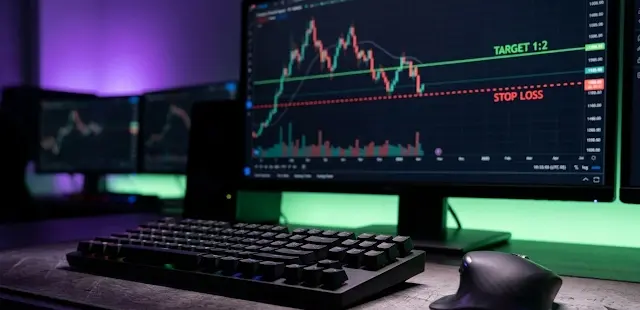
To turn this defense mechanism into a profitable engine, you have to pair it with a 1:2 Risk-to-Reward ratio. This just means for every rupee you risk, you aim to pull in two rupees in profit.
Let’s see how the math plays out over 10 trades using our ₹50,000 account (risking ₹1,000 per trade to make ₹2,000):
5 Winning Trades: 5 x ₹2,000 = +₹10,000
5 Losing Trades: 5 x ₹1,000 = -₹5,000
Net Profit: +₹5,000
Think about that. Even if you are only right 50% of the time (which is literally a coin toss), you walk away completely profitable at the end of the sequence because your wins are twice as large as your controlled losses.
How to Execute This on Your Next Trade
Know your number before the bell rings: Look at your account balance and write down your exact 2% maximum rupee loss limit.
Set a Hard Stop-Loss immediately: The exact moment you enter a position on your brokerage platform, place your stop-loss order. If you're trading an opening range breakout, your stop-loss belongs right at the designated breakout line or invalidation point.
Calculate position sizing, don't guess: Don't just buy a random round number of shares or tokens. Calculate how far your entry price is from your stop-loss, and adjust your total quantity so that the gap equals your maximum 2% risk.
Trading isn't a game of guessing the future perfectly every single morning. It's a game of managing risk, keeping your head cool, and protecting your capital so you can live to trade another day.
What's your current risk management strategy? Do you use a strict stop-loss, or do you still trade on a gut feeling? Let’s talk in the comments below!





