
I'm of the mind that humanity does better overall when we treat any sort of currency as a means to an end, not as an end by itself. I haven't made myself a part of crypto just because I wanna make several thousands of United States Dollars -- setting aside, of course, that one of the loftier goals of crypto should be that when the day comes, I shouldn't have to be transacting in USD anymore if I really don't want to. Rather, I like to think that I'm a part of the world of cryptography in part because I'm compelled by the philosophical implications of using mathematics to develop a method of accountability. I find it amazing that large swaths of people are collectively developing interest in this field of study, and I have the privilege of being a part of it all this early on.
So today, I'd like to do a little something to resist the horrible, writhing influence that cryptocurrency markets have begun to exert on our culture and way of life. And I'd like to do that by talking about something I find worthwhile. And that something is token creation.
Remember when I said I didn't want to talk about cryptocurrency at all today? Pursuant to that, let's break the mold here -- though only figuratively -- since we're going to need that in a minute. I'd like to introduce you to CBT. Rest assured, by the time you're done reading this outline, you won't be able to shut up to all your friends about how much you love CBT!
Yeah okay, I'll stop it. Just don't google image search CBT in front of the kids.
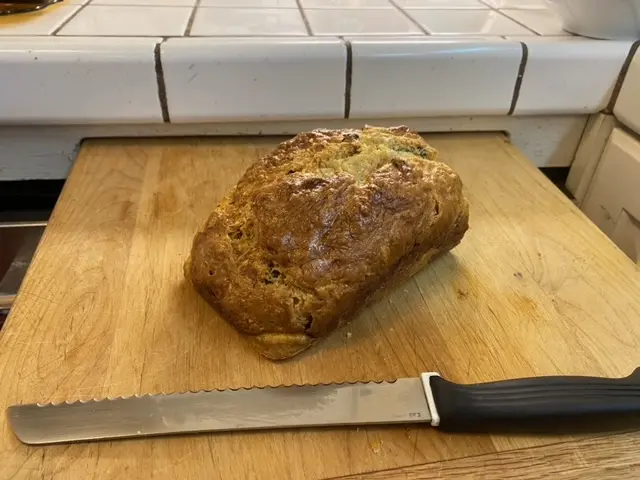
CBT takes its form as my very first NFT, or Non-Fungible Token. I guarantee you, it's incredibly difficult to replicate precisely -- unthinkably difficult, actually. For this reason, alongside my pending copyright claim, I feel safe sharing with the community the white paper for this design.
How to Make the Very Greatest Cinnamon Raisin Bread Loaf:
- Pre-Autolyse Requirements:
- 0.3oz (8.5g) yeast
- 3/4 cups (170g) of oat milk
- 1/4 - 1/3 cups (54 - 74g) of water kept at 110 F
- 1/4 teaspoon powdered ginger
- 1 Tablespoon powdered milk
- 1 Tablespoon vital wheat gluten
- 5 cups all purpose flour
- Tools:
- Kitchen thermometer
- Kitchen scale
- Large mixing bowl (boule)
- Smaller mixing bowl
- Baking pan
- Whisk
- A robust spatula
- Oven with broil feature
- Microwave/electric kettle/traditional kettle, if you're an old fart
- Post-Autolyse (Flavoring) Requirements:
- 2 Tablespoons (28g) butter, plus enough for pan and boule
- 1 cup of raisins and chopped walnuts/pecans
- 1/2 cup (45g) rolled oats
- 1/3 cups (50g) brown sugar
- 5/4 teaspoons (8g) salt
- A generous dash of cinnamon
Process:
I'm not gonna beat around the bush here. This recipe is kind of a bitch. Every step of the process must work hand-in-hand with each other in order to make this work well, and it mostly boils down to how cinnamon behaves as an antagonist to yeast. One can't exactly make a cinnamon raisin bread recipe by just mixing all the ingredients together and slapping that greasy puppy into the over to bake. One does not attain cinnamon raisin bread that way -- they attain a cinnamon raisin brick, which is a very different type of token indeed. This works as an excellent security feature, by ensuring that only those who follow instructions perfectly will even have a chance of producing counterfeit with any level of accuracy.
Step 1: Pre-Autolyse:
Start by warming your water to 110 F, measuring with precision by way of your kitchen thermometer. While you're at it, turn your oven's broil function to low. In a small bowl, whisk water, yeast, and powdered ginger, with maybe just a pinch of salt and sugar. The trick to this recipe is to keep a close eye on your yeasty-concoction. Watch it like you're a jealous lover. About 5-10 minutes in, you should see the bubbles "plume" from the center. This is your cue to mix it in with the flour mixture.
In the larger bowl, whisk your flour, powdered milk, and gluten. If you're some rich stickler bastard, you can use bread flour instead with the powdered milk, but I kinda don't see the point. When the time comes, introduce your yeasty-water mixture into the bowl, folding over the lumps of flour with your spatula until it's either fairly uniform or your spatula breaks. Once it's well mixed, turn the broil function off. Place this mixing bowl to rest in the residual heat of the oven covered with the dampest, dankest towel you currently have in the kitchen. It should be no warmer than 170 F. If the mixture's too dry, don't be afraid to mix in some of the oat milk early. It really depends on the season and humidity.
While you're at it, let some of your other ingredients get to know each other. In the residue of the smaller yeasty bowl, mix some of your oat milk, oats, brown sugar, butter, etc. Let these two bowls soak in the heat alongside each other in the oven like best friends for about thirty minutes. Fix yourself a drink while you wait.
Step 2: Post-Autolyse:
After thirty minutes have passed, pull the bowls from the heat. On a floured surface, begin kneading all the ingredients together except for the cinnamon. Ensure the texture is uniform. Once ready, go ahead and take the proactive step of greasing the inside of your boule bowl -- you can use the old mixing bowl, or a new clean one. Drop your mixed dough concoction into the bowl and let it sit covered for another hour or two. Maybe more, depending on how warm it is where you live. And how dank the rag you chose is. Baking bread is an exercise in patience. I dunno, make yourself a cup of coffee.
After this rising period, remove the dough and lay it out on your floured surface again. Gently roll it out into a long, flat pancake shape using a rolling pin. Across its top, spread melted butter, brown sugar and at long last, no shortage of cinnamon. Roll it up into a swirl shape, and place your burrito shaped roll of dough into a greased baking pan. Let it rise again for another hour or so, preheating the over for 350 F when the time's right.
When it's done rising in the pan, pop the sucker into the over. Bake for 35 minutes or so, or until it's 195 - 210 F in the center. The last 15 minutes may use a foil tent to cover the top of the load, so as to make a crispier crust. Once finished, place on a wire rack to cool.
Applications:
Already, I've found that the ability to mint new non-fungible tokens of this variety -- or of varieties derived from similar recipes -- has made for useful exchange. So far, I've distributed many loafs of cinnamon raisin bread to friends and family, all of which have highly appraised its value. Just yesterday, I exchanged a derivative token -- dubbed "sourdough" -- for ten freshly lain free-range chicken eggs, previously belonging to the family up the street from where I live. Examples of these peer-to-peer exchanges are already proving to be extraordinarily useful for local utility. The exchange is even tax-exempt, and since you can cut your own slices, the resolution for denominations is hypothetically unlimited.
In addition, this NFT has an application for utility that no modern cryptocurrency NFT is able to emulate -- It is entirely edible. By creating this token, I'm also able to consume it, ideally alongside a fried egg and a cup of coffee. It even sustains my bodily functions at top capacity without any wavering in performance until at least lunch time.
Any user who receives the Cinnamon-Raisin Bread Token can enjoy it to a similar nature, allowing its application to be widely compatible with any user interface. Except for people who have no mouths, I suppose. The only problem that I've found with the token is that by being a literal loaf of bread, it doesn't transmit well through any medium of exchange besides in person or maybe mail-based exchanges, which reduces its ability to be distributed easily. Furthermore, since it's made of ingredients, it has the potential to go bad if you don't do anything with it for a while. But rest assured, my engineers claim they're working on these issues as we speak. If all goes well, we'll be able to see loaves of bread transmitted through electronic signals. The key, they say, is to try to force a loaf through a CAT-5 cable. For wifi, our dev team will be tasked with chucking bread at users from across the room. Although they told me not to say that part out loud.
My firm is confident that NFTs are the way of the future, and that you should absolutely invest gobs of money in the development of this token. I look forward to seeing how the value of this commodity will skyrocket, considering its relative scarcity -- I only make one loaf a day, at most. I think it has a lot of potential, considering that it's a resource with incredible scarcity, because I'm the only guy who's able to make it come out exactly right. Everybody else who tries to emulate my work ends up making something just a little tiny bit different, as this is what you get when you go for tokens that are not minted by General Jack's Bakery Company. This protects its unique characteristics from counterfeit and adds extra security, not to mention deliciousness. Looking at you, grandma.
Make sure to subscribe to my comment, I look forward to hearing from each of you regarding future business ventures. Now if you'll excuse me, I believe that's my friend at the door with an NFT in the form of a freshly baked cake.






