
That’s right! Bring Back Satire is now an NFT on Ethereum.
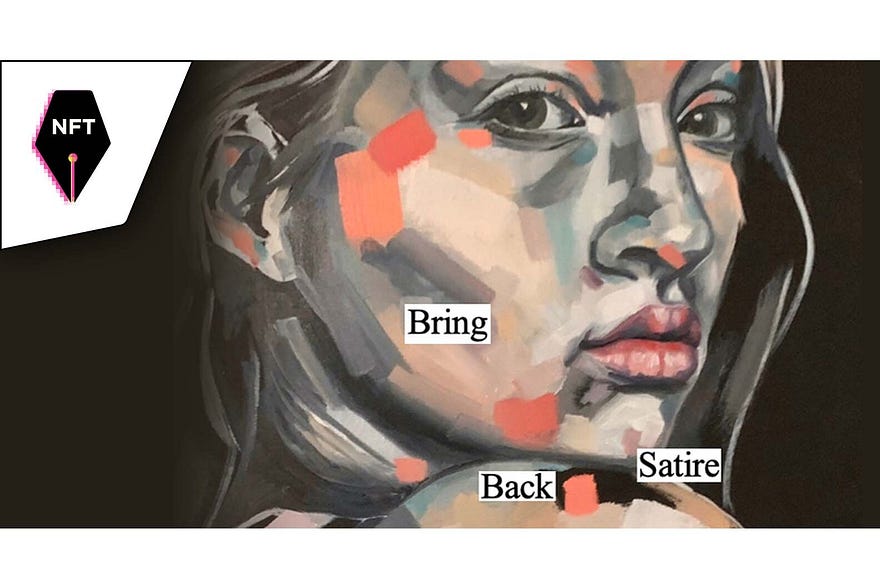
I’m new to the NFT space. In fact, less than a year ago, I appeared on a podcast and spoke in public about how I didn’t understand the concept. Fortunately, a lot has changed since then. Services such as Cargo and OpenSea have made it easier than ever to mint and view NFTs with a set of web-based services that allow users to put almost any sort of digital content into the blockchain. But let’s back up just a second and work up to that. I just figured out what an NFT was myself, after working up to it for almost a full year.
How It Got Started
The story starts last December, when, a day or two after Christmas, a friend of mine sent me a link to a website called Cent. I joined up and saw it as a golden opportunity to pursue a new audience online. I’d experimented with a site called Ello that was billed “the creator’s network,” but I hadn’t received much in the way of reward or anything there and was fairly slow to build my account in terms of followers. I discontinued my use of that platform a bit after getting onto Cent and beginning to receive tips in Ethereum for my work.
Ethereum is a network, and ETH is a cryptocurrency which is used to pay fees on the Ethereum network. Ethereum is special because it is backed by the most robust development community in the blockchain marketplace; that is, more applications accomplish more diverse ends on the Ethereum network than on any other blockchain. Games, information exchanges, trading, and even authentication services such as Metamask which make use of ETH wallet addresses to manage accounts securely; all of these and more are already deployed at various stages of development via Ethereum today.
Naturally, I was getting paid in this stuff, so I had to figure out what it was. That took a few months, but was rather boring, so I saved up one paycheck and bought a crypto token called Tezos with it for a lark. It doubled over the course of the next two weeks or thereabouts. I was hooked on cryptocurrency! I took up trading and did fairly well over the course of the immediate past. While this was going on, I was experimenting creatively with the most engaged audience at the deepest level that I’ve found anywhere on the internet today. The new beta came out and I believe the site has declined since that point in terms of this activity, but I waxed philosophical and watched the tips roll in faster than my eBook sales on Amazon counted upward, not that I made all that much via Cent.
I published a book to Cent, in fact, called A Murder In The Silicon Hills which you can read from beginning to end onsite using links at the bottom of each chapter. People tipped the work each week it seemed, sometimes quite generously. If I’d kept all of that ETH I probably would have at least a few hundred dollars today. I noticed that artists were doing artwork that was selling on websites for substantial sums, but didn’t really understand which parts of an NFT were stored in ETH, which were in sidechains, and whether it would all work long-term or not. I knew I didn’t want to see the inconsistent storage I’d previously experienced with IPFS, and I understood that blockchain’s immutability was what made it different from IPFS, but I was uncertain of the price.
So I waited. I looked at the concept of happiness from a philosophical angle, then put together a short and light philosophy book about happiness called Bring Back Satire. I put this new book up on Amazon and sold a handful of copies, but never drew much attention for it until I minted an NFT version of it and put a copy onto OpenSea.io, where it sold for about $125 in ETH.
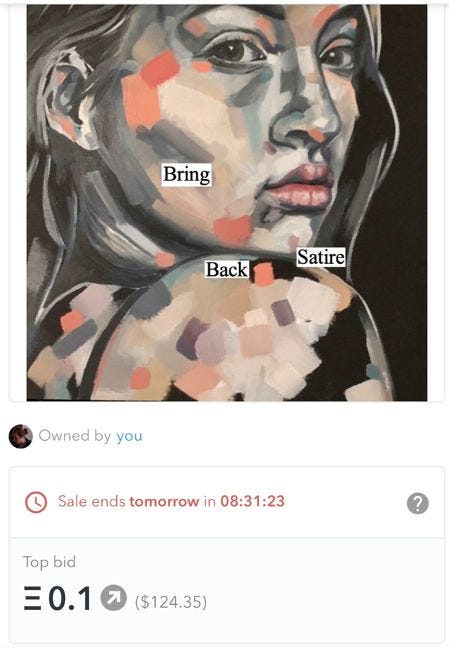
It turns out, even these days gas can be as low as $20 or so to mint a single NFT using Cargo. To do a run of identical NFTs with royalty agreements that can retroactively pay you over time as the artifact changes hands, it’s looking like significantly more (.8ETH, all in, give or take). Enough more that I won’t pay that much to go forward with this project if it’s possible to wait out the high prices, though using Valuables as a fundraising platform for this work of art is a new possibility I’m looking into. So, for now, I’m waiting for the price of gas to drop on the Ethereum network so that I can execute my transactions for a reasonable sum of money.
With that said, the prices are generally reasonable enough that, if there really is enough of a market to support a $20 or $25 average first sale price for 25 of these books, I will be able to get them out into the world where people can trade them at will as collectibles. I believe there is substantial reason to believe that this improves the upside for the writer dramatically in comparison to services like Amazon Kindle which do handle some marketing and some money for authors, but charge far higher fees. I’m about to try to divorce the monetization of the book from the text by tokeninzing it, after which I plan to make a few formats of the work completely free to the world to read.
What’s Next?
From here, it looks to me as if NFTs are poised to take over. These unique and immutable assets have an opportunity to change everything about digital commerce and digital rights management in the near term! Once the owner holds the token, the files locked inside can be downloaded and viewed at any time with no transaction fee to pay. The owner incentive structure is fascinating, though: it is more financially beneficial to the owner of such an NFT to download the file and sell the token (if the goal is to retrieve the information within) without sharing the PDF file or other content!
That’s right! The collector’s mindset here could be an asset to creators everywhere who are interested in cutting out the middle man and assuming more responsibility for the distribution of their content. The sword cuts both ways, however, and widely-read works are more likely to generate interest as collectibles, so content creators will be able to approach the market from different angles as they see fit.
Weird collaborations between writers such as myself, studio artists who make audio files, and of course our friends who do visual art, may become far more commonplace as the digital art universe takes on a new degree of complexity in response to the ease of integration offered by the new medium. For one example, have a look at this lovely poem/picture combo by Cent user @Puffin. A small thing, which has long been the fashion in magazines and in books, images featured alongside works of prose can have a certain priming effect upon the reader, perhaps striking a sort of familiar chord when it goes according to plan.
The same sort of thing should be feasible with music… here’s an early attempt at something like that by yours truly if you’re curious.The point of all of this is that what is happening is small-time creators are finding a major advantage in their ability to create unique, memorable and therefore collectible content on the blockchain. As Cent have recently shown with their lovely tweet bidding application Valuables, it is entirely possible to turn virtually anything that exists on the internet into a commodity with technology many creators can have direct access to today.The question on everyone’s mind is this: what will you make?
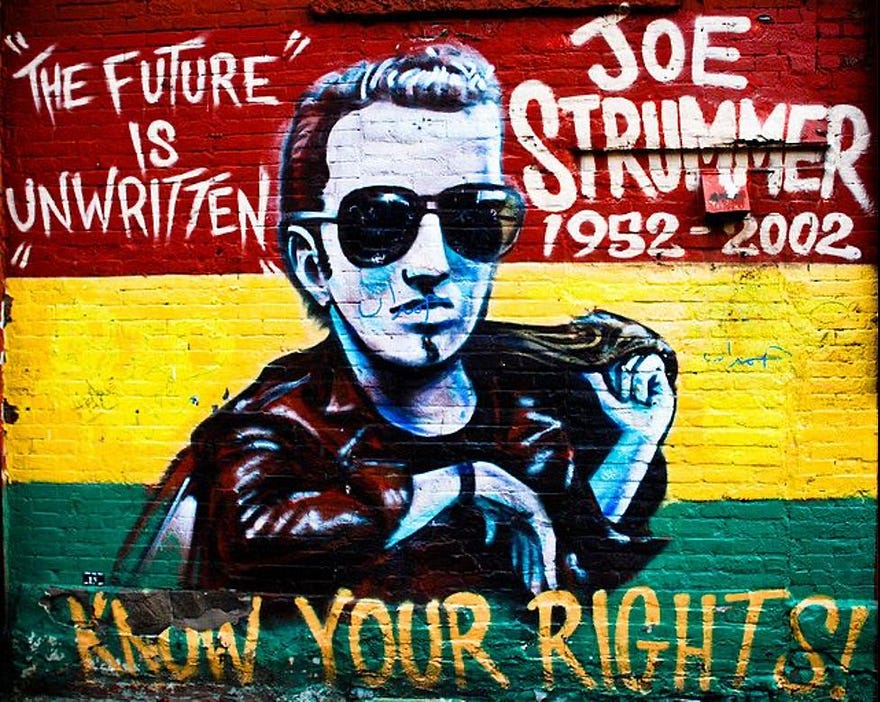
As the famous Clash frontman Joe Strummer once said, the future is unwritten. The genius Strummer had was that he could go around to all of the places where different people gathered to say what they had to say and make the music they wanted to make, and he could see the value in all of it.
Strummer’s career as a musician, from the Clash to the Mescaleros, was about taking the sounds he heard and putting them together in his own way, to create something new that spoke to people. The point, to him, was to “communicate something” to the audience, and as a creative and a writer I think what excites me the most about the evolving NFT space is the treasure trove of new possibilities that web3 communication has already begun to open up.
The barriers between an artist of any stripe and an audience are eroding rapidly in the face of Ethereum’s rapidly increasing library of automations for almost everything. Soon, middlemen will be out of the game entirely. It is possible that these new distribution methods for classic forms of information will dramatically reshape the economics of the independent creative lifestyle, making it far more accessible as well as more stable and thus more desirable.
The ability of a smart contract to create and enforce royalties will simplify DRM (digital rights management) and I can’t help but think that increasingly direct communication between creatives and ever-larger audiences enabled worldwide by technology could have the potential to create a modern-day Renaissance. However, after my conversation with the one and only Marjan Moghaddam this weekend, I am convinced that the present day’s NFT art movement represents merely a Roccoco and not yet a true Renaissance.
Originally published at Voice.






