

After my latest article about the disposition effect, explaining how you may be unconsciously killing your crypto and stock returns, it's time for a much less known and subtle tendecy you may be exhibiting, and which I mentioned in early January. Let's fly by this bias and get a good look at it!
What is the action bias?
Patt and Zeckhauser have coined the term action bias, which may be succinctly defined as a predisposition to take action, even if there are no rational reasons to carry out an action, hence making it an irrational behaviour (its contrapositive is the omission bias but that's for another article). Generally, there are a number of intersecting factors contributing to the action bias. One of the key ones is the illusion of control, which means you may often feel that taking an action will let you take control over a situation (seemingly on fire), even if that control is illusory. In the context of trading, you might believe that constantly adjusting the portfolio's balance will help you to better manage risks and returns, even if those adjustments are ultimately counterproductive and won't produce better returns.
For some people, the act of trading can be exciting and stimulating, providing a sense of engagement and purpose of "being at work". This can lead to overtrading, even when there is no sound financial reason to do so. The hussle culture, having its roots in the protestant work ethic of always keeping busy only amplifies a need to do just something. A person sitting idly and observing the world is "a lazy person," which has been culturally stigmatised since the advent of capitalism. You're supposed do work, and work hard for your investment at all times (even after you've researched your crypto projects and stock companies) to deserve your winnings, also after you've purchased the assets because leaving it as it is would be an anathema to the industrious person's ethic. And see yourself as a hard working person, after all.
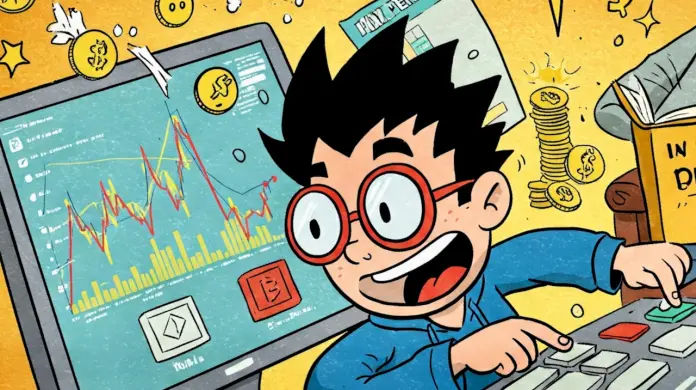
Action bias in the world of crypto and stocks
But how does that apply in the fast-paced world of crypto and stock trading? Where fortunes can be made or lost within a time interval it takes to munch your Monday lunch, it's easy to get caught up in the constant buzz of unnecessary activity. The perverse design of the trading charts, continuously blinking in red and green lights of the order books and settled trades, the flashing values of assets' prices and percentages, the constant stream of incoming news suggesting the next big opportunity or an impending crash is just a few minutes away, and the buzzing smartphone of push notifications, they all try to persuade your both conscious and unconscious mind to take action – to engage in never ending trading activity. The reason for that, partially, is that this bias benefits all exchanges - the more you trade, the more fees they collect, thus they keep exploiting and amplifying your predilection for the action bias.
With time, the more you spend in front of the trading screen, the more you become biased towards the unavoidable need to just do something, in order to stay ahead of the game. However, this urge to act often can become detrimental to your investment performance. The inside nudge to regularly check your portfolio is another factor for the action bias, reinforcing the very habit and occupying your working memory in a never ending loop. Upon noticing a slight dip in value, you may rashly decide to sell before, as you might think, the matters would worsen. Often, these drops in assets' price are only temporary, and things soon miraculously "right on their own".
The highly volatile nature especially of crypto markets can create a constant sense of urgency, making it feel like you need to be constantly vigilant to price swings and be ready to buy or sell at a moment's notice. To make matters worse, the fact that crypto markets trade 24/7 can only exacerbates the action bias, as there is always an opportunity to make a trade, day, afternoon or night, even outside of the traditional stock exchange market hours but even that is changing with steps taken by Robinhood or T212 and most recently by the New York Stock Exchange looking to trade for 22 hours a day. Surely, a "trader's burn out" guaranteed. The sheer volume of information available online, from news articles and analysis to social media discussions and trading signals, can also create a sense of information and cognitive overload, leading to impulsive and not fully rational, often regretted at a later time, decision making.

Counteract your tendency for the action bias
While the action bias is a deeply ingrained psychological tendency, there are several strategies you can employ to reduce, or even neutralise, with conscious effort, its pervasive influence on your psyche. Here's a list of actionable steps you can consider:
- Develop a long-term investment strategy: Having a well-defined investment strategy with iron-clad goals and a long-term focus can help you to resist the urge to make impulsive trades based on short-term market fluctuations.
- Set specific entry and exit criteria: Before entering the trade, define clear entry and exit criteria based on your analysis and thought out strategy. This can help you to avoid making emotional decisions based on fear or greed.
- Use limit orders: Limit orders allow you to buy or sell an asset at a preset price, preventing you from making impulsive trades at unfavorable prices.
- Practice patience and discipline: Remember that investing is a marathon, not a sprint. Patience and discipline are essential in the markets.
- Limit your exposure to market noise: Avoid constantly checking the market prices and news, and become selective about the information you consume.
- Seek out contrarian viewpoints: Actively seek out opinions and analysis that contradict your own views. This can help you to avoid confirmation bias and make more objective decisions.
- Consider using automated trading tools: Automated trading tools can help to remove emotions from the trading process by executing trades based on pre-defined criteria.
- Take scheduled breaks: take breaks at regular intervals from monitoring the markets, get away from your computer or put your smartphone away in a bag or leave in another room. This can help you reduce cognitive and physiological stress and gain clarity of vision of the overall, long-term strategy.
In conclusion
The action bias is a common pitfall for many traders, especially in the crazy fast-paced world of crypto. By understanding the factors that drive this bias and implementing strategies to mitigate its effects, you can make more rational investment decisions and improve your portfolio's long-term performance. So, please, remember – sometimes the best action is no action at all.
For more intel on blockchain tech, crypto & market insights from the perspective of {meta}cognitive and behavioural economics but not only, join me at my X / Twitter account and follow at Publish0x.






