
In the field of crypto assets, there was no custody service provider at the beginning, because one of the initial goals of cryptocurrency was to eliminate all intermediaries (such as banks, governments, etc.), so that people can really control their own assets. The only custodian party is the exchange. Users deposit funds into cryptocurrency exchanges, and believe the exchange can keep the safety of their assets, but in a centralized exchange, when users need to withdraw the assets, they must initiate a withdrawal request, which means they need the exchange’s permission to transfer their own assets.
However, these exchanges are not regulated (although there are now compliant exchanges), and as buyer institutions enter the market, it is found that these institutional investors need regulated custodians to ensure the safety of their funds (although many regions of regulatory authorities have not given clear regulatory guidelines).
Crypto Assets Custody Service Is Needed
With the accelerated development of Blockchain technology, the scale of crypto assets continues to expand, and the demand for custody of institutional investors is increasing. Providing safe and credible custody services for institutional investors is particularly important for the development of the industry. As it were, compliance is the foundation of the development of crypto assets, and the compliant crypto assets custody is believed as the “infrastructure” of the crypto market.
Kyle Samani, managing partner of cryptocurrency funding company Multicoin Capital, said in a telephone interview with Bloomberg, “For many investors, crypto currency regulation is the last obstacle. Over the next year, regulatory issues will be resolved, and thus a surge of capital wave will be released.”
When Will the Traditional Institution Enter Crypto Filed
Brendan Blumer, CEO of EOS parent company Block.one, stated that “95% of the barriers for institutions to accept crypto assets are related to custody.”
Compared with the volume of traditional finance, there is undoubtedly a long way to go in the field of crypto assets.
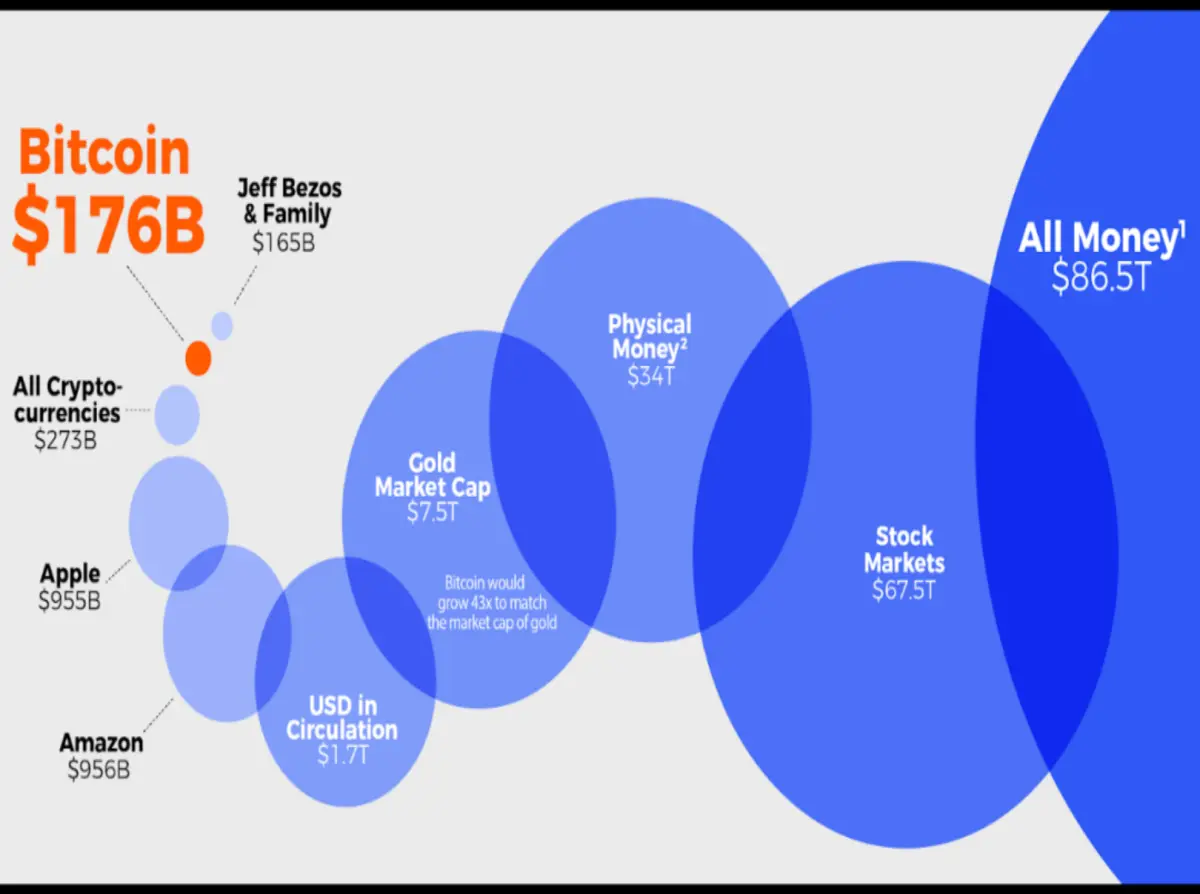
The picture still looks impressive no matter how many time you see it. The market value of the $ 248 billion of crypto industry is only a negligible part of the capital market.
The total assets of the 20 largest asset management companies in the world are 42.3 trillion US dollars, and these asset management companies only need to invest 0.5% of the total value of cryptocurrency assets, that is, 211.5 billion US dollars, which is equivalent to 85.28% of the total market value of the crypto asset industry.
Since Satoshi Nakamoto released the first version of the Bitcoin client in 2009, new crypto assets are created every day. As of May 10, 2020, the total market value of the crypto has reached 241.7 billion US dollars. Therefore, how to safely store the crypto assets becomes a big problem that investors must face. According to Chainalysis, about 4 million Bitcoins are permanently lost. Keep the assets by yourself, the private key is easy to lose;, using a hardware wallet requires a certain cost, and requires certain technology and experience; and due to the explosion of crypto assets and the security issues, a number of emerging custodians stride into the cryptocurrency market.
The custody and management business of crypto assets is still in its early stages, and it has not yet formed a standardized function like traditional finance, it waiting for further development. The crypto industry is also making great strides forward, a large number of traditional hedge funds, family trust funds, wealth funds, etc. have begun to configure crypto assets, and the demand for crypto asset custody and management business is also increasing.
The US Bitcoin futures exchange Bakkt is scheduled to be officially launched at the end of September 2019 after many struggles. One of the important reasons for supervision to turn on the green light is inseparable from its acquisition of the DACC company. The compliance custody solution is not only an important boost for Bakkt on the compliance road, but also its biggest bright spot in attracting institutional funds.
What Are Those Crypto Custody Platforms
The demand for crypto asset custody in large institutions is very strong. The custody business in the traditional financial field such as banks are very similar to crypto asset custody, but they lack sufficient experience and innovation. There is no doubt that banks will only provide crypto asset custody services when they fully consider compliance and risks. According to statistics from The Block’s report last year, large banks are reluctant to provide banking services for crypto assets because of their high risks. All banks in the United States that provide crypto asset services have less than $ 70 billion in total assets. Only one-third of crypto-friendly banks provide custody services. But it is foreseeable that with the perfection of regulation and market, more and more banks will join. In January of this year, Vontobel, a private investment bank in Switzerland, launched a crypto asset custody solution for banks and asset management companies; JPMorgan Chase, Northern Trust, Bank of New York Mellon, etc. are all exploring and researching crypto asset custody business; BitGo invested by Goldman Sachs is hosting the crypto assets of Bitstamp, one of the largest exchanges in Europe. Unfortunately, in China, it is rarely possible for banks to carry out related business in the short term.
There’s controversy about whether the user’s crypto assets placed on the exchange is considered custody. Unlike traditional securities trading, in the process of crypto trading, the exchange assumes the double responsibility of brokerage and bank. As a third party in the transaction, the exchange is in charge of receiving payment from and issuing the crypto asset to the buyer. Therefore, it is also counted as custody. Exchanges are an important part of crypto assets, that miners can monetize the mining proceeds; almost all the new participants purchase crypto assets through centralized exchanges; many small and medium participants use the exchange as storage tools. According to the data of chain.info, the top ten exchanges have a total balance of about 2.366 million BTC, accounting for 11.3% of the total supply of Bitcoin.
The exchange provides liquidity to the market, and at the same time, it collects huge commissions and listing fees by providing order matching and fund settlement services. As say from official announcements, in the first quarter of 2020, Binance destroyed 3.374 million BNB and the market value of the destroyed portion is approximately 52.46 million USD; Huobi destroyed HT worth 26.68 million USD; OKEx destroyed OKB worth 17.5 million USD. In fact, exchange is still one of the few companies in the crypto industry that can make money. In addition to the transactions we care about most, Binance, Whale Exchange, etc. have all launched lending and asset management services, and some exchanges also have services for staking.
In addition to the crypto asset trading, storage and management services for small and medium users, a small number of exchanges, like Coinbase also provide professional custody services for institutional investors. Coinbase is the largest crypto currency exchange in the United States, managing more than 20 billion in crypto assets that worth $8 billion. It possesses a BitLicence license issued by the New York Financial Department, ranked third in the “10 largest fintech companies in the U.S. in 2020”. Its derived employees are inextricably linked to Coda, dYdX, Oasis, Filecoin, OxZcash, Blockstack, NEAR, XRP and other projects, and are called “Coinbase gangs” in the industry. Coinbase’s custody service officially launched in 2018, the annual fee for the service is 1.2%, which is higher than the common, but due to its large regulation, with good compliance, technology, and credibility, it is the primary choice for many organizations. Coinbase Custody exists independently of Coinbase and is managed by the New York State Banking Act. All crypto assets are segregated and held in trust. Coinbase custody uses cold storage to protect funds, has industry-leading insurance policies, and regularly accepts financial and security audits from external companies as well. Through Coinbase custody, it can seamlessly connect with Coinbase Pro institutional trading platform, and can participate in staking and network governance. Coinbase also custody the assets of the famous crypto trust fund Grayscale.
Some Coinbase-related crypto organizations:
Polychain, investment fund(Olaf Carlson-Wee)
Paradigm, investment fund(Fred Ehrsam)
dYdX, decentralized derivatives trading platform(Antonio Juliano)
Scalar Capital, investment fund(Linda Xie、Jordan Clifford)
1Confirmation, investment fund (Nick Tomaino)
TruStory, authenticity verification platform (Preethi Kasireddy)
District0x, decentralized market (Joseph Urgo)
Radar Relay, decentralized trading platform (Caleb Tebbe)
Blocksphere, Blockchain application development (Cailen Sullivan)
merkleX, trading platform (Patrick Lorio)
Many people choose to put crypto assets in their wallets, but stored in a decentralized wallet can’t be regarded as custody, for only the person who has the private key can access the account, and stored in some centralized wallets can’t guarantee the security of assets.
Cobo and other software derived from wallets have also launched professional custody services, and are mainly in China. Cobo is a one-stop crypto asset storage and management platform co-founded by F2Pool founder Shenyu and former Facebook senior research scientist Jiang Changhao. Cobo’s product line includes wallets, vaults and custody. Its custody service, Cobo Custody, was launched in 2018 and is targeted at institutional customers. Cobo provides multi-signature, API and other solutions for institutional clients through collaborative and full custody services, as well as multiple security protection systems. By providing custody services, Cobo can also gain a management and other fees. For example, Cobo provides custody and sales services for the ChaiNext-Qin Index Fund, and customers will be charged a 1% management fee when redeeming the fund.
BitPay is a Bitcoin payment solution for merchants and individuals. It was founded in 2011, when Bitcoin was in its infancy. As a pioneer in building Blockchain payment technology, BitPay is changing the way companies and individuals send, receive, and store funds globally. BitPay provides merchants with Bitcoin webpage and email payment solutions, and provides payment cards and wallet functions to individuals. Its wallet also uses multiple signatures to ensure security. In addition, in BitPay, users can also directly exchange crypto assets into US dollars, and even can purchase gift cards from Amazon and Delta. While providing solutions to customers, BitPay will charge a 1% fee. Since 2011, BitPay has processed more than $ 2.8 billion, trusted by thousands of merchants.
Matrixport was founded by Bitmain co-founder Wu Jihan and his former employees and went online in July last year, headquartered in Singapore. The company aims to provide a one-stop platform for OTC, loans and asset custody. Matrixport custody service is provided by Cactus Custody, a compliant and independent Hong Kong trust company that holds a Hong Kong trust company license and meets the regulatory requirements of the Swiss Financial Institutions Authority FINMA. Cactus Custody assists both parties in the transaction and in the safe custody of fiat and crypto currencies, reducing the risks. Cactus Custody’s customers are mainly mining machine manufacturers / mining pools / mines, crypto currency project parties / funds, exchanges, OTC platforms, and loan platforms.
HyperBC is a professional encrypted asset safe custody service provider, providing enterprise users with one-stop custody services and merchant payment services, headquartered in Singapore, branched in Malaysia, Melbourne, Hong Kong, China, etc. It has already obtained financial licenses from the United States and Singapore. HyperBC custody service is 7*24 and global. It provides full and collaborative custody, private deployment and other solutions to create adaptive and customizable service systems for users. Technically, HyperBC adopts a multiple secure storage solutions, uses HSM bank-level security protection and KMS multi-signature mechanism, and uses the unique separation of cold, warm and hot wallet storage technology to dynamically strengthen the security of data assets. Cold-end private keys are distributed and backed up globally, with safes of the highest security level in Asia, Europe, Oceania and other places, to resist physical threats and systemic risks to the greatest extent. HyperBC Custody has an AI risk control engine to provide users with artificial intelligence risk sensing and real-time risk control warning. Currently, assets from HyperPay wallet, HCash wallet, HyperFin platform, CoinW exchange, HPX exchange, etc. are all managed by it, and the amount is equivalent to 13,000 BTC. HyperBC supports 10000+ currencies of 44+ public chains, with a payment scale of $60000000+ and user scale of 3500000+

In Conclusion
The scale of crypto assets continues to expand, but lack of compliance limits institutional investors ’enthusiasm for participation. In the face of market demand, a large number of institutions from all walks of life began to develop compliant crypto asset custody companies, even some of the traditional financial giants of banks and securities are also deploying the entrance of crypto assets custody. For example, Goldman Sachs invested in BitGo, a Blockchain security company, and BitGo has received approval from the US department to provide regulated crypto asset custody services for institutional clients. Bitstamp, one of the largest cryptocurrency exchanges in Europe, announced that it will custody its customers’ crypto currency to BitGo, which brings a large amount of businesses to BitGo. ICE’s Bitcoin futures contract platform Bakkt was approved by the US Commodity Futures Trading Commission through the acquisition of a cryptocurrency custodian service company. Traditional financial institutions possess a large amount of assets and pay attention to compliance, so deploying in advance can help them occupy the market and step in the crypto market at any time if necessary.
Exchanges represented by Coinbase have their own custody companies for compliance and have sufficient technology. Coinbase may be the largest and most compliant exchange in the world, and it is even allowed to list security tokens. The famous crypto trust fund Grayscale has its funds in custody in Coinbase. However, Coinbase’s custodian fees are relatively high, and the withdrawal time is also very long.
Other companies divide relatively small businesses in the custody of the crypto market, and only satisfy basic compliance requirements, so they mainly occupy the market by providing differentiated services. For example, BitPay’s payment solution helps customers receive Bitcoin through their websites and emails, and individuals can directly exchange tokens for cash. Matrixport’s purpose is to help Bitmain and its partners solve compliance issues. HyperBC is a comprehensive, secure and compliant platform that integrates custody service, financial service, and payment service. It provides one-stop solutions for customers such as wallets, exchanges, lending platforms, Token Fund, and OTC platforms.
It is foreseeable that more and more institutions will enter the crypto market in the future, and custody will become more and more important. As the compliance of the custody in the industry being perfected, crypto market can share higher custody proportion compared with traditional marker, which also can bring more flows to other businesses such as loan, asset management, Staking, etc.






