
In the field of crypto assets, there was no custody service provider at the beginning, because one of the initial goals of cryptocurrency was to eliminate all intermediaries (such as banks, governments, etc.), so that people can really control their own assets. The only custodian party is the exchange. Users deposit funds into cryptocurrency exchanges, and believe the exchange can keep the safety of their assets, but in a centralized exchange, when users need to withdraw the assets, they must initiate a withdrawal request, which means they need the exchange’s permission to transfer their own assets.
However, these exchanges are not regulated (although there are compliant exchanges), and as buyer institutions enter the market, it is found that these institutional investors need regulated custodians to ensure the safety of their funds (although many regions of regulatory authorities have not given clear regulatory guidelines).
Mike Poutre, executive partner of Blockchain hedge fund Terraform Capital, said: “Big banks and brokerage firms are hoping to introduce custody so that more derivative products can be created to sell to existing customers. The motivation is pure and simple — profits. Crypto purists are very anxious about it. Wall Street will most likely win this. ”
Why the Field of Cryptocurrencies Requires the Entry of Traditional Institutions
Compared with the volume of traditional finance, there is undoubtedly a long way to go for crypto assets filed.
The picture still looks impressive no matter how many time you see it. The market value of the $ 248 billion of crypto industry is only a negligible part of the capital market.
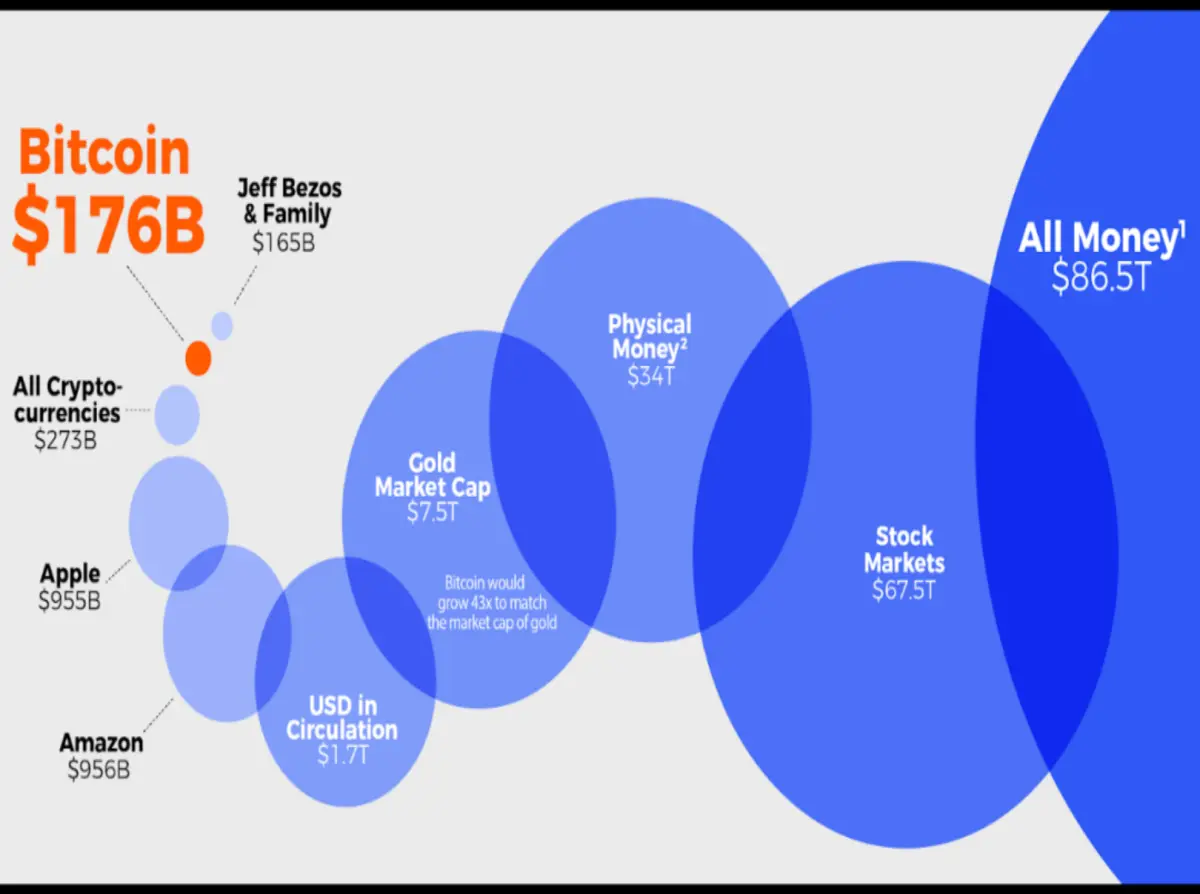
The total assets of the 20 largest asset management companies in the world are 42.3 trillion US dollars, and these asset management companies only need to invest 0.5% of the total value of cryptocurrency assets, that is, 211.5 billion US dollars, which is equivalent to 85.28% of the total market value of the crypto asset industry.
Even if cryptocurrencies have risen infinitely over the past few years, it must be acknowledged that cryptocurrencies are not the same as the playing field in traditional markets. Grayscale Investments, is the largest public trading tool for cryptocurrency institutions to invest, which manages $3 billion in funds, but still not enough to be mentioned in the same breath with the world’s largest finance management firm.
Source: CNN Business
Banks, credit cards, insurance and brokerage firms are important portfolio elements for all large asset managers. BlackRock, Dow, Vanguard, Fidelity and Wellington have consistently topped the top 20 of the financial stock list.
Among them, banks are key players in the investment filed, with HSBC, JPMorgan Chase, Goldman Sachs, Deutsche Bank, BNP Paribas, UBS and Wells Fargo all ranking top among the world’s largest mutual fund managers. Under current circumstances, cryptocurrencies are in no way a threat to Visa, Wells Fargo, Chubb, or Charles Schwab, no matter how great the de-centralized financial performs or how large the current Bitcoin transactions scale is.
The cryptocurrency media and Bitcoin advocates have placed high emphasis on institutional investor demand for cryptocurrencies all the time, and generally believe that institutions’ involvements will bring widespread usage of and value soaring of cryptocurrency assets.
How Far is it from Getting into Crypto Filed with Institutional Funds
“95% of the barriers for institutions to accept crypto assets are related to custody.” Brendan Blumer, CEO of Block.One, the parent company of EOS, stated.
Custody is the act in which a trustee takes the commission of the client to conduct business management of the custody object under a pre-established contract.
Currently, the custody and management businesses of crypto assets is at an early stage, far away from developing a standardized function like that of traditional finance. The crypto industry is also making great strides forward, a large number of traditional hedge funds, family trust funds, wealth funds, etc. have begun to configure crypto assets, and the demand for crypto asset custody and management business is also increasing.
The US Bitcoin futures exchange Bakkt is scheduled to be officially launched at the end of September 2019 after many struggles. One of the important reasons for supervision to turn on the green light is inseparable from its acquisition of the DACC company. The compliance custody solution is not only an important boost for Bakkt, but also its biggest highlight in attracting institutional funds.
Traditional financial institutions are clearly aware that under no circumstances should it be at the expense of security when they are trying to enter new business filed, especially crypto market, and how to save as much cost as possible, is also a big challenge they face.
Why Institutions Need Custody Service
There are three main reasons:
(1) Crypto assets are easily lost
As a result of the blockchain’s decentralization and encryption method, once the private key is lost, the crypto asset is completely lost. Storing crypto asset on a decentralized wallet, although guarantees absolute control over private property, means that the crypto assets are lost forever in the event of losing private key caused by accidents such as a false operation, forgetting mnemonics, damage to hardware software.
As on December 9, 2018, Gerald Cotten, founder of the QuadrigacX exchange, died en route to travel and resulted in no recovery of the exchange users’ $140 million assets for he was allegedly the only person in control of the exchange’s cold wallet private key.
(2) Crypto assets are vulnerable to hacking theft
Reports of crypto-asset exchange assets being stolen by hackers are not rare.
Mt.Gox, once the largest crypto exchange, was stolen 850,000 BTC in total, once in June 2011 and the other in February 2014, declaring bankruptcy. In June 2018, two exchanges in South Korea, Coinrail, Bithumb, were stolen $40 million and $30 million respectively.
On November 7, 2017, Parity Wallet MultiSig contract suffered a bug, resulting in a loss of approximately 500,000 ETH which includes development funds of 300,000 ETH raised by Polkadot’s Web3 Foundation through Crowdsale.
On May 8, 2019, Binance was stolen 7074 BTC by hackers…
(3) Multi-party trust issue
Blockchain start-up projects are generally funded through BTC, ETH and other crypto assets. Due to regulatory deficiencies, project parties have potential to misappropriate funds or even stole, as well as quantitative teams and fund parties.
On June 29, 2019, Plustoken, which was called “the first funding”, made off with approximately 20 billion yuan, as estimated according to the public reports. Plustoken was the world’s first application of blockchain ecology, combining cross-chain wallets, decentralized trading platform, global payment, smart arbitrage,computing mining, and blockchain industries in one ecosystem.
However, custody can provide third-party asset supervision and ensure the asset transparency. As crypto assets become more important, there is a strong demand for crypto asset custody in order to prevent accidents such as asset loss, theft, and to solve multi-party trust issues.
What HyperBC Enterprise Cloud Wallets Can Bring to the Industry
Enterprise Cloud Wallet is a one-stop solution for asset custody with payments launched by HyperBC (Superbank) in the face of problems such as high R&D costs, risk exposure, and low level of trust for current digital asset platforms, including but not limited to digital currency wallets, exchanges, loan, mine manufacturers, mining pools, cloud computing, quantitative funds, and OTC service providers.
It can support 44+ mainstream public chains and the derived currencies, and users only need to dock the API interfaces, leaving the rest completed by HyperBC, that can help enterprises to save millions for R&D.
At the same time, the enterprise cloud wallet has a high scalability: the standard version provides enterprises with complete receipt and payment services, real-time payment risk detection and multiple risk control review mechanisms, accurate asset settlement and reconciliation services, with data monitoring, abnormal data alarm call, and SMS alarm functions, which can meet most business scenarios; the customized version on the other hand provides services on the basis of users’ unique demands, strictly satisfying every detailed needs.
In the future, HyperBC will also provide convenient custody services for consumer users. HyperBC gives a promise that when using HyperBC enterprise cloud wallet, any losses caused by the platform is fully covered by HyperBC.
Conclusion
In the long term, cryptocurrency market will usher in bulk admission from traditional financial institutions. Recently, some well-known traditional banks are paying close attention to this field. Goldman Sachs, Citigroup and Fidelity are competing in asset custody, announcing that they are also developing relevant solutions. Therefore, how to provide effective product solutions for market pain points to achieve differentiated competition and better service for enterprises and institutions becomes the direction of crypto market practitioners.
The compliance operation and clear supervision is the most difficult problem for many crypto asset practitioners. At present, there is no formed security regulation on the storage of crypto assets, but the compliance financial license of the custodian of crypto assets definitely represents a solid guarantee in the fierce market competition. HyperBC has obtained the financial license of the United States, Singapore and other countries and regions, and has realized the compliance operation within the regulatory framework. Combined with the years of development and technology accumulation, HyperBC has the ability to stand out in the fierce competition and become the only crypto asset custody choice for enterprises and institutions.






