
Blockchain funds have been facing security risks in multiple perspectives. A small oversight in any link can lead to heavy losses. The industry is mixed, good and bad, so the issue of trust cost has not been reduced greatly even with the rapid development of blockchain technology, especially when large amounts of funds are involved. The existences of runaway of exchanges and wallets, technical loopholes in DeFi platforms or exchanges, and fund scams, are threatening the security of users' funds.
However, many users believe that it is safer to store funds in exchanges. They do not know that destruction pursues the great. Up to now, 28 bitcoin theft incidents have occurred in exchanges, and the loss is as high as 1.2 million bitcoins. According to the settlement in US$44,300, the stolen amount has reached more than 53 billion US dollars.
It is true that large exchanges may compensate users for their loss, but the idea that exchanges will definitely compensate their losses is unreliable. When the stealing happens, some platforms (such as Binance) have special funds for compensation, some platforms (such as Mt.Gox) are forced to go through bankruptcy process, and some platforms (such as Bitfinex) split losses to all users.
As a lawless place, the crypto market itself has many hidden dangers in terms of security. In addition, as a brand-new product, there are many gaps in technology, cognition, etc. Therefore, scams abound.
The continuous growth of the size of digital assets also gradually reveal corresponding problems such as safe storage and safe circulation. According to statistics from security companies, by the end of 2021, the theft of digital assets has reached a size of more than 2.5 billion US dollars. For example, a small number of users on Crypto.com have been stolen of 4,836.26 ETH and 443.93 ETH from their accounts without approval. A total of $150 million of Bitcoin, ERC-20 and other tokens was stolen when withdrawing large amount from hot wallet of an exchange.
Security incidents caused by the lack of security awareness and standardized operation have never stopped. Phishing attacks, fraud are the most typical incidents. Therefore, users should keep all kinds of private information carefully, for any tiny negligence may cause irreparable losses. Besides, platforms also need to improve its own security awareness after receiving such feedback. Traditional security protection facilities cannot completely solve the risk of theft, such as multi-signature,segregation of hot and cold wallets, and construction of risk control systems. Common risks are concentrated in the theft of hot and cold wallets, system vulnerabilities, phishing attacks, and transaction data tampering attacks. To solve these problems, a whole set of security solutions needs to be formed with the combination of secure storage, secure circulation and algorithm.
State of the Crypto Industry
On January 1, 2022, according to a report released by Finbold that on January 1, 2021, there were 8,153 cryptocurrencies in the world, and the number became 16223 as of December 31. It was an increase about 98.98% from January. Finbold data showed that there were 8,070 new tokens created in the crypto industry in 2021, with an average of about 21 new tokens launched on the market every day.
According to the relevant data, as of June 2021, the number of global cryptocurrency users reached 221 million, of which it took only four months to increase from 100 million users to 200 million users. The user growth in January and February 2021 was majorly driven by Bitcoin. but since May it was driven by altcoin adoption, from 143 million at the end of April to 221 million in June. It was a surge of nearly 80 million new users, most of which were interested in tokens such as ShibaToken (SHIB) and Dogecoin (DOGE). In the second half of 2021, the growth rate of user slowed down. By December 29, 2021, there were 295 million cryptocurrency users in the world, an increase of 178.30% compared to the beginning of 2021.
Cryptocurrencies are increasingly becoming an important component of the assets to mainstream investment institutions. A survey by global asset management firm Natixis Investment Managers reported that 28% of all institutions surveyed are investing in cryptocurrencies, of which nearly one third of them said they planed to add the allocation of cryptocurrencies.
Moreover, the accounting firm Ernst & Young released new researches showing that traditional alternative investors are slowly becoming more enthusiastic about cryptocurrencies. 31% of hedge fund managers, 24% of alternative investors and 13% of private equity fund managers said they planed to include cryptocurrencies in their portfolios within the next one to two years.
In the Collins Dictionary, the metaverse refers to a persistent online virtual world, known as the dream future of the internet world. At present, all walks of life are chasing for the metaverse track. Among them, mainstream technology companies use VR, AR and other simulation technologies as breakthroughs to create a reality Internet. On October 28, 2021, Facebook announced that the company would change it name to "Meta" , expressing its determination to focus on shifting to emerging computing platforms dominated by virtual reality. Tech giants such as Tencent and Nvidia have also joined the track.
Although Ethereum leads the Web3, many other blockchains are also working hard. The developers of blockchains like Solana, Polygon, BNB Chain, Avalanche, and Fantom are all chasing similar success.
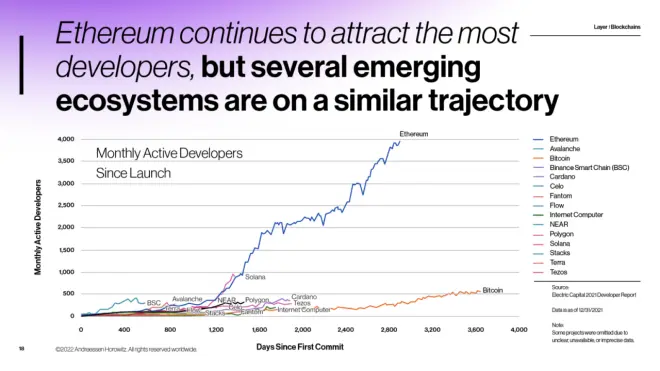
Ethereum's domination has a lot to do with its early start, and a healthy community. Ethereum has the most developers, with nearly 4,000 monthly active developers, followed by Solana (nearly 1,000) and Bitcoin (about 500). Ethereum’s overwhelming number of developers explains why its users are willing to pay over $15 million on average per day in gas fees to use it.
We see the industry narrative moving from DeFi to NFT, DAO, L2, Play-to-Earn, Metaverse, Web3, and back to NFT, the L1 war spanning 5 stages. The crypto industry is justifying its capital allocation by seizing new narrative themes to satisfy investors’ appetite for huge profits expected.
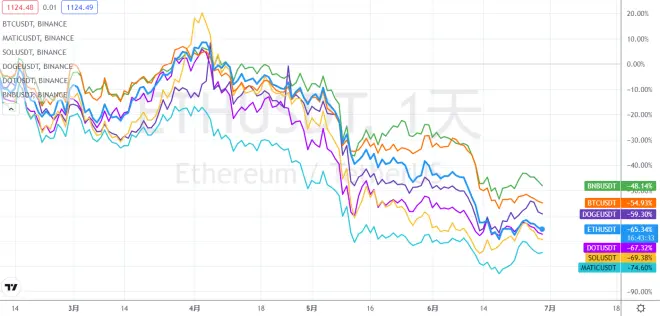
These days the market caps of mainstream tokens seem to become reasonable, but the market caps of the altcoins are still accompanied by bubbles. The Fed rate hike rhetoric was initially ignored as not entirely credible, but is now mostly believed, which is reflected in the price. The new development of Fed hawkishness led to small losses but were quickly supported. It looks like there will be 4 or 5 rate hikes this year, no more, no less, at least in latest expectations. Speculative assets like BTC and ETH saw some pullbacks, but not as severe as in 2018. Most of the third or fourth big money raised by crypto VCs will likely go where they always go: new projects rather than old ones. If the macro situation improves, these capitals may still get ten or hundred times the return from new projects, but it is hard to happen on old projects.
Security, still the original intention of HyperPay
Different security solutions usually correspond to different private key storage methods, usually including HSM (using dedicated physical hardware key), MPC (similar to private key sharding), multi-signature, etc. Exchange or hedge fund clients who need to execute large withdrawal trades may prefer a low-latency MPC solution that stores keys online rather than a multi-signature solution that stores keys offline, which prolongs the required time of withdrawals.
However, for institutional customers with stronger security needs, many custodians are also making a big fuss about private key storage locations. For example, Coinbase Custody and Xapo have set up vaults in the United States or around the world to store private keys of user assets. Xapo has even built a vault in Switzerland transformed from abandoned military bunkers, and only those who have authorized biological DNA information can enter.
HyperPay off-chain wallet is managed by HyperBC, which has obtained a compliance custody license, and is regularly audited by well-known security companies such as SlowMist Technology, KnownSEC, CERTIK, etc. Founded in 2017, HyperPay Wallet is a multi-eco digital asset wallet that integrates off-chain wallet, on-chain wallets, HyperMate hardware wallet, and shared wallet. It provides users with one stop services for asset custody, wealth management, and consumer payment, etc. So far, HyperPay wallet has more than one million users, assets in management has exceeded 1 billion US dollars, and the processed transfers have been more than 310 million times. Meanwhile, the off-chain wallet supports 53+ public chains, on-chain wakket supports 33+, and HyperMate hardware wallet supports 17+.
HyperPay on-chain wallet is one of the wallets that supports the most public chain currencies on the market. Currently, it supports more than 50 public chains, and DApps covering ETH, TRON, EOS, BSC, HECO, OEC, HSC, Polygon, AVAX, Fantom, Sol, Optimism, Arbitrum and other public chains. The user only needs to create an identity to easily manage assets on different chains, and the user's private key is stored in the user own device through local storage, to ensure the security of private keys and assets by physically isolating the important data.
HyperPay protects the security of users' assets through multiple measures such as MPC, TEE, and multi-cloud TEE security architecture. It has also deployed a cutting-edge security and risk control center, and continues to invest resources in and iterate technologies to monitor the overall system operation, account security and software operation. At the same time, big data is used to analyze users' transactions, capital volume and transaction behavior, as well as multiple verification systems on the chain to mark suspicious situations. Once there is any suspicious situation, the user's account will be blocked until authorized by the user himself, so as to minimize the risk in a dangerous environment.
For the asset security, HyperBC has recently obtained the Lithuanian crypto asset custody license, and HyperPay wallet under HyperBC has become the first digital currency wallet to hold a compliant custody license. Thus HyperPay can provide compliant custody services for global users and safeguard their digital assets.
In conclusion
The theft of giant whales will never stop, and hacker attacks will only become more rampant. The future will pose more severe challenges to the security of crypto assets. Therefore, it demands that the crypto platforms should try more methods instead of just focusing on technical solutions to protect user asset security. Platforms should refine and summarize their core advantages, guide industry norms, and provide users with high-quality asset security mechanisms based on user thinking to enhance user trust. As crypto assets gradually receive widespread attention, in order to prevent security problems such as asset loss and theft, as well as multi-party trust issue, the build-up technology of the platform itself determines the level of the platform in the crypto industry.
At a time when compliance has become the main theme of the whole market, HyperPay will continue to operate crypto asset services under the compliance regulation, and continue to explore security boundaries to provide users with more assured products. HyperPay wishes to bridge the gap between the real and virtual worlds through the digital economy, and achieves a win-win with users.






