
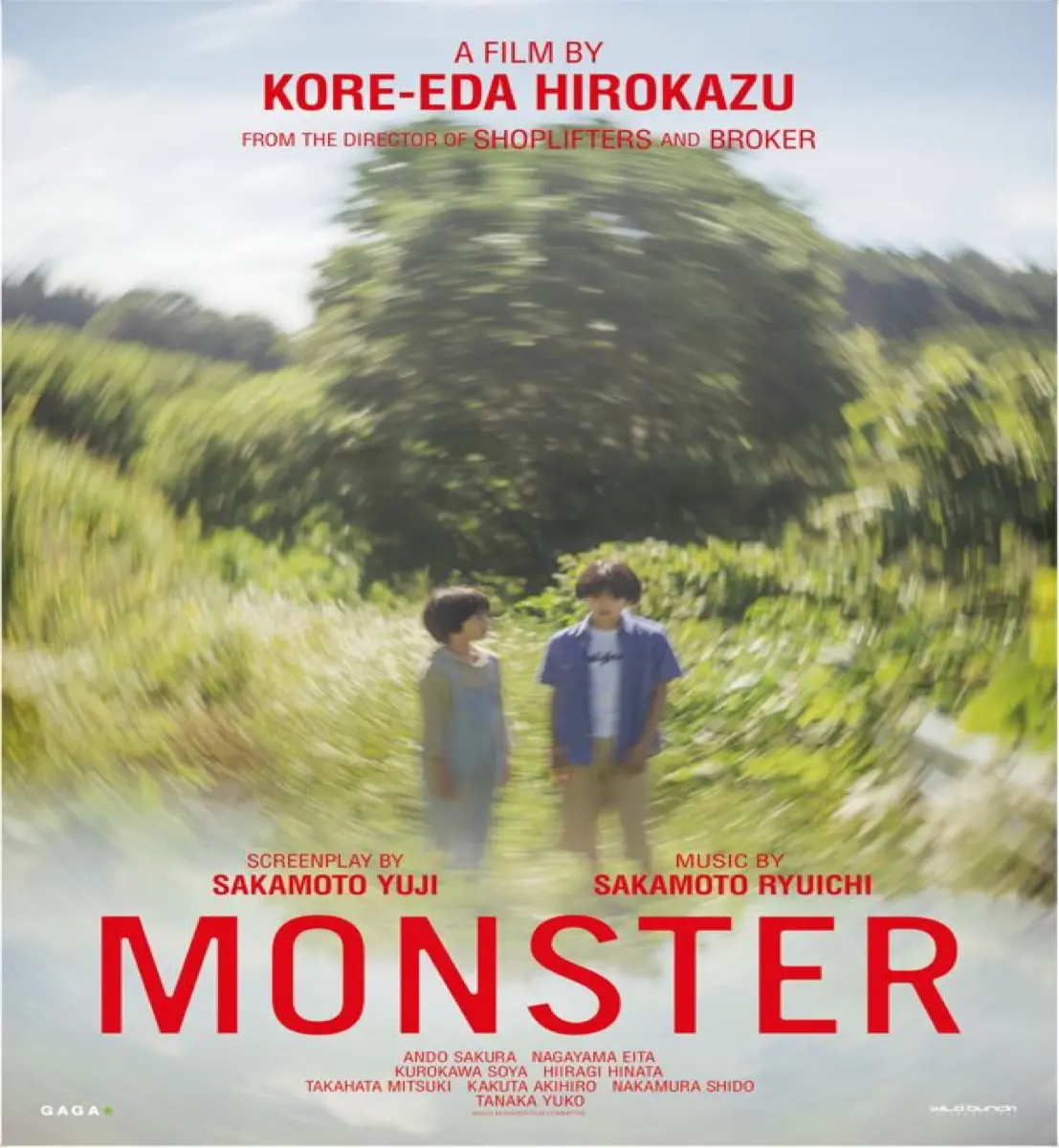
The Japanese filmmaker Hirokazu Koreeda dares in his new film, Monster, with a very current and unfortunately widespread topic in any culture or country such as bullying. This violence towards those who deviate from the norm has the devastating result of the social isolation of that different boy or girl, beyond the probable physical abuse to which they are also subjected most of the time. In the story that Koreeda tells us, the protagonist is Minato (Soya Kurokawa) a boy of about 11 years old who lives with his mother Saori (Sakura Ando) and who lost his father a few years ago. Suddenly Minato's behavior changes radically and he begins to behave very strangely. Given Saori's obvious concern about her son's behavior, he explains that he is being bullied by a teacher at his school, Professor Hori (Eita Nagayama). Astonished and angry at such an event, Saori decides to go to school to complain about the teacher's attitude and ask for his immediate dismissal. He meets with the director of the center several times and with other teachers, including Professor Hori, to try to clarify what happened. But the truth is not as simple as it seems and, little by little, the film will reveal to us a reality, much more complex than what the adults involved think.
For the first time in a long time, Koreeda is not responsible for writing his film, but the script is the work of Yûji Sakamoto, a screenwriter with extensive experience in both film and television who signs a work that was deservedly awarded in the past Cannes Film Festival. The film follows a complex narrative structure that reminds us of Kurosawa's Rashomon and shows the points of view of the mother, the teacher and, finally, the child, the most important when it comes to completing the puzzle and solving the mystery. We will see how the story differs greatly if we pay attention to the subjectivity of the adults or let ourselves be carried away by Minato's point of view, who is the true protagonist of the story.Some viewers may think that the script is somewhat tricky, that it tries to deceive them by hiding information to reveal it at the right and most effective moment, but in reality it is a narrative decision that adapts perfectly to the type of story it is about. He says and that's nothing. strange for Koreeda since he already used it in his film The Third Murder (2017). It should also be noted that the performances are convincing, especially that of the children in the final stretch of the film. And a notable element of the film is the music composed by the brilliant Ryuichi Sakamoto, in what was his last work for the big screen before passing away last March.
After two projects carried out outside his native Japan, Broker (2022) in South Korea and The Truth (2019) in France, with irregular results, Koreeda returns to his country to continue the path of his magnificent films Nobody Knows (2004) or Still. Walking (2008), with this story that deals with a multitude of topics such as bullying, alcoholism, lying, the efforts of a widowed mother to raise her son, etc. but in reality it is a beautiful story of love and friendship between two children. The ending of the film, full of poetry and delicacy, will undoubtedly touch the hearts of many viewers. Koreeda has done it again.
THANK YOU FOR FOLLOWING!!
All proceeds will be donated to reforestation projects of @El_Ente_Reforesta
For other donations:
IBAN: ES20 1465 0130 02 2033059578
BIC: INGDESMMXXX
METAMASK
0x3a81DF00eE6c32661FA239cFDFde4A9473737C9C
Thank you!!
If you make a donation to this metamask, please indicate privately through which network you make it to count it.






