
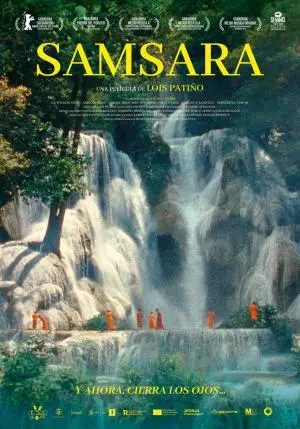
In his third feature film, the young Galician director Lois Patiño explores the theme of reincarnation, that moment of transition between life, death and life again. It does so with this film divided into two well-differentiated parts and with a most original hinge that will make the viewer live a very peculiar experience, watching movies with their eyes closed. The first part of Samsara takes place in a community in Laos where a Buddhist temple welcomes monks in the process of spiritual learning. But it is Amid, a boy who is fascinated by rap music, who carries the weight of the narrative when he comes to keep a very old woman company, who is dying. During his visits, Amid reads him passages from the Bardo thodol, erroneously known in the West as the Tibetan book of the dead, more properly called the "Book of Intermediate States," in which instructions are given to the dying to achieve nirvana and avoid being reborn and entering samsara again. In this segment of the film we find a documentary style that captures the life of the monks in the temple, treated all with a fantastic tone that is indebted to the cinema of Thai Apichatpong Weerasethakul, creating a magical lyricism in the images that transmits a lot of inner peace. .
The second part of Samsara takes place in Zanzibar, Tanzania, where we follow a girl with her pet goat as her grandmother and mother tell her stories about how their religion (Islam) views the topic of death. We also witness how women work on seaweed farms, very hard and sacrificial work, which brings them few benefits. In this part of the film the textures and colors become more intense. The chromatic difference with the part shot in Laos is very significant and was voluntarily sought because Patiño had two different directors of photography to shoot in both territories. And, in the middle of the two parts, we find that element that connects them and that causes the viewer to explore their sense of hearing in search of producing images with their eyes closed. If you don't keep them closed, you will see paintings of intense colors and Gaspar Noé-style spectroscopic effects that are the real culprits of creating those subjective images in viewers. This pivotal segment of Samsara has a great influence on Stan Brakhage's experimental cinema and Derek Jarman's film Blue, risky references for a film that is intended for a more general audience.
The work of Lois Patiño, after her interesting Costa da Morte (2013) and Lúa vermella (2020), is a work of maturity, a film that exudes beauty and peace thanks to a simple narrative and a treatment of light and color very careful and delicate. Samsara will become a unique experience for the open-minded viewer who gets caught up in its enigmatic proposal, but those expecting a conventional film must be warned that this is not the place for them.
THANK YOU FOR FOLLOWING!!
All proceeds will be donated to reforestation projects of @El_Ente_Reforesta
For other donations:
IBAN: ES20 1465 0130 02 2033059578
BIC: INGDESMMXXX
METAMASK
0x3a81DF00eE6c32661FA239cFDFde4A9473737C9C
Thank you!!
If you make a donation to this metamask, please indicate privately through which network you make it to count it.






