
In the traditional economic system, states and governments can print banknotes as they please. This does not happen in Bitcoin for two reasons:

There is a limit of 21 million coins and you cannot change that amount.
The number of coins released as a reward for work done is limited in the software and halved every 210,000 blocks by a process called halving.

Until the moment when the 21 million bitcoins are fully issued (around the year 2140), new coins are put into circulation every 10 minutes. These coins the miners earnings in compensation for the work done. The miners in turn generate and validate the blocks that make up the great ledger of the blockchain network.

If we think of gold mining, it consists of removing earth with heavy machines to obtain gold in sufficient quantity to pay the exploitation costs and obtain a profit. The same happens in bitcoin mining, with the exception that the machinery is complex computer equipment that performs computational calculations and as compensation they obtain two incentives:

New bitcoins put into circulation
Transaction fees

The bitcoin mining process is always the same, miners receive a new mathematical problem every ten minutes and the fastest to solve it takes the new coins that are put into circulation. This mathematical problem is based on random calculations that aim to find the solution and thus obtain the validation of the block. Whoever deciphers this will get the reward, as long as the other members of the network confirm that the answer is correct.
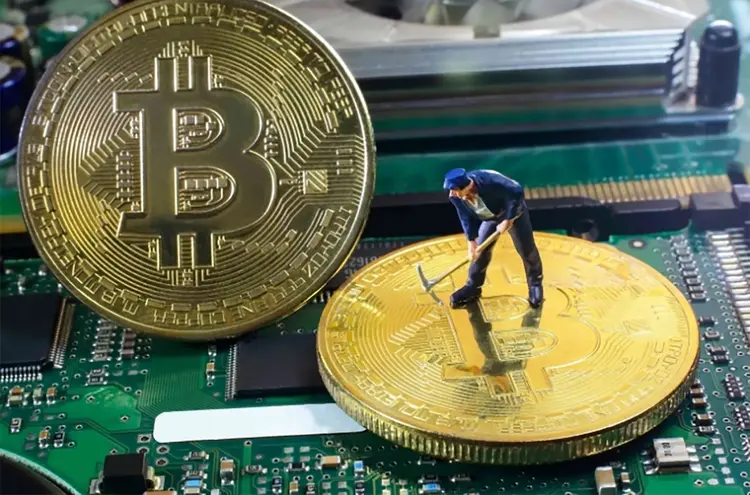
In cryptocurrencies there are two key figures. First of all, the nodes. That role can be played by whoever wants it and has a minimum computational capacity. The nodes keep constantly updated copies of that huge ledger. They are there out of altruism or to know the technology better and thus be able to develop applications on it. The nodes are important, but the key is in a subgroup within the nodes: the miners. The miners are the ones who carry out the operations themselves, the ones who monitor the nodes more passively. The miners work 24 hours a day, seven days a week, to solve computer problems in exchange for a fee in bitcoins, the bitcoins they extract according to the rate of issuance of the cryptocurrency that Nakamoto determined. But are those computer problems? They are cryptographic puzzles of a deliberate and enormous complexity, so that the network is secure. All Operations Performed on the Network are grouped into Blocks (blocks in Spanish), validate them and For Miners they must FIND a kind of computer hash key. They are mathematical formulas that synthesize a large amount of information in very few characters. No two hashes are the same, and they cannot be modified. Each block has a new hash and the hash of the immediately preceding block, as a kind of sealing wax. Everything is linked, hence the particle chain, chain in English. Every time a miner finds a valid hash (it must meet a series of conditions), it takes, after checking by at least 51% of the miners, 12.5 bitcoins; at the current exchange rate, almost 30,000 euros. Thus, the chain of blocks is constantly updated, keeping the books updated in the nodes.





