
The world of cryptocurrencies has seen a huge influx of new users in recent years, with many newcomers looking to jump into cryptos. With the ever-growing number of exchanges and wallets available, it can be challenging to decide which one to use.
Two of the most popular options are MetaMask and Binance. Both of these front-end platforms offer a variety of features and advantages, so it’s important to understand the differences between them to decide which one is best for you.
MetaMask
MetaMask is a popular browser extension and Ethereum wallet that allows users to store, send and receive Ethereum (ETH), ERC-20 tokens and NFTs. It also allows users to interact with decentralized applications (dApps) on the Ethereum network, and on any other EVM (Ethereum Virtual Machine) network like Avalanche (AVAX), Polygon (MATIC), Arbitrum, Optimism... Or the Binance Smart Chain, also called BNB Chain.
MetaMask is easy to use and is a great option for both new and experienced cryptocurrency users. One of the advantages of MetaMask is its integration with popular browsers. It is available as a Chrome, Firefox, Brave, Opera or Edge extension. Additionally, MetaMask is also available on mobile devices.
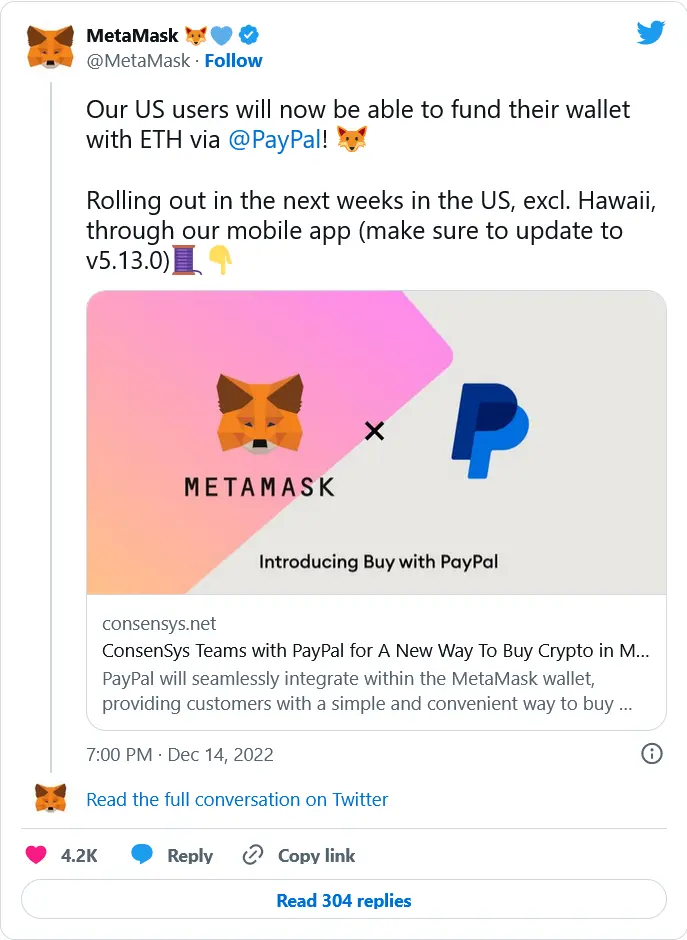
However, although it is possible to buy cryptos through MetaMask (e.g., by using Transak to convert fiat currency into ETH), most of the crypto holders use centralized exchanges like Binance (see below) to buy their cryptos, or to convert them back into fiat currencies. This could quickly change since MetaMask parent company ConsenSys has teamed up with PayPal to allow users to purchase and transfer Ethereum (ETH) via PayPal’s platform:
Binance
The cryptocurrency exchange Binance has quickly become one of the most popular exchanges in the world. It is the largest crypto exchange by trading volume and has a wide range of features and services to offer traders.
However, as with any centralized exchange, there are certain risks associated with using Binance. While Binance does take certain measures to protect its users, such as requiring two-factor authentication, Binance users are still vulnerable to fraud, hacking, and other types of malicious activity. In addition, Binance is known for its lack of customer support. Many users have complained of slow response times when they have had issues with their accounts or transactions.
Last but not least, the recent FTX crash has shown that other centralized exchanges could collapse in case of high market volatility. The proof-of-reserve recently published by Binance is a good first step but it discloses only the Bitcoin (BTC) reserve whereas it would also be required for altcoins and fiats.
Binance CEO, CZ, is aware of the threat posed by MetaMask and the other self-custody wallets since he recently declared in a Twitter Space discussion that users are more likely to lose cryptos by holding them in a cold wallet than by putting them on a centralized exchange:
For most people, for 99% of people today, asking them to hold crypto on their own, they will end up losing it
Conclusion
As most of the people still hold their cryptos through centralized exchanges like Binance, the market share of self-custody wallets can only grow, especially after the FTX collapse which has highlighted the risks of centralized exchanges and the PayPal-ConsenSys deal allowing to buy ETH through Paypal directly into MetaMask.
Furthermore, there are alternative solutions to MetaMask, some of them more decentralized and open source (like TallyHo), which will help the adoption of self-custody wallets.
However, Binance and the other centralized exchanges, like Kraken or Coinbase, will still be used by many crypto holders, particularly for small amounts. Therefore, it is likely that both solutions (centralized exchanges and self-custody wallets) will continue to coexist for a while.
Disclaimer: this article does not contain any financial advice. The information is provided for general informational and educational purposes only.
Please find below a few more links to earn a few more coins...






