
Decentralized Finance (DeFi) received a lot of attention last week as total value locked in DeFi smart contracts hit $1 billion for the second time in history. Coinbase played their part adding support for MakerDAO’s ERC-20 governance token (MKR). For those who aren’t familiar with MakerDAO, it is one of the first successful DeFi projects to come out of the ICO era and structurally operates as a DAO (Decentralized Autonomous Organization). In Maker, Ether holders lock up ETH and in return are capable of generating up to 66% of the locked Ether’s value in its native stablecoin DAI. Within MakerDAO there are two important tokens, DAI and MKR. Dai is unique within the stablecoin market because of how it is pegged. Behind each Dai there is at least $1.5 of Ether providing Dai its value. Dai can be used to trade, lend/borrow, or in blockchain games. On the other hand the MKR token is used to vote on changes within the Maker protocol. Once a week MakerDAO conducts governance polls. These polls range from interest rate changes (Base Rate Adjustment & DSR) to protocol improvements (MIPs). Anyone can follow the participation of these polls here and most importantly anyone who holds MKR can vote!
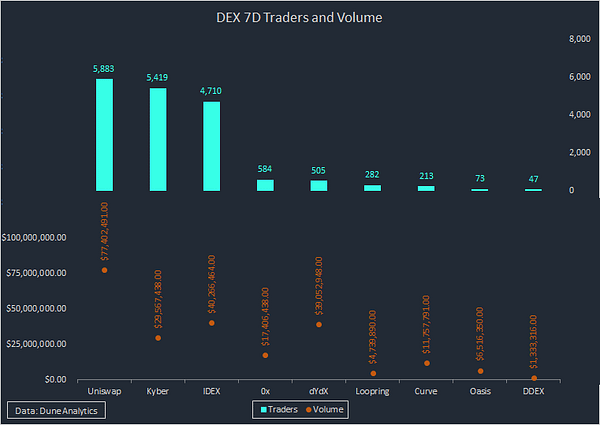
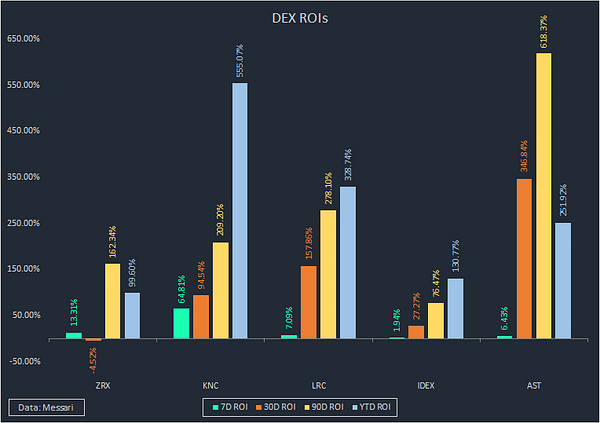
Since the majority of ICO projects launched in 2016-2018, many have struggled to find product-market fit with compelling token-economics. Kyber Network seems to be one project gaining traction after several years of development. The Kyber project leverages their Decentralized Exchange and ERC-20 token (KNC) to create a more robust and liquid trading experience for those who want to trade on-chain rather than on centralized exchanges. Kyber’s Katalyst upgrade is referenced in a CoinDesk article from May, “Holders of Kyber Network Crystal (KNC), an Ethereum-based (ERC-20) token, will be able to delegate their tokens and voting power to StakeWith.US’s staking pool, ATLAS, when the network’s Katalyst upgrade is completed by the end of June.” Staking KNC will now give investors an opportunity to earn passive income on their investment. Other DeFi leaders include Synthetix (SNX), Aave (LEND), Bancor (BNT), 0x (ZRX), Ren Protocol (REN), Uniswap, and IDEX.
 Matt Casto @mcasto_
June 14th 2020
4 Retweets9 Likes
Another sector crucial to the future success and main-stream adoption of DeFi applications is layer 2 scalability. A couple projects working on these solutions are Loopring Pay (LRC), Diversify, and OmiseGo (OMG). With over $5 billion dollars of USDT (Tether) live on Ethereum, OmiseGo and Bitfinex partnered to migrate some of USDT’s activity to the OMG Network. Doing so will free up much needed blockspace on Ethereum’s base layer and will hopefully lower overall gas prices. Digital dollars leveraging public blockchains like Ethereum as a payment rail is a real opportunity for businesses of the future.
Head of Crypto at Visa, Cuy Sheffield:
 Cuy Sheffield @cuysheffield
June 14th 2020
5 Retweets30 Likes
From a developer and consumer perspective, interacting with DeFi applications, especially digital dollars, has never been easier. For someone looking to use a DeFi application today, it’s as easy as downloading the Argent App from the App Store or Google Play. The Argent team has tackled two pain points making Ethereum far more user friendly. Argent covers most gas fees when using the network and made wallet security 10x easier with their Guardian model. Two of my favorite applications integrated into the Argent wallet are PoolTogether’s “No-Loss” Lottery and Compound savings accounts.
Market Update (Monday 8:30 AM EST)
Percent Change (Rounded) Based on Last Monday Open (8:30 AM EST)
Bitcoin- $9,188 (-6%)
Ether- $224 (-9%)
Gold- $1,710 (+1%)
DJI Average- 25,270.39 (-6%)
NYSE Composite Index- 11,565.82 (-7%)
NASDAQ Composite Index - 9,426.90 (-3%)
S&P500 Index- 2,993.76 (-6%)
New Developments
-
Three (1 & 2 & 3) transactions spent 22,000+ Ether ($5.7M) on Gas Fees, Decrypt
-
Ja Rule to create his own social token using Ethereum and TryRoll.
-
UMA Protocol experienced first successful liquidation for ETH/BTC, Messari
-
Building Bitcoin Batteries, Brandon Arvanaghi- Chief Security Officer for Layer1
 Brandon Arvanaghi @arvanaghi
We at @LAYER1OFFICIAL are building a virtual power plant. The technology making this possible: #Bitcoin as a battery. Here's how our "Bitcoin Batteries" work, and how they help stabilize electrical grids. 👇
Brandon Arvanaghi @arvanaghi
We at @LAYER1OFFICIAL are building a virtual power plant. The technology making this possible: #Bitcoin as a battery. Here's how our "Bitcoin Batteries" work, and how they help stabilize electrical grids. 👇 June 10th 2020
53 Retweets190 Likes

Industry Insights
-
JPMorgan Analyst point to Bitcoin’s production cost as price floor, Forbes
-
80% of Surveyed Institutional Investors See Appeal in Digital Assets, Fidelity
-
EIP-1559 Analysis, Deribit Insights
-
Grayscale Trust Analysis, Ryan Watkins- Messari
-
Ethereum Infrastructure and Tooling, Anthony Sassano & Messari Research
 Anthony Sassano | sassal.eth @sassal0x
Interesting chart from @MessariCrypto here. Basically shows how #Ethereum network usage has increased over time as the tooling and infrastructure improved to help developers build useful apps 🏗️
Anthony Sassano | sassal.eth @sassal0x
Interesting chart from @MessariCrypto here. Basically shows how #Ethereum network usage has increased over time as the tooling and infrastructure improved to help developers build useful apps 🏗️ 
June 14th 2020
20 Retweets49 Likes
Blockchain Activity
Unstoppable Domains is a software company focusing on the decentralized web. Unstoppable recently launched .crypto, a domain registry on the Ethereum blockchain. To give a little more context, instead of asking a friend or customer to send Ether to 0x3eC44A823E07555B5f889d8d954eec736eb5865b or Bitcoin to 1BUU1Tcoh6xpFtru83199yE8eyioG8ghW3, I can now ask anyone to send Ether, Bitcoin, XRP, Litecoin, USDC, etc… to defibridge.crypto instead! Human readable addresses are a big step forward for public blockchains as a payment network for the masses. However, there is one caveat for this to work, the wallet application needs to support Unstoppable’s .crypto domain registry. Luckily, there are quite a few wallets who already support .crypto domains including Binance’s Trust Wallet and ImToken Wallet.
Now not only can anyone send any popular cryptocurrency to a .crypto domain, an owner of a .crypto domain can also turn it into a website! This is very similar to websites ending with .com or .org except a blockchain enabled version. To test this out, I created a website using html and css templates, uploaded the code to IPFS (InterPlanetary File System), then saved that hash to defibridge.crypto. Now anyone who has the Unstoppable Domain’s extension can access my website by typing in defibridge.crypto into their browser URL bar.
Python Activity
3D Interactive Charting (Using KMeans model to predict Iris characteristics)
*Important to note the new_iris_data.csv came from a data folder on my local machine
# Initial imports
import pandas as pd
import numpy as np
from sklearn.cluster import KMeans
import plotly.express as px
import hvplot.pandas
from pathlib import Path
# Loading data
file_path = Path("data/new_iris_data.csv")
df_iris = pd.read_csv(file_path)
# Initializing model K = 3
model = KMeans(n_clusters=3, random_state=5)# Fitting model
model.fit(df_iris)# Get predictions
predictions = model.predict(df_iris)# Add a new class column to df_iris
df_iris["class"] = model.labels_# Plotting the clusters with three features
fig = px.scatter_3d(
    df_iris,
    x="petal_width",
    y="sepal_length",
    z="petal_length",
    color="class",
    symbol="class",
    size="sepal_width",
    width=800,
)
fig.update_layout(legend=dict(x=0, y=1))
fig.show()
——————————————————————————————————————

Quick Earn Opportunity
Proof of Stake is a fairly new consensus mechanism differentiating a new generation of blockchains from Proof of Work chains like Bitcoin. In Proof of Stake, validators “stake” cryptocurrency to earn an interest reward for securing the network. The largest public blockchains a form of Proof of Stake are EOS, Binance Chain, Tezos, Tron, Dash, and Cosmos. Staking requires far less hardware and consumes far less electricity than Proof of Work blockchains. For the majority who don’t have the technical expertise to stake, there is an option to delegate coins to a team who does. The team then pays out delegators proportionately to the amount of coins staked. Head over to Coinbase Earn to learn more about Tezos and Proof of Stake.






