
I recently read about Indonesia's religious leaders banning cryptocurrency for Muslims. Cryptocurrency was tagged as haram because it is said to have elements of uncertainty and high volativity. I think certain news headings are misleading though, since it was also mentioned on the same article that "if the cryptocurrency, as a commodity or digital asset, can abide by Shariah tenets and can show a clear benefit, then it can be traded".
That is why when I heard about MRHB or Marhaba DeFi, I was excited of what Marhaba DeFi can do for the Muslims of the world. This would particularly impact Muslim countries that has a low adoption of cryptocurrencies. The best part is that it is not limited to Muslims, but open to all. It is said to be "Muslim also", not "Muslim only".
Marhaba DeFi Concept
You should have seen the halal word everywhere, such as in the grocery, supermarket, shops, etc. halal is an Arabic word that means allowed or permitted. When we say allowed, it means it aligns with Islamic law called Shariah. haram is the opposite of halal. Hence, we get the picture of how serious it is when something or an activity is tagged as haram. It is a definite "No" for Muslims.
Before we delve deeper on Marhaba DeFi concept, what exactly are the reasons why cryptocurrency was flagged as haram in the first place? The foremost issue was said to be about the protection of wealth. One of the prohibitions in the Islamic law is that there should be no activities involving uncertainty (gharar). Hence, to be fully compliant to Shariah law, the cryptocurrency needs to be:
- Backed by an asset. Examples of an asset are oil or gold which reduces speculation and therefore less volatile.
- Have a regulatory authority.
In Marhaba's concept paper are three words "Inclusive", "Ethical", and "Simple". This may allude to MRHB DeFi offerings, but it also resonated with me while reading the paper. Proper care was taken for a non-Muslim to understand the terms and concepts and how MRHB DeFi offerings align with Shariah law and I appreciate that. I also read the Whitepaper, which I would mention if ever the point I am making is based on it.
Marhaba's concept paper classifies crypto assets into many types. Stable coins (e.g., Tether), gold or silver-backed tokens (e.g., PAX Gold), and unstable coins (e.g. Bitcoin) are all considered money from the Shariah perspective. All tokens (utility, security, or governance) and Non-Fungible Tokens (NFT) may be considered Shariah compliant if the underlying asset, project, or platform is Shariah compliant and if the principles or rulings adhere to Shariah law.
Based from the paper, MRHB DeFi ensures the following:
1. That any crypto tokens or assets dealt in the ecosystem of MRHB Defi is aligned with Shariah law or is a valid asset (Mutaqawwam).
2. That earning wealth is through halal means, meaning the process and mechanism of a transaction is Shariah compliant. This means the following elements are prohibited; interest/ usury, wagering or gambling, uncertainty or any ambiguity leading to dispute.
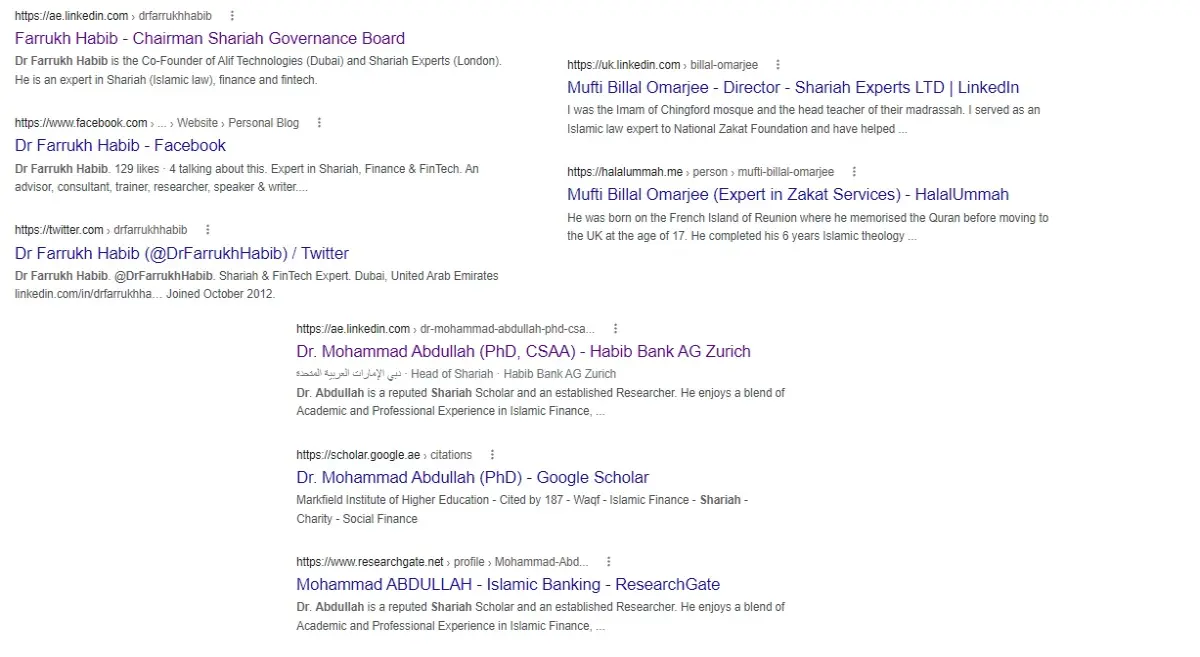
MRHB DeFi has a Shariah Governance Board (SGB) that is a team composed of Shariah Scholars to conduct evaluation and monitoring of MRHB Defi activities and offerings. The Board is composed of:
- Dr. Farrukh Habib
- Mufti Billal Omarjee
- Dr. Mohammad Abdullah
A few searches online shows these scholars are highly visible in social media. I saw no negative feedback or reports thus far.
The concept paper presented the governance framework of MRHB DeFi. There is also a Marhaba Governance Board (MGB) mandated to drive overall platform governance and product focus. One member of the SGB sits in the MGB. There is no confusion on who owns Shariah compliance, as this is fully owned by SGB. SGB has a veto power for any products or practices. Hence, both MGB and SGB must agree before a product or service is released.
The SGB is involved during concept planning, development and implementation of a product. I was happy to read that the SGB is also involved in the continuous monitoring of the product as well. What this means is that any non-compliant incidents are identified and addressed, and any changes or updates in any product are pre-approved before implementation. Lastly, a Shariah audit and review on a regular basis will be implemented. This is strong governance in my books.
I believe one important point discussed in the concept paper was acquiring approval from an external Shariah auditor or reviewer. This provides a stronger governance process. It is currently under consideration and I am eager to see an update about this in the future.
Also, it is great that there would be an audit review process and continuous evaluation. However, I would like to see the following discussed in more detail. If I missed these points or these may have been discussed elsewhere, let me know.
- After an audit review, how fast would the corrections be implemented, for example, how fast can swapping of approved tokens be put on hold after it has been deemed non-compliance (after the audit).
- Clarity on what happens with the existing asset tokens of users when the token becomes non-compliant to Shariah law.
The whitepaper clarified my question about the DeFi concept. We both align that the ideal DeFi is a truly autonomous financial ecosystem of products and protocols. There are plans to automate the governance in MRHB DeFi as much as possible, however due to the complicated nature of Shariah ruling, it is unclear when the driving force for MRHB DeFi can be migrated to the MRHB Community and Shariah experts community. Also, how much of Shariah aspect can be automated is another aspect that needs to be explored. I appreciate and respect the transparency and this clarified a lot.
Going back to the issues above, MRHB DeFi aims to release a product that is compliant to Shariah law by establishing a Shariah Governance Board composed of Shariah experts who will screen all products, processes and practices to ensure it meets compliance.
In a nutshell, MRHB DeFi is a world-first Shariah compliant DeFi platform. Its services include the following:
- Sahal wallet: a wallet that is multi-currency and non-custodial with token swapping features. It would only allow Shariah-compliant tokens. Non-custodial here also means users have the private keys of their digital accounts and gives the users full control of their funds.
- Souq NFT (sNFT): a marketplace for Shariah-compliant NFTs.
- Liquidity Harvester: a cross-chain liquidity harvesting protocol. It is based on the underlying contract of Mudharabah, and therefore Shariah-compliant. Both the Mudharib (Marhaba DeFi) and Rab al Maal (investors/ harvesters) share the risk of the investment. It is designed to generate halal returns in the 5 - 15% range (in comparison to the 1% Islamic Banks currently offer).
- Dexregator (Cross Chain DEX Aggregator): an aggregator of decentralized exchanges (DEXs). Its aim is to optimize slippage, swap fees, and token prices.
- Decentralized Philantropy (De-Phi) protocol: a new venue for the collection and distribution of charity in the form of crypto assets.
- MRHB Finance Digital Token ($MRHB): a crypto asset initially minted on Binance Smart Chain (BSC) with a total supply of 1 billion tokens. It would be a utility, governance and payment token. All token sale phases before Token Generation Event (TGE) are based on the Islamic contract of Salam, while at the TGE or initial public sale, a spot sale of $MRHB token would be on the basis of Bai Musawamah.
SouqNFT, Shariah-Compliant NFT Platform
I would like to focus on SouqNFT (sNFT). Not only because NFTs are hot items today, but when I visit art museums or galleries, I am always amazed by Islamic arts and works, like calligraphies. Giving these works of art a home is a welcome thought for me, although we have to remember that the intent of sNFT is to be inclusive so I expect artists of different culture to check this out (as long as Shariah-compliant).
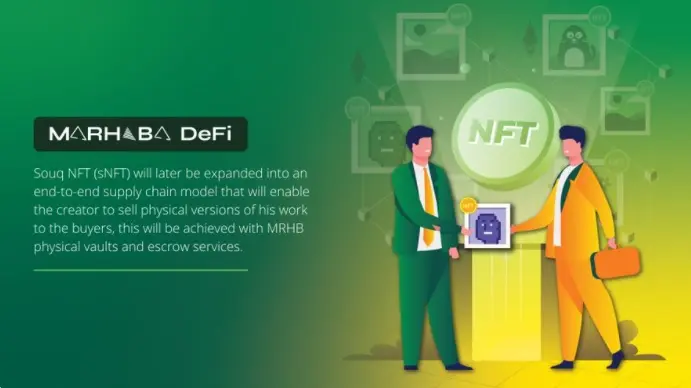
Per whitepaper, while this platform is initially focused on creation and commerce surrounding Islamic art and regional culture, it would support the exchange of assets in the future. An artist would be able to upload his artwork to the app and it would be converted into an NFT. sNFT also enables users to buy or sell NFTs and has integration with Sahal wallet or MetaMask wallet.
The only allowed NFTs in sNFT are Shariah-compliant art or works. These are inanimate objects, such as trees, flowers, etc. Aside from this, Islamic rules of modesty and decency are also followed, e.g. anything sacred such as a photo of Allah are prohibited. To ensure these requirements are met, sNFT Marketplace would be monitored by SGB using Not Safe for Work (NSFW) and Neuro-Linguistic Programming (NLP) machine learning algorithms. They hope to detect and filter any negative content, such as nudity, adult content, etc. These filtering algorithms would always have false positives. A threshold value would be set and provided by a "Shariah Compliance API" and NFTs that would meet the threshold would be screened and approved for publishing.
I am excited on what sNFT Marketplace could become. Below is the sNFT Architecture.
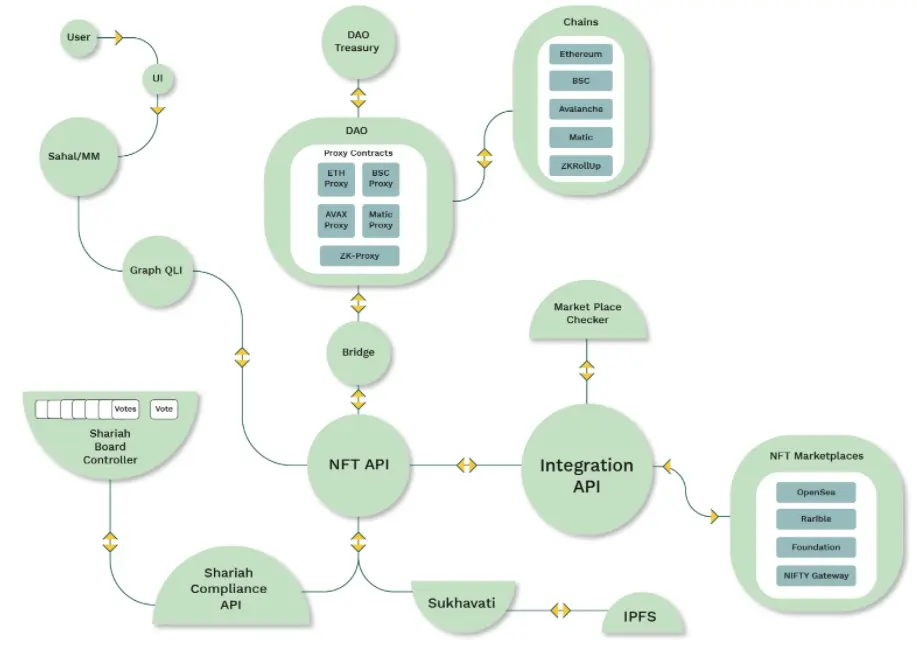
Reviewing the sNFT Marketplace diagram, a user would be accessing the sNFT Marketplace via a UI that has integration with Sahal wallet or MetaMask wallet. From there, the GraphQL API and NFT API would orchestrate what the user wants to do. GraphQL is an open-source data query API, basically an effective way of loading data from a source to a user.
The user would be able to reach the sNFT Marketplace, but at the same time may reach other NFT Marketplaces as well using the Integration API. There is OpenSea, Rarible, Foundation and NIFTY Gateway that I see in the diagram.
The NFT API would have a connection to the Sukhavati Network's (SKT) decentralized storage technology and connects to the InterPlanetary File System (IPFS) network for NFT storage. SKT is a technology partner of MRHB. It is a decentralized cloud service network focused on storage. It uses Efficient Proof of Spacetime or EPoSt, a low consumption storage verification mechanism.
The NFTs would be subject to monitoring of Shariah Compliance API with a connection to a Shariah Board Controller.
As part of decentralised network architectures, the whole solution is also subjected to Decentralized Autonomous Organizations (DAO) networks that provides governance and enables participants to govern cooperatively. A variety of chains, such as Ethereum, BSC, Avalanche, Matic and ZKRoolup appears to be supported.
sNFT proposes to resolve problems in gas transaction fees by using "lazy minting" so artists can display their work in sNFT platform without the need of paying minting fees, deferred until the NFT is sold to the first buyer. This is based from ERC 721 and EIC 712 standards. Then using the Integration API as shown in the diagram, artworks can be cross-referenced to other NFT Marketplace as an attempt to address problems of plagiarisation, or re-minting in another chain.
I was delighted that sNFT would partner with orphanages and special schools. The little "creatives" would be trained to create their own NFTs and make their mark on the sNFT platform. The MRHB team would not only help them create NFTs, but will also support them with sales and marketing. Then profits from the sales would go directly to the participating institutions. This sealed the deal for me.
Conclusion
MRHB DeFi concept can pave the way for Muslims to enter the cryptocurrency space. But it is more than that. Three words, "Inclusive", "Ethical", and "Simple", says a lot about the project. It is open to anyone who would see value at what the MRHB team is trying to establish. A project that would be implemented in an ethical manner without the complications.
At the end of the day, I am not an expert to identify if MRHB DeFi abides to Shariah tenets and hence, safe for Muslims. The acceptance of a cryptocurrency would be restricted to the designated council of religious leaders in each country where MRHB DeFi would be made available. But hearing about MRHB DeFi sure provides comfort that hopefully soon, Muslims everywhere would soon be allowed to partake in this flourishing space of crypto. So visit this space for future updates.
Hope I was able to provide some useful insights. Any other things you wanted to add? Please leave your comments.
If you reached the end of this article, thank you. Please show your support with a like, comment or a tip. It would be greatly appreciated.






