Ethereum: The Blockchain That's So Much More Than "Digital Money"
Let me be honest with you — the first time I heard about Ethereum, I thought it was just "another Bitcoin." Same crypto hype, different coin, right? Wrong. So wrong. The deeper I dug, the more I realized Ethereum isn't trying to be digital cash at all. It's trying to be a global, unstoppable computer that anyone on Earth can build on. And once that clicked for me, I couldn't stop reading about it. Let me take you down that same rabbit hole.
So What Even Is Ethereum?
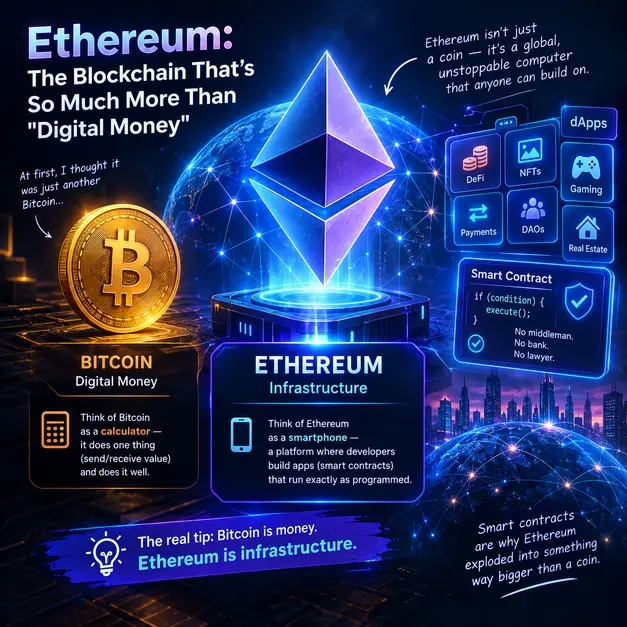
Think of Bitcoin as a calculator — it does one thing (send/receive value) and does it well. Ethereum, on the other hand, is like a smartphone. It's a platform. Developers write "apps" on top of it called smart contracts — self-executing pieces of code that run exactly as programmed, with no middleman, no bank, no lawyer needed.
That's the tip that made everything click for me: Bitcoin is money. Ethereum is infrastructure.
Smart contracts are why Ethereum exploded into something way bigger than a coin — they're the engine behind almost everything interesting happening in crypto today.
DeFi: Banks Without the Bankers
Here's where it gets genuinely wild. DeFi (Decentralized Finance) is a whole financial system — lending, borrowing, trading, earning interest — built entirely on Ethereum smart contracts, with zero banks involved.
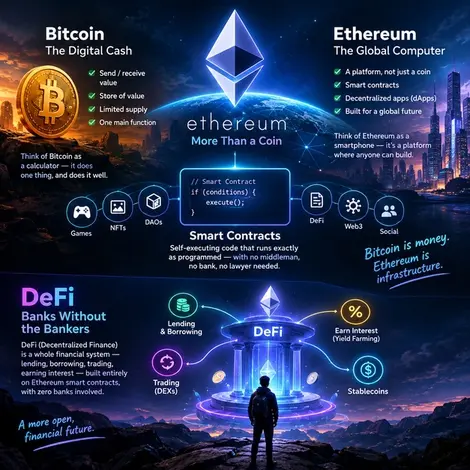
Want to lend your crypto and earn interest? There's a protocol for that (Aave). Want to trade tokens instantly without a centralized exchange? Uniswap has you covered. Want a stablecoin pegged to the dollar without trusting a company? DAI does exactly that — and it's all governed by code, not a CEO.
Quick tip for readers: if you want to actually feel what DeFi means, don't just read about it — try swapping a tiny amount of a stablecoin on Uniswap. The moment you realize no bank approved that transaction is the moment DeFi stops being a buzzword.
Ethereum's Crypto Family Tree
Ethereum doesn't exist in a vacuum — it sits at the center of a whole ecosystem of related coins and chains, and understanding them makes the whole picture click:
Bitcoin (BTC) — the OG, digital gold, Ethereum's "older sibling" that inspired it but does something totally different.
Layer 2s (Arbitrum, Optimism, Base) — think of these as express lanes built on top of Ethereum to make transactions cheaper and faster while still using Ethereum's security.
Polygon (MATIC/POL) — one of the earliest "helper chains" that made Ethereum usable for everyday people by slashing fees.
Stablecoins (USDC, DAI, USDT) — the backbone of DeFi, mostly living and moving on Ethereum.
Chainlink (LINK) — feeds real-world data (like prices) into Ethereum smart contracts, since blockchains can't see the outside world on their own.
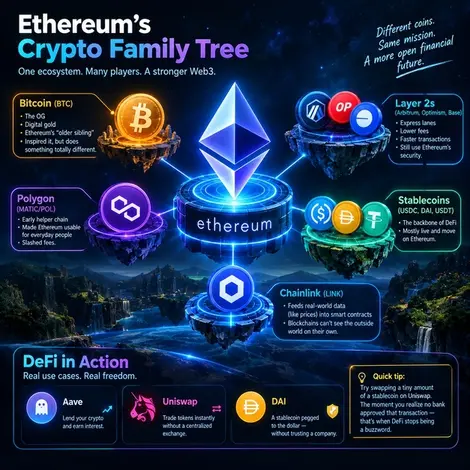
Tip: whenever you research a coin, ask "what does this token actually do on Ethereum?" That single question separates real utility projects from pure speculation.
The Merge: When Ethereum Went Green
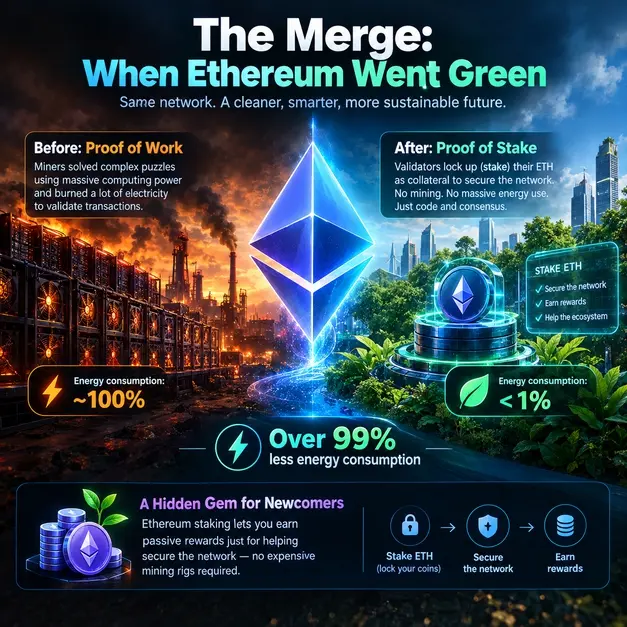
In 2022, Ethereum pulled off one of the most ambitious upgrades in crypto history — "The Merge." It switched from energy-hungry mining (Proof of Work) to a system called Proof of Stake, cutting its energy consumption by over 99%. Instead of miners burning electricity to validate transactions, "validators" now lock up (stake) their ETH as collateral to secure the network.
This is a genuinely underrated tip for anyone new to crypto: Ethereum staking lets you earn passive rewards just for helping secure the network — no expensive mining rigs required.
NFTs: The Part Everyone's Heard Of
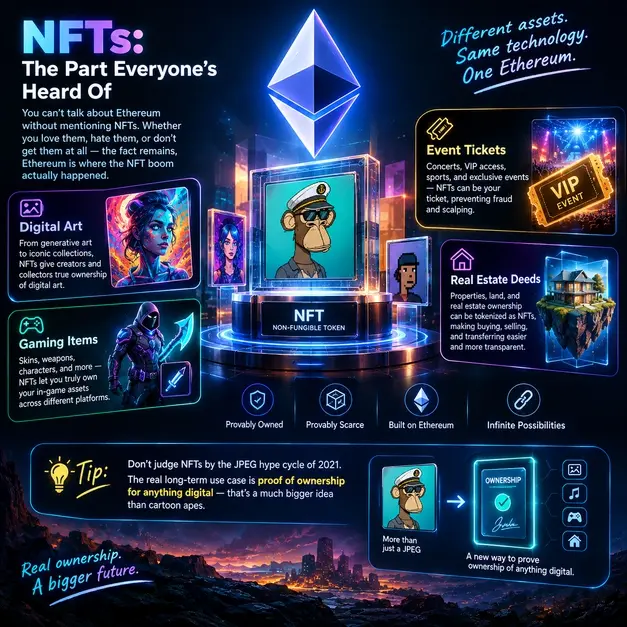
You can't talk about Ethereum without mentioning NFTs. Whether you love them, hate them, or don't get them at all — the fact remains, Ethereum is where the NFT boom actually happened. Digital art, gaming items, event tickets, even real estate deeds — all represented as unique tokens, provably owned, provably scarce.
Tip: don't judge NFTs by the JPEG hype cycle of 2021. The real long-term use case is proof of ownership for anything digital — that's a much bigger idea than cartoon apes.
Why I Personally Think Ethereum Matters
At the end of the day, what pulled me in wasn't the price chart — it was the idea. A world where contracts execute themselves, where finance doesn't need permission from a bank, where ownership of digital things is actually provable. Ethereum isn't perfect — gas fees can still sting, and the ecosystem is genuinely complex to navigate as a beginner. But it's one of the few technologies in crypto that's actually being used, not just traded.
My biggest tip if you're just starting out: don't try to learn Ethereum by staring at price charts. Learn it by using it — swap a token, mint a cheap NFT on a Layer 2, try staking a small amount. The lightbulb moment happens through your hands, not your eyes.
That's the Ethereum story as I've come to understand it — not just a coin, but a whole economy quietly running in the background of the internet's next chapter.