
Cradles: Origin of Species is a new virtual reality game built by the DRepublic team and powered by blockchain that you will be able to equip with your VR device and immerse yourself into Cradles world, pretend to be any species you like, and explore the virtual world from your soul.
The NFT hype is real. At least, judging from the countless blockchain players from around the globe who continue to flow into different DeFi and NFT markets. The pain is also real, as the majority of them are now experiencing massive losses from the aftershocks of the inevitable pullbacks that crypto markets must go through.
So we are left to observe a swirling detritus of NFT projects, floundering amid spiraling sentiment as they face a reality of perpetual market limbo. This is a genuine reflection of the bubble period we are in at the moment regarding NFTs.
In this article, I don’t want to set out any metaphysical theories, nor do I wish to apply any laborious ideals from the viewpoint of a crypto professional. I will simply point out in straightforward terms why the NFT market calls for a complete overhaul and transformation.
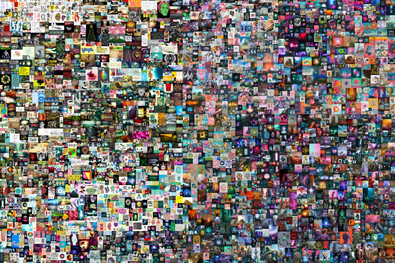 Figure 1. Beeple’s collage, Everydays: The First 5000 Days, sold at Christie’s. Image: Beeple
The 2021 NFT hype achieved a remarkable peak; clearly, the pinnacle moment was the Beeple’s auction, reaching a 69M USD auction price back in March.[1] That set off everyone wanting to join the wave to deliver “precious” NFTs. For both sellers and buyers, it was as if a magic wand had suddenly appeared, able to generate millions and millions of dollars out of nothing.
About Use Value
NFT market sellers are still looking for opportunities to make some serious income. One way is by creating celebrity NFTs to capitalize on the perceived collectibility value to enthusiasts and fans. Digital collectors who believe in the value of these influencers hope that these NFTs will appreciate over time, hoping for a quick flip to eager fans. Because of this tentative interest, the majority of the current buyers in the entire market are speculators and only a fraction is made up of the fan base. Nevertheless, the celebrity pull has drawn them into the market and they are happy to pay the price.
Under these immature market circumstances, hype and speculation are dominant and hold a massive market share. Some real market behaviour has already occurred thanks to fans buying NFTs which make up true supply and demand exchange; a win-win transaction. Once such supply and demand exchanges increase, then we can say that NFTs are truly leading the transformation of the market from a bubble to a practical one. These supply and demand exchanges bring a unique value to buyers: the Use Value.
There is an argument that the encryption market demonstrated use value for the first time in 2015 when Vitalik, a teenager, announced the main network of Ethereum. Cryptocurrencies were posing a serious threat to FIAT currencies by that time and Ethereum gave birth to a new value that never existed before, the Use Value. Similar to Bitcoin, Ethereum brought the idea of distributed consensus to the code level. It made distributed programs credible, and that technology solved the dilemma of formal verifications which started dominating the cryptocurrency market.
Owing to this, Ethereum has totally separated itself from Bitcoin in terms of function and value. It is no longer as ‘useless’ as Bitcoin, which was ultimately released on consensus and belief. Instead, ETH is reconstructed into fuel for smart contracts. As long as the value of smart contracts remains, ETH, as its fuel, must be the most valuable resource of the ecosystem.
Just like in biological evolution, in the boom stage of a market, there are plenty of new application scenarios and projects but these will quietly disappear when the bubble bursts. With the creation of ETH, projects like CryptoKitties mushroomed that ignited a frenzy of interest. Transaction volumes soared (2000 to 12000 in just a few days after CryptoKitties went online[2]) and unconfirmed transactions congested the network, prompting users into a bidding war, paying higher and higher gas fees to miners to jump the transaction queue. These strange-looking useless meows even accounted for more than half of all transactions at the time.
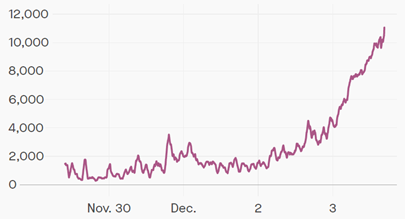 Figure 2. Pending Ethereum transactions after CryptoKitties’release.
Most projects copied the deflationary model of Bitcoin, with a clear aggregate to convince traders that their tokens can appreciate over time. Such a deflation mechanism can change the way the token is viewed, making them a commodity instead of money. Once the expectation of appreciation is high enough, the currency will lose its general equivalent property and become a paradise for speculators. To maintain scarcity, CryptoKitties directly sets the total number of tokens to 1, which improves the scarcity value of each token to the extreme. However, one cat cannot be sold, so CryptoKitties used a randomness factor to give birth to many of these kinds of tokens, giving people the illusion that every cat is a unique, precious treasure. This is also the reason people buy some NFTs nowadays. After all, “you are the only one for me” is the pursuit branded in the human soul.
With this, a new value concept method emerged and CryptoKitties introduced a new evolutionary possibility to cryptocurrencies. When more and more people realized they could make their token more unique by adjusting the number of tokens, the ERC-721 standard came about. This standard defined, for the first time, the token form of a single token. We call this kind of unique token a Non-Fungible Token. They all have independent IDs, and each one is unique. Even though the current standard used today is ERC-1155, all NFTs seem to hype a concept: Scarcity.
About Scarcity
We can divide NFTs into two types: on-chain scarcity + celebrity scarcity, and on-chain scarcity + randomness.
In the former, celebrities take advantage of the scarcity of real-world celebrities and the scarcity created by blockchain. It can easily blend the two to create the illusion of “more scarce”. The latter class are represented by the likes of CryptoPunks, Meebits, Hashmask and other projects that use the combination of on-chain scarcity and randomness to create a kind of “new scarcity”.
Currently, it appears that the combination of randomness and scarcity brings more value. However, blockchain players have undoubtedly fallen into the trap of scarcity, ignoring the fact that on-chain scarcity is merely a manufactured concept and cannot sustain such high prices.
To explain that, I bring forward a thought experiment: Odin’s Ring problem.
Odin’s Ring problem
The Draupnir ring is the legendary gold ring belonging to the Norse god Odin. The Draupnir would reproduce 8 more rings every 9 days, while the ring box containing them would not increase in number.
So, if you are a digital collector, would you buy many Odin rings with superior properties or would you buy just an ordinary Odin ring box? In the current market environment, the ring box is the target for speculators, because they believe that the rarity of the contract definition will bring infinite value-added potential to the ring box.
The answer to this question reveals the most bizarre point on blockchain: the value measurement standard on blockchain differs from that in the real world. Blockchain regards scarcity as they must, regardless of its use value or why it is defined. This reflects the conflict between scarcity and real value on blockchain. This difference has completely become the first obstacle to the development of metaverse. If the virtual world can not develop healthy values, it won’t be able to develop a healthy virtual world.
From Odin’s Ring problem, we can conclude that players in the blockchain industry have not changed. They just switch from one speculation to another which is the NFT speculation in this case. All NFTs are waiting for their appreciation on the market but no one will appreciate their own NFT every day, unless it has some practical value. So at the moment, this is a battlefield of hype, and celebrities are happy to see this as it will allow them to sell more and multiply their wealth. Obviously, the losers of this financial game will be the buyers. Some of them are continuously spending vast amounts of money to gain more and more NFTs, hoping that it will appreciate over time, but the stark eventuality is that most of them will not be able to sell it for more than the likely unrealistic price they paid for it. NFTs are like a sadistic version of musical chairs or ‘time bombs for a group of people who are delivering a time bomb’. In the end, the bomb will explode in someone’s hands. Today, all the players who enter the NFT game in any meaning also gamble that they won’t be the last to receive the ‘time bomb’.
I believe that only the NFTs which can be used on the blockchain or that have (artistic) value that the real world does not have — such as VR/AR paintings — will truly shine.
What should a real NFT look like?
Some articles will tell you that NFT should be interoperable, interactive and programmable. This seems to be very general and difficult for players to understand. NFTs need only one feature: Usability, that’s it.
The most important difference between an NFT and a token is that an NFT can be compared to goods on blockchain. The emergence of real NFTs can also end this infinite awkward situation of exchanging a currency for a currency NFT, while finally bringing real use value to blockchain.
Four years ago, I wrote an essay describing how Ethereum demonstrated value to cryptocurrencies through use value. Ethereum can be used as the fuel of smart contracts, a valuable tool for design, and this kind of fuel will surely announce the birth of an era. Regrettably, few real valuable tokens appeared after that. However, with this year’s NFT boom, I see a genuine opportunity to bring the real use value of NFTs into blockchain. As long as NFTs are used to generate rigid demand, the volatility of the blockchain can change in an unprecedented manner, and the basic currency circle market can evolve into a more sophisticated state.
The best use cases of NFTs are in games and metaverse. An NFT perfectly matches the props in the game, such as the axis in Axie Infinity. These games often have the characteristics of resisting market fluctuations[3]. In the recent volatility, the price of axis infinity’s governance token AXS ignored the sharp fluctuations of mainstream coins and rose 477% against the trend. Game token SLP also rose nearly 154% in the past month. All of that is because entertainment is a rigid demand for everyone. If a game really wants to be world class, it must only regard NFTs and blockchain as a module of the game. Instead of creating a DAPP game entirely, how blockchain really empowers the game industry is through its unparalleled entry traffic and global payment channels, not just smart contracts.
Nowadays, most NFT games are covered with the skin of the game, and there is only one picture link in the chain. As long as the game stops operating, all data will disappear. When you open your wallet, all you see is a bunch of ugly numbers. After a period of disuse, you may not even remember what it is or what it does. This is also because there are no other functions with game NFTs. Although props depend on the creation of smart contracts, their properties are controlled by a centralized server, which is also one of the limitations of ERC-1155. Other limitations of property class NFTs are their lack of attributes and other functions.
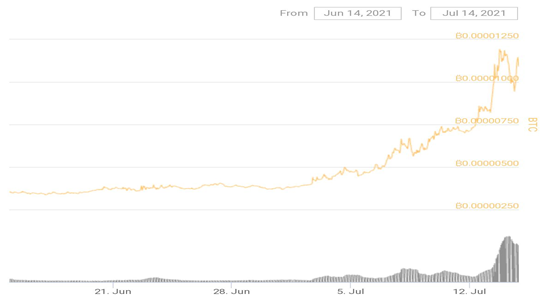 Figure 3. Price of AXS comparing with BTC, from CoinGecko.com
A new NFT standard for gaming
To solve this problem, Cradles team proposes a new NFT standard for gaming: ERC-3664.
This standard can transfer, store, upgrade, and strengthen all the attributes related to props. The transfer can be completed through smart contracts with low gas cost, and even can achieve the same rich prop attributes and functions as traditional games with smart contracts. This kind of creativity is a cross-time innovation.
The growth and upgrading of the ERC-1155 contract is also a strong demand in the next NFT era, and it is also a sufficient and necessary condition for building a complete metaverse. The concept of time and space in the Cradles game is also the first simulation of the real world in the history of blockchain games. Time in the game elapses and even causes NFT changes. Imagine you have an iron sword and, after a time, it becomes an “ancient” iron sword, just like in the real world. All these functions are based on contracts.
Cradles intends to conceptualize beyond its time, seeing a future that is metaverse’s first simulation of the real world. Only based on the simulation and creation of reality, can the metaverse shine a different light from the game world. I think Cradles chose the right way and, maybe in the way of simulation and transcendence, we can really touch the illusion of the metaverse world.
Another big application market for NFT is the software industry.
In fact, many blockchain practitioners and players will fall into the metaverse trap and speculator’s perspective to see what is metaverse and appreciation value. The biggest application scenario of NFT is not just games, metaverse, or the same tired conversation about data transfer and usage verification. The software industry urgently needs innovation by NFT.
The software industry or high availability DAPP industry is the real export of NFTs and tokens. More and more big countries are blocking the cryptocurrency market because it is easy to understand in order to maintain social stability and legal status of powerful countries. It has also given some smaller countries a chance to be conspicuous.
This year, El Salvador recognized Bitcoin as legal tender, an event ahead of its time. This is significant also because it is a declaration that cryptocurrency will never disappear, that there will always be an export. In an era when there are few restrictions for commerce in developed nations, few will do business in emerging countries because the powerful ones are more attractive, with obvious advantages in human resources and funds for the development of enterprise.
But from now on, more and more promising enterprises will take root in less-recognized countries and these will play an important role in the export of digital currency. People will use virtual currency to purchase software services and use rights. Software companies rooted in small countries will exchange virtual currency for local legal currency, which will result in unimaginable GDP output of small countries. Meanwhile, people can obtain software and similar remote services faster and more conveniently. Such a large supply and demand market is just what blockchain does not have now.
Learning from the past and taking heed of the warnings, NFTs are by no means the end of the encryption world. We will eventually clamber over the mountain of trash and look past it for the next generation of technology.
However, in the future, we will recognize retrospectively that the past has brought real valuable things to the blockchain world and guided us to truly understand and develop the use value. In that period of hindsight, we will also see that NFTs have taken us beneath a vast starry sky shining over a new era. A new era for every investor, every blockchain player and every Internet user.
=====================================
Join the conversation and get the latest updates!
Website: http://www.cradles.io/
Cradles Official Forum: https://forum.cradles.io/
Twitter: https://twitter.com/cradlesio
Discord:https://discord.com/invite/5Rp4vUAJea
Telegram Group: https://t.me/cradles_official_group
Telegram Channel: https://t.me/cradles_official
Reddit: https://www.reddit.com/r/Cradles_Official/






