
Introduction
Nobody asks this before marriage: if we ever get divorced, who gets the Bitcoin?
Most couples never have the conversation. Then the divorce happens. And that is when things get expensive.
In 2026, crypto forensics is one of the fastest-growing services offered by family law firms. Exchanges comply with subpoenas. Blockchain analysis tools can trace transactions from years ago. And the blockchain itself remembers everything, forever.
This article is about how crypto is changing divorce, why hidden wallets are no longer safe, and what both sides need to know. If you hold crypto, suspect your partner does, or are simply planning ahead, this matters to you.
Key Takeaways
- Crypto is no longer a hidden asset in divorce.
- Blockchain forensics can trace transactions and identify wallets.
- Courts accept blockchain analysis as evidence.
- Hiding crypto in divorce can result in losing more, not less.
- Pre-nuptial agreements are the cleanest protection.
- Transparency is cheaper than litigation.
- The same tools used in divorce are used by tax authorities.
Why Crypto Was Once the Perfect Hidden Asset
No Statements, No Paper Trail
Most assets leave a trail. Bank accounts send statements. Brokerages mail tax forms. Real estate is recorded in public databases. Even large cash holdings usually leave a footprint somewhere.
Crypto used to be different. A person could buy Bitcoin on an exchange, move it to a hardware wallet, memorize the seed phrase, and destroy every record. The spouse had no way to prove the crypto existed, let alone find it.
Pseudonymous, Not Anonymous
Here is the catch people missed for years. Crypto is not anonymous. It is pseudonymous. Every transaction is written to a public blockchain. Wallet addresses are visible to anyone with an internet connection.
The only missing piece is the identity behind the address. And that piece is getting easier to fill in.
The KYC Era Changed Everything
Starting around 2018, most major exchanges began requiring identity verification, known as KYC, for new accounts. That means the exchange has a record of who owns which wallet. If a court subpoenas the exchange, the exchange hands over the records.
The blockchain provides the transactions. The exchange provides the identity. Combine the two, and you have a complete trail.
How Blockchain Forensics Actually Works
The Tools
Three companies dominate the blockchain forensics market: Chainalysis, Elliptic, and TRM Labs. They sell software to law enforcement, exchanges, and law firms. The software traces crypto flows, links wallets, and identifies the entities behind addresses.
The Process
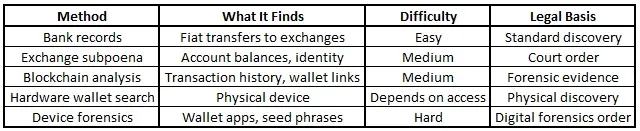
Imagine a spouse suspects their partner is hiding Bitcoin. The attorney files a discovery request. Bank records show a $50,000 wire to a crypto exchange three years earlier. The exchange, under subpoena, produces the account records. The attorney now has the wallet address.
That address goes to a forensic analyst. The analyst traces the wallet, identifies linked wallets, and finds the current balance. The value today might be three times the original wire.
The Evidence
Courts have accepted blockchain analysis as evidence in the United States, the United Kingdom, Singapore, and other jurisdictions. The analysis is treated like any other forensic accounting. It must be documented, replicable, and admissible.
Discovery Methods Compared
What Happens in Court
The Disclosure Requirement
Both parties must disclose all assets during discovery. If one party hides crypto, the other can request additional discovery, subpoenas, and forensic analysis.
The Penalty for Hiding
In many jurisdictions, hiding assets in a divorce is treated as fraud on the court. The judge can award the hidden amount to the other spouse, plus legal fees. In extreme cases, the hiding party can be held in contempt.
The Valuation Problem
Crypto is volatile. A wallet worth $100,000 on the date of separation might be worth $50,000 or $250,000 by the time the divorce is finalized. Courts handle this differently. Some use the date of separation. Some use the date of the decree. Some average the two.
This is one of the most contested areas in crypto divorce cases. It is also where a good forensic analyst earns their fee.
The Settlement
Most cases settle before trial. The forensic analysis gives both sides a realistic picture. The settlement is usually a negotiated split, informed by the analysis and the legal risks. Going to trial over crypto is expensive and unpredictable, so both sides usually prefer a deal.
The 5 Biggest Mistakes Crypto Holders Make in Divorce
Mistake 1: Assuming the crypto is invisible. It is not. The blockchain is public. Exchanges respond to subpoenas. The IRS now receives cost basis data on Form 1099-DA.
Mistake 2: Moving crypto during divorce proceedings. This can be treated as fraud on the court. Judges have frozen assets and held people in contempt for doing exactly this.
Mistake 3: Not disclosing a hardware wallet. If the wallet is discovered later, the court can award its full value to the other spouse. You lose twice.
Mistake 4: Forgetting about DeFi and staking. Staking rewards, liquidity pool positions, and NFT holdings are all assets. They need to be disclosed and valued. Missing them creates a bigger problem later.
Mistake 5: Not having a prenup. If you own crypto before marriage, a prenup is the cleanest protection. Without one, the crypto may become marital property depending on your jurisdiction.
How to Protect Yourself Before Divorce
Pre-Nuptial Agreement
A prenup can keep pre-marital crypto as separate property. It can also define how crypto acquired during marriage will be treated. This is the single most effective protection available.
Post-Nuptial Agreement
If you are already married, a post-nup can achieve similar goals. Both spouses must agree voluntarily and with independent legal representation.
Documentation
Keep records of what you owned before marriage, what you inherited, and what you bought during marriage. If you ever need to prove separate property, you will need this documentation.
Separate Wallets
Keeping your pre-marital crypto in a separate wallet, without commingling it with marital funds, can help preserve its separate status in some jurisdictions. This is not a guarantee, but it helps.
Transparency
Some couples benefit from full disclosure. It removes the risk of later disputes and builds trust. Not always possible, but worth considering before the marriage, not after.
How to Find Hidden Crypto if You Suspect It
Start With Bank Records
Crypto does not come from nowhere. Look for wires to Coinbase, Kraken, Binance, Gemini, or other exchanges. Look for recurring small transfers that might be dollar-cost averaging.
Look for Hardware
A hardware wallet looks like a USB drive or a small device. Ledger, Trezor, and Coldcard are the most common brands. If you find one, do not destroy it. Preserve it. It is evidence.
Check Apps and Extensions
Phones, computers, and browser extensions can hold wallet apps like MetaMask, Phantom, or Trust Wallet. Screenshots, notes apps, and password managers may contain seed phrases or exchange logins.
Hire Legal Help
Hire an attorney with crypto experience. Ask directly if they have worked with blockchain forensics. If they have not, they can refer you to someone who has.
Do Not Hack the Wallet
Trying to access a wallet without authorization can be illegal. It can also destroy evidence. Let the professionals handle it.
The Bigger Picture
The same forensic tools used in divorce are used by the IRS, the SEC, and foreign tax authorities. The same analysis that finds a hidden wallet in a divorce can find unreported income, undeclared holdings, and unpaid taxes.
The crypto industry spent its first decade promising privacy. The next decade is about transparency. Not because users want it, but because the tools exist and institutions are using them.
If you are holding crypto and you think no one will ever know, you are operating on an assumption that stopped being true years ago.
Conclusion
The blockchain remembers everything. For most people, that is a feature. For anyone trying to hide assets, it is a liability.
Divorce is already expensive and emotionally draining. Add hidden crypto, and the cost multiplies fast. The forensics are standard. The courts are experienced. The tools are cheap.
If you are married, talk to your partner about your crypto. If you are getting married, consider a prenup. If you are getting divorced, hire a lawyer who knows crypto.
And if you are hiding crypto, understand that this is not a strategy. It is a delay. The delay gets shorter every year.
FAQ’s
Can my spouse force me to reveal my crypto in a divorce?
In most jurisdictions, yes. Both parties must disclose all assets during discovery. Hiding assets can result in penalties, including losing the hidden amount.
Is crypto traceable in a divorce?
Yes. Blockchain analysis can trace transactions, link wallets, and identify exchange accounts through subpoenas.
What if I bought crypto before marriage?
In many jurisdictions, pre-marital assets remain separate property. But if you commingled the crypto with marital funds, it may become marital property.
Do I need a prenup to protect my crypto?
A prenup is the cleanest protection, but not the only one. In some jurisdictions, keeping crypto separate and not commingling it can preserve its status.
What happens if my spouse hides crypto and I find out after the divorce?
In some jurisdictions, you can petition to reopen the divorce. Time limits apply, and you will need evidence.
Can a judge order my spouse to hand over their seed phrase?
Yes, in some cases. Courts have ordered disclosure of private keys and seed phrases. Refusing can result in contempt of court.
Is crypto divided 50/50 in divorce?
In community property states like California and Texas, yes. In equitable distribution states, it depends on the judge's view of fairness.
Disclaimer
This article is for informational purposes only and does not constitute legal, financial, or tax advice. Divorce law varies by jurisdiction. Blockchain forensics tools and legal standards differ across countries. Consult a licensed attorney and a qualified tax professional before making decisions about your crypto holdings or marital assets. The author is not a lawyer or tax advisor.





