
Introduction
Something strange is happening in crypto right now. Software programs are starting to make decisions that used to require humans. They're trading, managing portfolios, and interacting with financial systems on their own.
These programs are called AI agents. And they're about to change how regular people handle crypto.
Most articles about this topic either assume you're a developer or drown you in hype. This guide does neither. In the next few minutes, you'll understand what AI agents are, how they work in crypto, what risks they create, and how to decide if you should use one.
No jargon. No fearmongering. Just clear answers.
Key Takeaways
- AI agents are software that can make decisions and take actions on their own
- They differ from trading bots because they can adapt to new situations
- Crypto is a natural home for AI agents because it's programmable, open 24/7, and transparent
- The Three Levels of Trust framework helps you decide how much access to give
- Real risks include permission problems, bugs, herding effects, and unclear accountability
- Always set spending limits, use separate wallets, and test with small amounts
- The future will bring agent-to-agent economies, regulation, and better trust infrastructure
- Start with Level 1 access (read-only) and move up only when you understand the risks
What Are AI Agents?
A Simple Definition
An AI agent is software that can make decisions and take actions without someone telling it exactly what to do at every step.
Here's a comparison that helps. A calculator waits for you to press buttons. It does nothing on its own. An AI agent is more like a personal assistant. You give it a goal, and it figures out the steps to reach that goal.
If you tell an assistant "book me a flight to London," they check options, compare prices, and make a booking. You didn't specify which website to use or which flight to pick. They figured that out.
AI agents work the same way. You give them a goal like "earn yield on my stablecoins." They research options, compare rates, and execute trades.
How They Differ From Regular Bots
Crypto has had trading bots for years. These bots follow fixed rules. "If Bitcoin drops 5%, buy $100 worth." That's it. They can't adapt.
AI agents can adapt. They can learn from new information. They can handle situations they weren't specifically programmed for.
Think of it this way. A bot follows a recipe. An agent can improvise when ingredients are missing.
This difference matters because crypto markets change constantly. Rules that worked last month might fail today. Agents can adjust. Bots cannot.
Why Crypto Is the Perfect Home for AI Agents
Crypto and AI agents fit together naturally. Here's why.
First, crypto runs on code. Smart contracts, wallets, and exchanges all work through software. AI agents are also software. They can interact directly without needing human interfaces.
Second, crypto is open 24/7. Markets never close. AI agents never sleep. This is a perfect match.
Third, crypto has programmable money. Stablecoins and tokens can be sent anywhere in the world in seconds. AI agents can move money around the globe faster than any human.
Fourth, crypto has transparent data. Every transaction is public. AI agents can analyze this data to find opportunities humans might miss.
How AI Agents Actually Work in Crypto
The Basic Setup
Most AI agents in crypto need three things to operate.
First, they need access to information. This means price data, news, and on-chain activity. Some agents also read social media or analyze documents.
Second, they need decision-making ability. This comes from AI models that process information and choose actions.
Third, they need execution power. This means the ability to actually make transactions. This is where things get sensitive because it involves your money.
What Agents Can Do
AI agents in crypto can perform many tasks.
They can trade. An agent might monitor multiple exchanges and buy when prices dip, then sell when they rise. It can do this faster than any human.
They can manage portfolios. You might tell an agent "keep my portfolio at 60% Bitcoin and 40% Ethereum." The agent will rebalance automatically as prices change.
They can find yield. DeFi protocols offer different interest rates that change constantly. An agent can move your funds to wherever the best rates are.
They can monitor risks. An agent can watch for signs of trouble, like a protocol being hacked or a token losing value rapidly. It can exit positions before losses get worse.
They can interact with other agents. This is new and strange but real. Agents can negotiate with each other. One agent might offer a loan. Another might accept it. No humans involved.
What Agents Cannot Do
AI agents have limits. Understanding these limits protects you.
They cannot predict the future. No AI can. Markets are unpredictable. Agents can analyze patterns, but patterns break.
They cannot guarantee profits. Any agent promising guaranteed returns is lying. Crypto is risky. AI does not change that.
They cannot recover from certain mistakes. If an agent sends your crypto to a wrong address, that money is gone. Blockchain transactions are final.
They cannot understand context like humans do. An agent might see a price drop and sell. A human might recognize it as a temporary dip caused by news that doesn't matter long-term.
Real Examples of Agent Actions
Let me paint three scenarios to make this concrete. These are illustrative, not real events.
Scenario one. A user sets up an agent with $1,000 in stablecoins. The goal: earn the best available yield. The agent checks lending protocols, finds one offering 8% instead of the usual 5%, moves the funds, and monitors for better options. The user checks in once a week.
Scenario two. A user wants to accumulate Bitcoin slowly. They give an agent $500 per month to spend. The agent buys small amounts at different times, avoiding big purchases when prices spike. Over a year, the user has more Bitcoin than if they had bought all at once.
Scenario three. A user gives an agent full access to their wallet. The agent has a bug. It enters an infinite loop of transactions, draining the wallet in gas fees. The user loses everything. This is why access limits matter.
AI Agents vs Trading Bots vs Human Traders
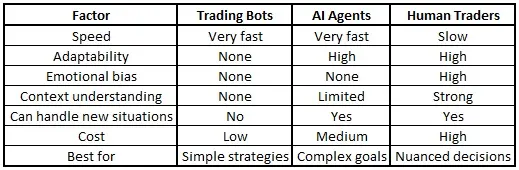
Trading bots win on simplicity and cost. They're perfect for basic strategies that don't change.
AI agents win on adaptability. They can handle goals that require judgment.
Humans win on understanding context. They know when something feels wrong even if data looks fine.
The future probably involves all three working together. Humans set strategy. Agents handle execution. Bots handle routine tasks.
The Three Levels of AI Agent Trust
This framework helps you decide how much access to give an agent. Start at Level 1. Move up only when you understand the risks.
Level 1: Read-Only Access
The agent can see your wallet and analyze your holdings. It cannot move anything.
What you can do: Get recommendations, track performance, receive alerts.
What you cannot do: Let the agent trade for you.
Risk level: Minimal. The worst case is bad advice.
Best for: Beginners who want to learn before committing.
Level 2: Limited Execution
The agent can trade, but only within limits you set. You might allow it to spend up to $100 per day or only trade specific tokens.
What you can do: Automate small trades, test strategies, build confidence.
What you cannot do: Give the agent unlimited access.
Risk level: Moderate. You could lose your spending limit, but not everything.
Best for: Users who understand the basics and want to experiment safely.
Level 3: Full Control
The agent can do anything with your funds. No limits.
What you can do: Fully automate your crypto strategy.
What you cannot do: Recover funds if something goes wrong.
Risk level: High. You are trusting the agent completely.
Best for: Experts who have audited the code and accept the risks.
Real Risks Nobody Talks About
The Permission Problem
Every AI agent needs permission to act. That permission is powerful. If an agent has access to your wallet, it can move your funds. If it has access to your exchange account, it can trade.
Most people give too much permission. They don't set limits. They don't use separate wallets. They treat the agent like a trusted friend instead of a powerful tool.
Here's the rule: Give the minimum permission needed. If the agent only needs to trade $500, don't give it access to $50,000.
The Bug Problem
AI agents are software. Software has bugs. A bug in a trading bot might cause a bad trade. A bug in an AI agent might drain your wallet.
This isn't hypothetical. Bugs happen. Audits help, but audits don't catch everything. Even well-tested code can fail in unexpected conditions.
Protection: Use spending limits. Test with small amounts. Never give full access to an agent you don't fully understand.
The Herding Problem
Imagine thousands of AI agents all using similar strategies. They all see the same data. They all make similar decisions.
What happens when they all decide to sell at once? The market crashes faster than it would with human traders. What happens when they all buy? Prices spike.
This creates new kinds of volatility. Regulators and researchers are paying attention. The outcomes are uncertain.
Protection: Understand that AI agents can amplify market moves. Don't assume historical patterns will hold.
The Accountability Problem
If an AI agent makes a mistake, who is responsible? The user who gave permission? The developer who wrote the code? The platform that hosted the agent?
Right now, the answer is usually: the user. Most terms of service put responsibility on you. If the agent loses your money, you have limited recourse.
Protection: Read the terms. Understand what you're agreeing to. Assume you bear the risk.
Should You Use an AI Crypto Agent?
Use this decision tree.
Question 1: Do you understand what the agent does?
If no, stop. Learn first.
If yes, continue.
Question 2: Can you afford to lose the money you're giving the agent?
If no, stop. Only use money you can lose.
If yes, continue.
Question 3: Does the agent have spending limits?
If no, stop. Never give unlimited access.
If yes, continue.
Question 4: Have you tested with a small amount?
If no, start small.
If yes, continue.
Question 5: Do you understand the risks?
If no, re-read the risk section.
If yes, proceed carefully.
Before You Give an AI Agent Access: A Checklist
Run through this list before connecting any agent to your crypto.
- Research the agent. Who built it? Is the code open source? Are there audits?
- Read the terms of service. What happens if something goes wrong?
- Set spending limits. Start lower than you think you need.
- Use a separate wallet. Don't connect your main holdings.
- Test with a small amount. Run it for a week before adding more.
- Monitor regularly. Check transactions daily at first.
- Have an exit plan. Know how to revoke access if needed.
Red flags:
- Promises of guaranteed returns
- No spending limits available
- Closed source code with no audits
- Pressure to invest quickly
- No way to revoke access
Green flags:
- Transparent team and code
- Independent audits
- Clear documentation
- Spending limit features
- Active community
What's Coming Next
AI agents in crypto are early. Expect rapid changes.
Agent-to-agent economies. Agents will start transacting with each other. One agent might lend to another. They might form teams. This is already being tested.
Regulatory attention. Governments are watching. Rules are coming. Some will help. Some will hurt. Uncertainty is high.
Trust infrastructure. New systems are being built to verify agents. Think of it like credit scores but for software. This could make agents safer to use.
Better user interfaces. Early agents required coding. The next wave will work more like apps. This will bring mainstream users.
Conclusion
AI agents are real. They're working in crypto right now. They offer genuine benefits like automation, speed, and access to opportunities humans might miss.
They also create genuine risks. Permissions are powerful. Bugs happen. Accountability is unclear.
The smart approach is cautious curiosity. Learn the basics. Start small. Set limits. Never give an agent more access than necessary.
The future likely involves AI agents playing a bigger role in crypto. Understanding them today prepares you for tomorrow.
FAQ’s
What is an AI agent in crypto?
An AI agent is software that can make decisions and take actions in crypto markets without step-by-step human instructions. It analyzes data, chooses strategies, and executes trades or other operations.
Can an AI agent steal my crypto?
If you give it full access, yes. Most agents are legitimate, but malicious agents exist. Always use spending limits and separate wallets. Never give unlimited access.
Are AI agents better than human traders?
They're faster and less emotional. Humans are better at understanding context and handling unusual situations. The best approach combines both.
Do I need coding skills to use AI agents?
Not anymore. Early agents required technical knowledge. Newer platforms are building user-friendly interfaces that work more like regular apps.
How much money do I need to start?
You can start with as little as $50 to test. The key is starting small and learning before committing larger amounts.
What happens if the agent makes a mistake?
You bear the consequences. Most platforms put responsibility on users. This is why testing with small amounts and setting limits is essential.
Are AI agents regulated?
Regulation is still developing. Most jurisdictions don't have specific rules. This creates uncertainty. Check your local laws.
Can AI agents work across different blockchains?
Some can, but it's complex. Most current agents focus on one blockchain. Cross-chain agents are emerging but add risk.
What's the difference between an AI agent and a trading bot?
Bots follow fixed rules. Agents can adapt and make judgment calls. Bots are simpler and safer. Agents are more powerful but riskier.
Should I use an AI agent for my crypto?
Only if you understand the risks, can afford to lose the money, and start with strict limits. Never use money you need.
DISCLAIMER
This article is for educational purposes only. It does not constitute financial, legal, or investment advice. Cryptocurrency investments carry significant risk, including total loss of capital. AI agents introduce additional technical and security risks. Always conduct your own research and consult qualified professionals before making financial decisions. The author has no affiliation with any platforms or projects mentioned. Examples are illustrative and not based on real events.





