
Introduction
Thousands march in London on Earth Day, organised by Extinction Rebellion (XR), as part of a mass climate protest (Sky news, 2023). Global climate change and global warming has brought detrimental impacts to the environment. Higher temperatures, increased drought, loss of species and more have been felt by the world. Even as we tackle these issues, climate change has limited our ability to mitigate them. For example, increased forest fire has reduced the number of trees to store carbon and keep it out of the air, affecting our efforts to decarbonise the world.
Hence, under the 2015 Paris Agreement, 197 countries gathered to agree on keeping global temperature increase below 1.5C. Specifically, the UK has taken extra steps to spearhead the ‘save-the-environment’ movement. This is shown by its publication of 2019 Net Zero: The UK's Contribution to Stopping Global Warming, and 2021 Net Zero Strategy: Build Back Greener. The primary aim of these reports is to develop a sound strategy to take the UK to net zero by 2050.
Progress so far
To date, the UK government has been able to reduce greenhouse gas (GHG) emissions by 44% since 1990, accelerating deployment of cheap renewable power, providing funding for green sectors and more. These are strategies that reflect the serious climate change issues.
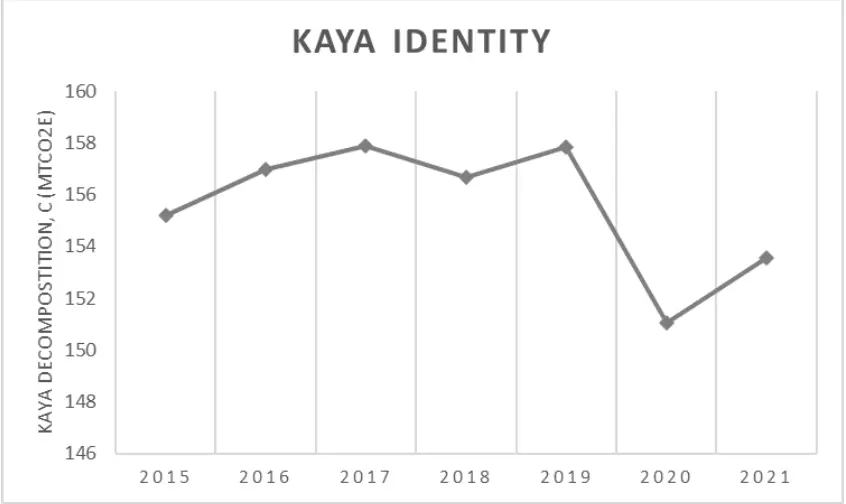
Figure 1: Kaya Identity
These are the kaya decomposition figures. The data was retrieved from Jonathan Gilligan’s kayadata study (Gilligan, 2023). As shown in the figure, there has been a decrease in kaya identity from 2015 to 2021. However, there is a concerning increase from 2020 to 2021. In order to reach a reasonable target of 70 MTCO2e by 2050, the UK government has to instil measures to decrease the kaya identity by half. More details of the kaya identity can be found in the appendix.
In this report, we will discuss the extent to which political and physical realism are in conflict, based on the measures mentioned in the two net zero reports. We will assess whether they fall short of the general requirement for 'Fairness and Physics'. We will look at specific sectors of the 2019 and 2021 report separately, and provide a general overview of the 2 reports. Additionally, we will look at the Kaya decomposition figures over the past 5 years
2019 net zero
In 2019,In 2019 the CCC produced a major report Net Zero: The UK's Contribution to Stopping Global Warming, recommending how the UK should reach net-zero
Recommendation 1
In 2019, transport was UK’s biggest source of emissions, not including international
aviation and shipping. Road transport accounts for 90% of the sector’s emissions, most of which is from passenger cars (56% of all transport emissions). The main obstacle is converting from petrol and diesel vehicles: there were almost 40 million registered cars in the UK, with only 300,000 electric vehicles (EVs) (Parry, 2020).
Furthermore, the Government will need to build a nationwide EV charging infrastructure – and adapt the electricity grid to support this. It will also need to encourage the use of public transport, such as trains and buses, encourage the adoption of walking and cycling, and reduce shipping and aviation emissions.
In the 2019 report, it was recommended that all new automobiles should be electric (or use a low-carbon alternative such as hydrogen). If possible, an earlier switchover (e.g. 2030) would be
desirable, reducing costs for motorists and improving air quality. Since then, the government has complied with the recommendation.
Limitations
However, DfT has not laid down clear plans for the consumers and businesses in this sector. Thought of as a “snap decision”, DfT were surprised as they could not consult businesses. This increases companies’ doubt about future plans.
Furthermore, the underprivileged could struggle to pay for replacement of petrol and diesel cars with EVs. This issue is mitigated with subsidies and tax reliefs such as 35% off the purchase cost of an electric vehicle (up to a maximum of £2,500). Nevertheless, the repeated changes to the tax and subsidy regime has caused problems for businesses. Businesses are not able to price in cost to pass down to consumers.
A recommendation to this would be to instil regulation, which would place the financial burden on firms, distributed between their shareholders, employees and consumers. All businesses should be given early notice of any tax and subsidies regime so that they can adjust their prices. A stringent and clearer plan is required to ensure that the UK does not fall short of the international agreement of limiting the temperature increase to below 1.5°C.






