
A frog-themed proof-of-work chain admitted, in public, exactly how little money it would take to move its market cap by millions. SimpleSwap's routing data explains why that confession is normal rather than alarming, and what it actually takes to trade an asset like this without losing money to the gap.
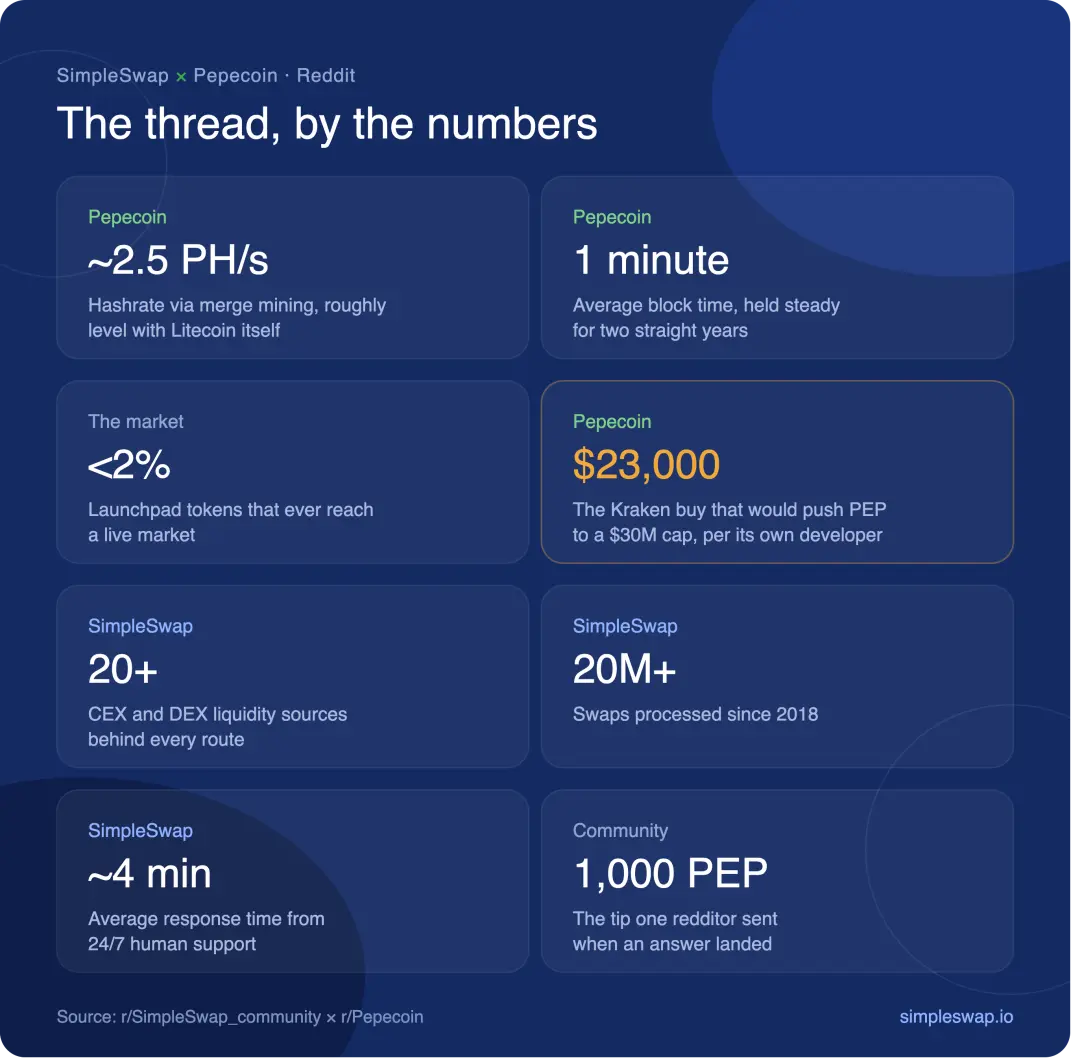
Pepecoin's lead developer, ZordiakDev, said something in his own subreddit that most projects bury: "An investment of just $23,000 USD on Kraken would skyrocket us to a $30 million market cap." He offered it as proof that bear-and-bull talk is beside the point for a project this size. It is also, read differently, a precise description of how thin a single-venue order book can be, and why that thinness is the actual story here.
The admission surfaced in an unusual format. Pepecoin's team took questions from SimpleSwap's community, and SimpleSwap answered questions posted directly in r/Pepecoin, including hostile ones. Both threads are a useful anchor for something worth explaining properly: how aggregated liquidity actually behaves on an asset like PEP, why a "middleman" routing engine changes a small-cap trade's outcome more than any single exchange's fee schedule does, and what that means for the next wave of proof-of-work memecoins launching without a market maker behind them.
The figures behind this piece
Why one deep venue isn't the same as liquidity
The instinct when evaluating a small-cap asset is to ask which exchange has it and trust the biggest name on the list. That instinct is wrong more often than traders assume. A single venue prices against its own order book and whatever flow happens to be moving through it at that moment. When flow for a pair like PEP/BTC runs thin, the quote reflects the limit of that one source, regardless of how large the exchange is overall. It's the same reason ZordiakDev's $23,000 figure works: Kraken is a large exchange, but PEP's book on Kraken is not a large market.
Aggregation exists to route around exactly that limit. SimpleSwap pulls live pricing, depth, and supported pairs from 20+ CEX and DEX providers simultaneously and selects the combination that offers the most realistic execution for a specific order, rather than the best headline rate. For a pair that trades across several thinner venues rather than one deep one, like PEP, that difference isn't merely cosmetic. It's the gap between a quote that holds and one that erodes the moment size hits the book.
The rate a SimpleSwap user sees before confirming bundles three things: a liquidity spread that typically runs 0.5% to 2% depending on how deep the pair actually is, a service margin, and network fees the blockchain itself charges. None of it is hidden after the fact. The number shown is the number delivered, which matters most for assets where a single-venue quote can't be trusted to hold steady.
What changes when the check gets bigger
The trader who asked SimpleSwap about slippage on a large PEP position was really asking a liquidity-depth question, whether they knew it or not. On a single exchange, price impact scales directly with how much of the visible book an order consumes, which is brutal on a pair with a $23,000 tipping point. Splitting that same order across CEX and DEX sources at once changes the math: instead of one book absorbing the whole trade, several absorb a slice each, and price impact compresses because no single venue has to carry the full size. On some assets, that combined-liquidity approach keeps price impact bounded, even for checks worth hundreds of thousands of dollars, well beyond what any one small-cap order book could handle cleanly.
This is also the honest answer to "isn't OTC the only way to move real size on an illiquid asset?" It isn't, and treating it as the default sends smaller holders to worse pricing than they need to accept. Aggregated routing, splitting across CEX and DEX depth, absorbs meaningful size while keeping price impact in check. OTC desks remain the right call for very large, illiquid, or compliance-heavy transfers, but the assumption that anything above a few thousand dollars requires a desk and a phone call is out of date for most pairs, including PEP.
For holders who repeatedly trade in this size range, the Loyalty Program's upper tiers are specifically designed for that pattern. At Gold and Platinum, the fee discount runs up to 20% (or up to 40% in the enhanced-discount mode), cashback runs up to 0.4% in USDT, and both tiers come with a personal manager reachable through Telegram rather than a queue. None of that shows up in a single swap's headline rate, but it's the layer built for exactly the checks that would move a thin order book.
What the routing engine actually does, step by step
"Swap aggregator" undersells the amount of engineering that goes into a PEP trade. In practice, it runs in four layers for every transaction: sourcing live pricing and depth from each connected provider, comparing the routes those providers can offer for the specific pair and size, executing the trade across whichever combination clears best, and settling the output to the wallet address the user specified, with tracking visible at every step through a unique order ID. For most floating-rate swaps, that pipeline delivers the estimated output within 99.998% accuracy of the user's quoted amount, and 86% of started swaps complete, a number that reflects route reliability more than user hesitation.
None of that engineering is visible in a subreddit thread. It shows up as a rate that holds, an order ID you can actually watch move, and support that answers in about four minutes rather than a ticket queue. Since 2018, that combination has carried more than 20 million swaps across 2,800+ assets and 3.2 million+ trading pairs, without ever requiring a user to fund an account balance first.
Why list a coin with a $23,000 tipping point at all
The case for adding PEP wasn't hype math. It was that self-custody holders on a merge-mined proof-of-work chain, with no premine and no dev fund propping it up, are precisely the audience a wallet-to-wallet aggregator is built for. They don't want to open an account, deposit onto an exchange, and wait for a balance to clear. They want a route in and a route out that ends the moment the transaction does. PEP's own math on thin depth is the argument for why that routing choice matters more here than on BTC or ETH, not a reason to avoid the asset.
That principle over trend is also why the reply to "you're just another middleman" didn't try to prove otherwise. Manual bridging and hand-picked routes remain a real option for anyone comfortable hunting liquidity venue by venue. What aggregation buys instead is one route, priced up front, executed across depth that no single order book on a coin like PEP could offer alone. For a holder deciding between doing that work manually or letting a routing engine do it, the honest pitch is convenience and execution quality, not a claim that the fee disappears.
The forward-looking read
Two structural shifts are worth tracking past this one thread. AI-generated short-form video is now cheap enough that a project with no dev fund, like Pepecoin, can run a TikTok and YouTube Shorts funnel that would have required an agency retainer two years ago. That collapses the advantage large marketing budgets used to hold over fair-launch projects, and it will keep producing small proof-of-work chains that behave exactly like PEP: real security, real community, genuinely thin books.
Regulatory readiness is the other one. AML, KYC, and exchange-security checks are built to activate only where they're genuinely warranted, with a one-time verification unlocking a broader pool of liquidity providers rather than repeated checks at every source. That's the design pattern aggregators need as more of this next generation of small, self-launched chains reaches a tradable market with the same depth problem PEP has today.
PEP swaps are live on SimpleSwap. Pick a pair on simpleswap.io and check your rate up front, with the result delivered to a wallet you own.






