
Dear PSB colleagues,
Thank you for drafting such a comprehensive PD session for our collective benefit.
In my experience working with students who have dyslexia, both in individual and group settings, I have noticed several recurring patterns during our interactions. I wonder if you could offer us some guidance on how best to address these challenges.
Firstly, I have observed that when presented with an unfamiliar word, students with dyslexia often vocalise the first word that comes to their mind, rather than breaking it down into syllables and blending them together. For example, they might say “explain” instead of the correct "express", or “remind” instead of “recommend”. Initially, I attributed this to them not being conscientious enough to monitor their reading. However, the following page made me realise that this may be an unconscious tendency. My first question is: How do we improve their meta-cognition so that they are made aware that they sometimes read words in a seemingly random manner?
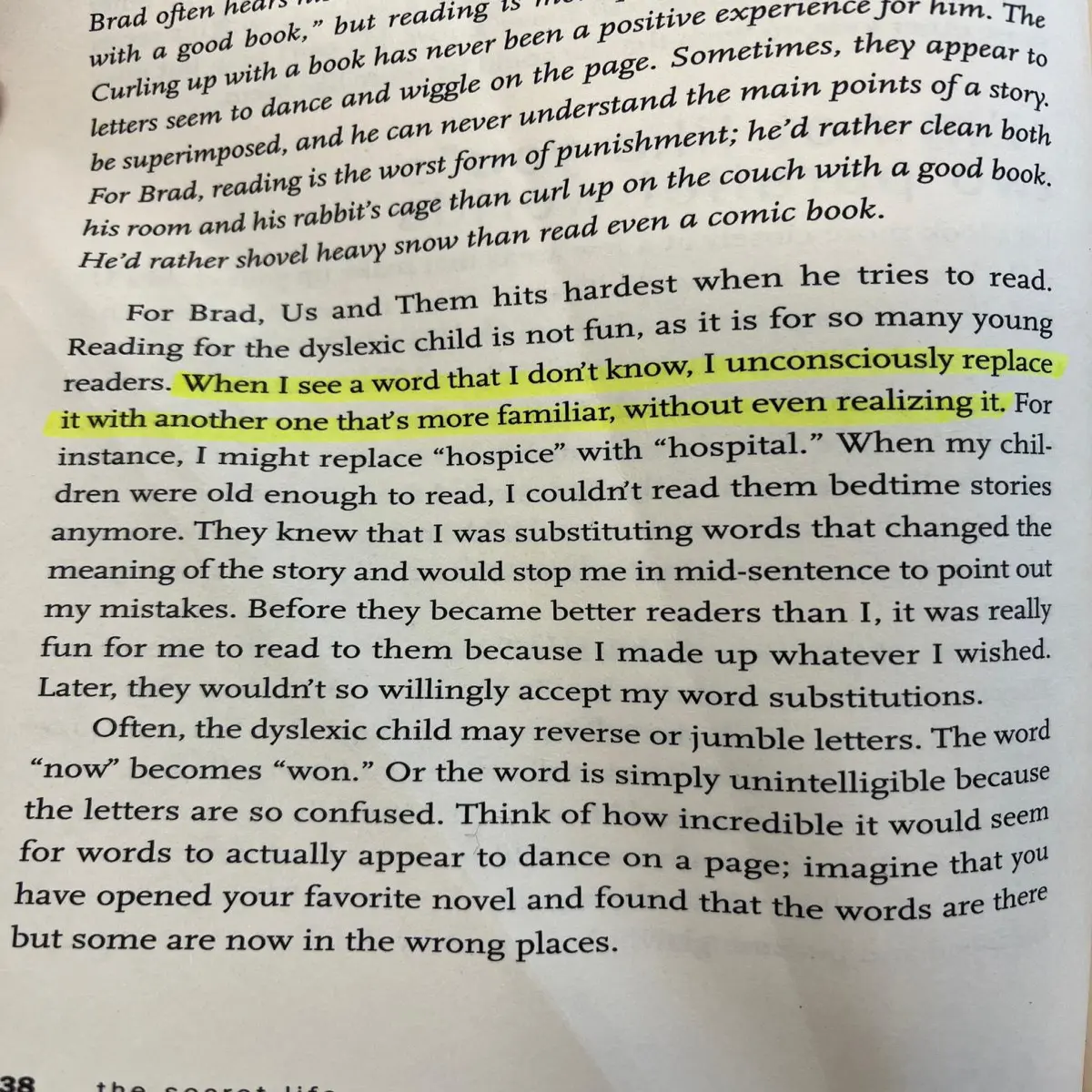
My second question is an extension of the first. Guided by the desire to help students recognise patterns in the English Language, I carry out a lot of work related to suffixes. In the first semester, I focused a lot on “-ed” and “-ing” because our curriculum emphasised comprehension of the simple past and past continuous tenses. However, I have observed a persistent reliance on "-ed" and "-ing" even as I've progressed to instructing on other suffixes like “-ate” and “-tion”. It's like they can’t shake “-ed” and “-ing” out of their minds. This leads to instances where they substitute “-tion” with “-ing” in their reading. How do we teach them to compartmentalise knowledge in their minds so that they are mentally prepare to assimilate the instruction of new affixes?
The last question pertains to comorbidity. It has come to my attention that 25-40% of those with dyslexia also have ADHD – a correlation notably prevalent in NorthLight School. Teenagers with ADHD may not respond favorably to conventional remediation strategies, finding them boring. So, capturing and maintaing their focus, especially within a classroom setting where teachers can't quite afford to give them personalised attention, can be quite challenging for us teachers. How can we customise these methods to better accommodate the shorter attention span of these students?
I recognise that there are no straightforward solutions to my questions. Nonetheless, I hope to bring these questions to the forefront in hopes that we can pool our expertise to develop effective methods to help these low-progress learning. Your insights on these three questions will be appreciated as they will help to shape our efforts here at NorthLight School.
Thank you for your thoughtful consideration in advance.
Best regards,
Kai Le






