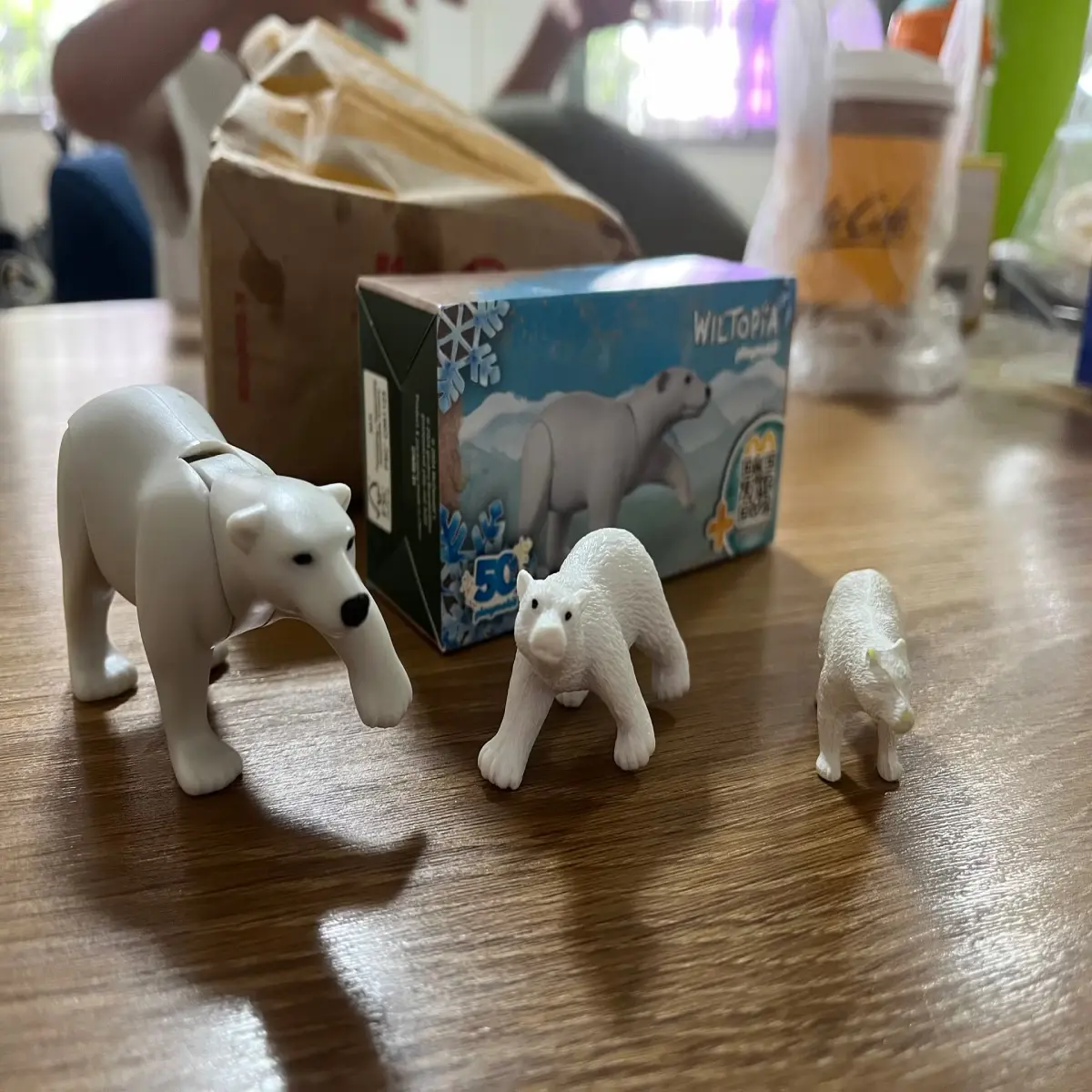
Decided to make my life easy today. Ordered McDonald’s for breakfast. Was encouraged to do so because McDonald’s dangles a free animal toy along with its Happy Set these days. Boy, did my boy fall for it hard.
He was thrilled. He said something about *cubs*. Geez, I never knew he knew that the young of a polar bear is called a cub. His kindergarten is doing a great job in educating him. This motivated me to dig up my adaptation notes and extract the relevant stuff related to polar bears.
I consider it money well spent because it not only bought my boy happiness, but also enabled me to know more about his knowledge tank.
Adaptations of Polar Bears
- Polar bears have thick fur and a layer of fat under its skin to keep itself warm. The fur keeps a layer of air close to the skin. Since air is a poor conductor of heat, polar bears lose heat to the surrounding cold air slowly.
- Polar bears have stiff hairs at the bottom of their feet to increase friction and allow them to walk on ice without slipping.
- White fur helps polar bears blend in with their snowy and icy surroundings, making it easier for them to camouflage with their surroundings and protect themselves from predators.
- Polar bears have short and stocky claws that allow them to grip heavy prey and ice.
- They have a keen sense of smell to locate their prey’s breathing holes in frozen water and land.
https://diaperfinancingfund.blogspot.com/2024/05/adaptation-of-polar-bears.html?m=1