
This Artikel is translated with DeepL Tranlator. The original Post in german Language can be found here.
In this article I would like to give you an understanding of the Zilliqa Blockchain.
I was asked by Telegram if I could write an article about Zilliqa to make the project a bit more known in the German speaking countries.
During my research about Zilliqa I realized very fast that this is not that easy.
The Zilliqua network is quite complex and has very little in common with other well-known blockchain projects.
Of course I made a video about this topic and this article should, as far as possible, summarize the information from the video.
The Video is in german Language.
Let's start with the structure of Zilliqa:
Zilliqua consists of two parallel running blockchains on which different data is stored.
These two blockchains are fed with data by two different "departments" working together.
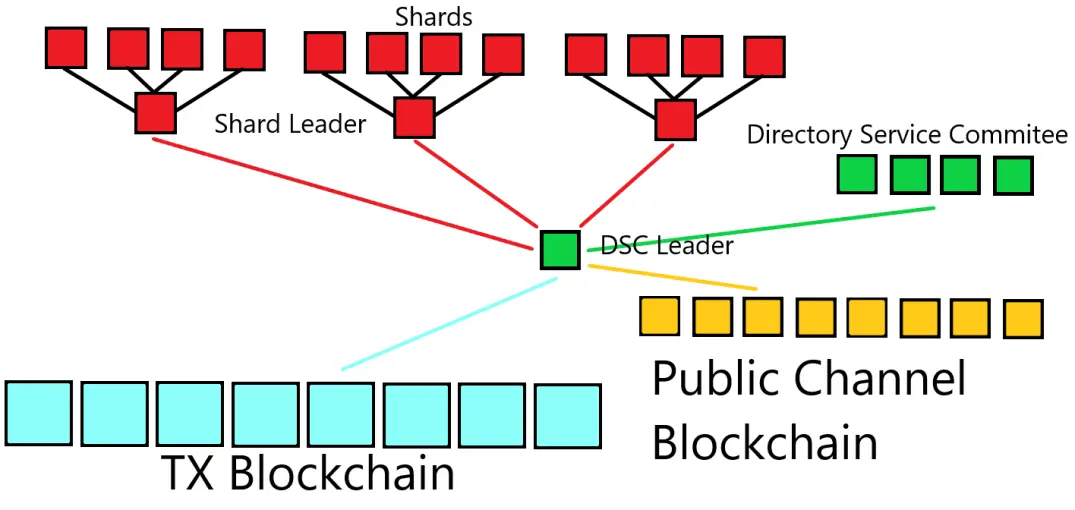
On one side there is the Directory Service Committee (shown in green in the graphic)
The DSC can best be imagined as the organization department.
On the other side, we have the Shards. The Shards are the departments that do the actual work. The Shards are where the transactions are validated. You could think of the Shards as production in a factory. ( shown in red in the graphic )
So, to stay with the factory, we have the Directory Service Committee as the administrative department that forwards and distributes the work to production.
The output of the shards, i.e. the production, is stored on the TX block chain in the form of TX blocks ( light blue) and the administrative data of the DSC is stored on the Public Channel block chain in the form of DS blocks ( yellow).
The two block chains are linked together so that the administrative data is linked to the transaction data of the individual blocks.
Now let's have a look at how the administrative side works:
Directory Service Committee / DSC
The DSC comprises a fixed number of nodes. The nodes are exchanged in the first in, first out procedure after a certain time. That means the oldest node drops out of the committee and is replaced by a new one. The new node can only join the committee if it has solved a proof of work puzzle before. By solving the puzzle, the node acquires a quasi access authorization. This access authorization is stored in the Public Channel Blockchain.
The DSC then determines a leader who remains in office for the time it takes to generate a DS block. One speaks of a DS epoch.
The DS Leader gets his office by solving a POW puzzle the fastest.
The task of the DS Leader is to distribute the tasks and nodes in the production, i.e. in the shards. In a way he passes on the tasks of the administration to the production and thus serves as a link.
Now we come to the Shards:
First we have to look at what the Shards actually are.
While in conventional block chain networks all nodes in the network work on the same task, in Zilliqa the nodes are divided into workgroups. Let's take 1000 nodes in a network as an example. These 1000 nodes are now divided into 10 workgroups (shards). This means that 100 nodes work in each shard. This also means that 10 tasks can now be processed in parallel and the transaction speed (TX/second) has increased by a factor of 10. In a Zilliqa shard, there are at least 600 nodes in a working group for security reasons.
Structure of the shards:
All nodes in a shard have to solve a POW puzzle before entering. Again, each node needs an access authorization which is stored on the public channel chain.
In contrast to the DSC, the number of nodes in the "production" is not limited. The more nodes in production, the more shards can be created and the more tasks can be processed in parallel. This means that the more nodes working in production, the higher the transactions per second.
Also in the shards a leader is determined with the help of a POW puzzle, the shard leader. The Shard Leader / SL remains in office for the duration of one microblock. A microblock denotes a validated task.
So, now we know how the two departments are structured.
Let's now look at how the shards are put together:
Once the newly appointed directory service leader takes office, he'll give a POW puzzle to all the nodes in production. All nodes that have solved the puzzle are then assigned to the different shards. This ensures that the shards are reassembled after each DS epoch, i.e. term of office of the DSC leader. Once the shards are newly assembled, the individual shards determine their leader using POW.
The consensus mechanism:
Practical Byzantine Fault Tolerance / PBTF
The consensus finding in the shards goes through 3 phases.
Phase 1: pre Prepare Phase
In this phase the shard leader sends the task to all nodes in the shard.
Phase 2: Prepare Phase
In this phase each node validates the task and sends a "done" message to all other nodes in the shard.
Phase 3: Commit Phase
In the commit phase each node waits until it receives a "done" message from at least 2/3 of the other nodes in the shard. When a node has received the appropriate number of "done" messages from the other nodes, it sends a "commit" Message to all other nodes in the shard. After that each node waits for the receipt of the "commit" message from at least 2/3 of the nodes in the shard.
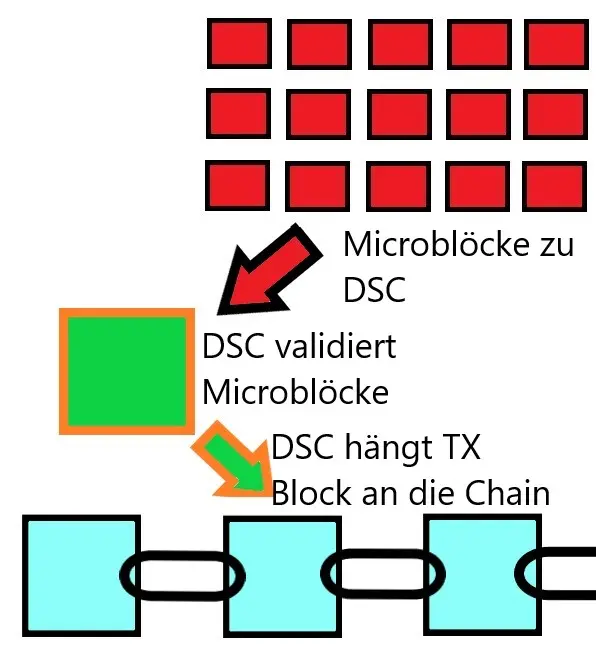
After these three phases, which are processed in the shard, the resulting microblock is sent by the shard leader to the Directory Service Committee. In the DSC, each microblock goes through the same validation procedure again. The DSC therefore executes the PBTF mechanism again for each microblock.
After the validation phases in the DSC are completed, multiple microblocks are packed into a TX block and the TX block chain is appended.
The data of the nodes that have passed through the validation phases are stored by the DSC in a DS block and the public channel block chain is appended and provided with the necessary links to the TX block chain.
Now that we know how the Zilliqa block chain is essentially structured, it is time to take a closer look at the security of the network.
Security measures:
Since every node in the Zilliqa network needs an access authorization and has to solve a POW puzzle in order to obtain this authorization, energy costs arise for every node operator. In this sense, every node operator uses the energy costs to buy into the network to solve the POW puzzle. This makes it relatively expensive for individual node operators if they want to introduce several nodes into the network. Thus the first hurdle for fraudulent nodes was created.
Since the determination of the leaders, whether in the DSC or in the shard, is another POW puzzle to be solved, the costs continue to rise. Also the assembly of the Shards begins with a POW puzzle to the nodes in the " production", ergo again costs.
With these POW puzzles the network is very effectively protected against Sybil attacks. A Sybil attack aims at the performance of a network by trying to flood the network with requests and thereby reduce the speed of the network or even completely paralyze it.
A further hurdle for fraudulent nodes is the fact that the shards are reassembled every time a new DSC leader takes office. This means that the operator of a fraudulent node does not know which shard he is assigned to and certainly not which transactions are validated in this shard.
In addition, the Zilliqa network assumes that fraudulent nodes are involved in the amount of 1/3 of the nodes in a shard. If the network is to be compromised, the fraudulent node operator must control 2/3 of the nodes in the shard. But he does not know in which shard his nodes are assigned.
From this point of view, it seems almost impossible to manipulate the network with fraudulent nodes.
Mathematically, the probability that 1/3 of the nodes in the shard are fraudulent is 1 in 1 million if there are 600 nodes in the shard. This is the reason why there must always be at least 600 nodes in a shard.
In addition, the Zilliqa network has a further security level built in. This level is aimed at fraudulent leaders. It is quite possible that a fraudulent node can become a shard leader, he just has to solve the POW puzzle the fastest. In such a case a 2/3 majority in the shard can remove the leader. Some parameters like the speed with which the leader communicates lead to a deselection. If the leader tries to slow down the transaction speed and thus slow down the network, he will be dropped if there is a 2/3 majority in the shard.
When validating the transactions in the shard, the transaction is validated twice with at least a 2/3 majority. In the DSC, the microblock is also validated with at least a 2/3 majority in 2 phases, i.e. also twice. Thus, at the end, each transaction was validated four times with at least a 2/3 majority.
If a new block is added to the block chain, no more confirmations or checks of the block are necessary. All confirmations and validations take place before attaching the block. A direct attack on the actual block chain is therefore useless.
So much for the security aspects of the Zilliqa network.
Now to the advantages of this architecture:
The first thing that catches the eye is of course scalability. With each additional node in the network, the transaction speed increases linearly.
The developers predict 2500 TX/ sec. which is on the same level as VISA.
Because the POW is only used sporadically and not continuously, as is the case with Bitcoin, for example, the energy requirement at Zilliqa is much lower.
As we have seen, the network is extremely secure and stable.
Finally, two additional layers at Zilliqa:
Without going into detail about the implementation, two more things.
There are smart contracts in the Zilliqa network. These are written with the Scilla programming language.
Meanwhile it is also possible to stake ZIL. In a first phase via a ZIL wallet at KuCoin and Binance. In further consequence staking should also be possible from other ZIL capable wallets.
So, that was it from my side about Zilliqa.
I hope I could give you an overview of the functionality.
Here is the Downloadlink for the Presentation in the Video
If I made a mistake somewhere, please correct me in the comments.
The same applies to any kind of criticism and suggestions.
In this sense
Tschüss Euch
Translated with www.DeepL.com/Translator (free version)






