

Automated Market Makers, or AMMs, are at the core of DeFi, letting users trade tokens freely without traditional order books or intermediaries. Using liquidity pools and straightforward algorithms, AMMs make asset swaps quick and easy, fueling decentralized trading around the clock.
Over time, AMMs have adapted to tackle issues like high slippage and limited liquidity. These changes have made AMMs more efficient and user-friendly, bringing a better experience to both traders and liquidity providers.
This evolution leads us to Dexlyn’s AMM, designed specifically within Supra’s ecosystem. Dexlyn builds on past AMM improvements with its own unique approach, making trading smoother and more rewarding. In this article, we’ll look at how AMMs have changed over time and what Dexlyn’s setup brings to the table for today’s DeFi users.
The Origins of Automated Market Makers
In traditional finance, market makers act as intermediaries between buyers and sellers. They place buy and sell orders, adjusting prices to keep the market flowing smoothly, and profit from the spread (difference) between these prices. However, this system requires centralized entities, which DeFi seeks to avoid.
Early Automated Market Makers (AMMs), like those used in Uniswap, brought a new model to the table. These AMMs rely on algorithms rather than traditional order books to set prices. Users contribute tokens to liquidity pools, and trades are executed automatically based on the pool’s ratio of tokens. This system made permissionless, trustless exchanges possible, opening the door for anyone to trade without needing an intermediary.
Despite their advantages, early AMMs had their share of challenges. Issues like impermanent loss (where liquidity providers lose out due to price fluctuations), low capital efficiency (the need for large pools to support trades), and slippage (when trade prices differ from expected prices) pointed to areas for improvement. These challenges drove the evolution of AMMs, leading to innovative designs aimed at minimizing these problems and making decentralized trading more efficient.
 Types of AMMs and Their Mechanisms
Automated Market Makers (AMMs) have developed several models to meet different trading needs, each with its own approach to liquidity and pricing. Here’s a look at some of the main types of AMMs and how they operate.
Constant Product AMMs
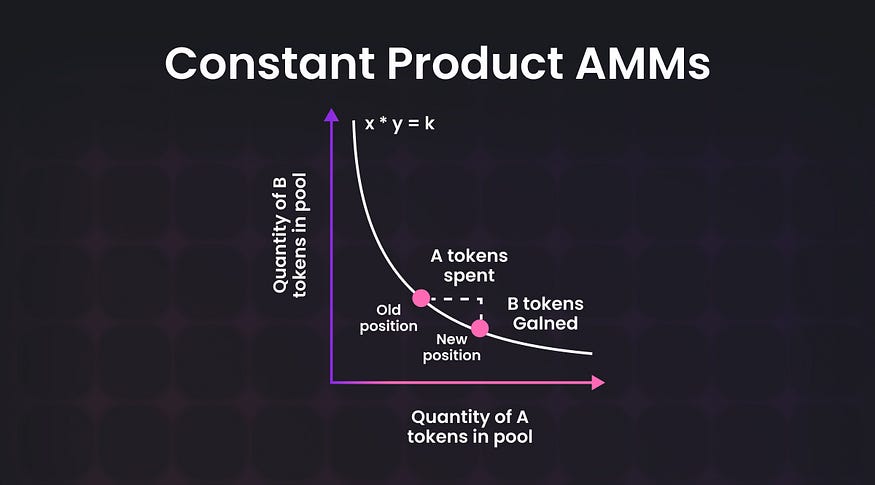
The most common AMM model, known as the constant product formula, uses the equation x∗y=k. Uniswap popularized this model, where x and y represent the quantities of two tokens in a liquidity pool, and k is a constant. This model keeps the product of the two assets’ quantities fixed, enabling trades at any time, as long as there’s liquidity in the pool. By adjusting prices based on supply and demand within the pool, constant product AMMs eliminate the need for an order book, allowing traders to swap tokens automatically.
Constant Sum AMMs
The constant sum model, though less common, aims to reduce slippage in trades, making it attractive for stablecoin pairs that don’t experience high price volatility. In this model, the sum of the two token quantities remains constant. While constant sum AMMs can offer lower slippage, they have a drawback: they can drain the pool’s liquidity quickly, as there’s no mechanism to maintain balances between assets. This limitation makes them less effective for volatile assets.

Hybrid AMMs
Hybrid AMMs, like those used by Curve and Balancer, combine features of different AMM models to address specific limitations. Curve’s AMM, for instance, is designed to minimize slippage for stable assets, while Balancer’s multi-asset pools allow for flexible asset ratios, which improves capital efficiency and reduces impermanent loss. These hybrid models offer more versatility and efficiency, accommodating a broader range of trading needs and reducing risks for liquidity providers.
Earn up to $1000 in bonus when you Click Here and Sign Up for a trading account on MEXC exchange
Innovations in AMMs — The Role of MultiVM and VRF
AMMs have come a long way, and Dexlyn’s setup on Supra’s ecosystem takes these innovations further with MultiVM and VRF technologies.
Cross-Chain Flexibility through MultiVM
Dexlyn’s foundation on Supra opens up more cross-chain potential thanks to MultiVM, which allows different virtual machines to operate together. This setup means that Dexlyn, supported by Supra’s versatile architecture, is well-positioned to accommodate multi-chain compatibility as it continues to grow. This compatibility translates to a smoother experience for traders and liquidity providers, as Dexlyn’s underlying infrastructure is ready to connect across chains and assets more flexibly.
Built-In Fairness with VRF
Supra’s tech stack includes Verifiable Random Function (VRF), which adds a level of randomness that can support fairness in token distribution, pricing, and high-demand scenarios. By building on Supra, Dexlyn taps into this foundation of transparency and fairness, meaning that trading outcomes and liquidity actions are underpinned by an infrastructure designed to prevent bias or manipulation. For Dexlyn’s users, this adds an extra layer of reliability during those intense market moments.
Dexlyn’s AMM — Key Features and Advantages
Dynamic Liquidity Pools
Dexlyn’s AMM lets liquidity providers create customizable pools, giving them more say in how their assets are managed. With options for single-asset and multi-asset pools, providers can decide on specific allocations that align with their risk and return goals. This flexibility means that whether you’re looking to support just one token or diversify across several, Dexlyn makes it easy to participate in a way that suits your strategy.
Reduced Slippage through Balanced Liquidity
Dexlyn minimizes slippage by strategically distributing liquidity across various tokens and compatible chains. This balance helps keep prices steady during trades, even when the market gets busy, allowing traders to execute transactions with less impact on the overall price. With better-managed liquidity, Dexlyn users experience more predictable and smoother trades.
Optimized Trading Fees
Dexlyn is designed to keep trading costs in check. Its competitive fee structure benefits both traders, who save on transaction costs, and liquidity providers, who can maximize their returns. By maintaining reasonable fees, Dexlyn aims to create an efficient ecosystem where traders and liquidity providers alike see greater value in every transaction.
Benefits for Traders
Cross-Chain Swaps
Dexlyn offers the flexibility of cross-chain swaps, giving traders an easy way to move assets between different supported blockchains. Built on Supra’s MultiVM, Dexlyn’s AMM can handle swaps across chains (currently limited to Aptos and Supra, with more chains to be added soon), so users can switch assets without having to jump through extra steps or platforms. This makes portfolio management and multi-chain strategies much simpler.
Real-Time Pricing and Transparency
With Dexlyn, traders have access to real-time prices, ensuring that each trade happens at a fair market rate. Dexlyn’s system updates prices consistently, which means no unexpected jumps or hidden changes. For traders, this means more confidence in each trade, knowing they’re seeing accurate numbers and avoiding surprises.
Efficient Trade Execution
Dexlyn’s integration with Supra’s high-throughput, low-latency network means trades happen fast. With a network designed for speed, traders can execute orders with minimal delay, which is especially valuable in the fast-paced crypto market.
Benefits for Liquidity Providers
Flexible Staking and Rewards
Dexlyn provides flexible options for liquidity providers, allowing you to stake assets and earn rewards based on your contribution to the pools. Whether you’re looking to provide liquidity long-term or just testing the waters, Dexlyn’s setup accommodates different approaches, making it easier to earn passive income from your assets.
Balanced Reward Distribution
Rewards on Dexlyn are distributed with transparency in mind so that everyone gets a fair opportunity to earn. By creating a balanced system that doesn’t overly favor large providers, Dexlyn supports a community-focused environment that’s inclusive for all types of liquidity providers.
Minimized Risk
Impermanent loss is a common concern for liquidity providers, but Dexlyn’s AMM is designed to address this risk through smart pool configurations and efficient trade management. By managing liquidity more strategically, Dexlyn helps reduce fluctuations in asset value, giving providers more confidence in their positions while keeping potential losses in check.
Future of AMMs and Dexlyn’s Role in DeFi
AMMs have come a long way. New developments in liquidity management, smarter pricing algorithms, and efficient cross-chain solutions are all on the horizon. Dexlyn is set to stay at the forefront of these advancements, ready to adopt the best features that can improve the experience for traders and liquidity providers alike.
Dexlyn’s Commitment to DeFi Growth
Dexlyn’s approach is all about building a sustainable, user-centric DeFi ecosystem within the Supra network. By continuously advancing its platform, Dexlyn is committed to offering impactful tools for everyone involved — from traders looking for efficient swaps to liquidity providers seeking steady rewards. With DeFi’s continuous growth, Dexlyn will stay focused on improving user experience, nurturing community, and driving innovation in collaboration with the Supra ecosystem.
Conclusion
Dexlyn’s AMM brings a fresh approach to DeFi by focusing on what matters most to users: flexibility, fair rewards, and a smooth trading experience. With a balanced approach to liquidity that minimizes slippage and a commitment to fair and transparent reward distribution, Dexlyn’s AMM has been built with traders and liquidity providers in mind.
Experience a new way to trade with Dexlyn, explore its AMM features, and discover the benefits of trading and providing liquidity in a DeFi ecosystem designed for efficiency and transparency.
Original Source - https://medium.com/cryptocurrency-scripts/the-evolution-of-amms-what-sets-dexlyns-automated-market-maker-apart-d30be23cd3b2





