A follow-up on the latest discoveries
“You believe because you have seen me. Blessed are those who believe without seeing me.” John 20:29.
The specific commonly accepted Hebrew translation of John 20:29 (based on the original Greek text and its translation into Hebrew): אָמַר לוֹ יֵשׁוּעַ, “כִּי רָאִיתָ אוֹתִי, הֶאֱמַנ. This verse is a cornerstone for the biblical definition of faith found in Hebrews 11:1: “Now faith is the assurance of things hoped for, the conviction of things not seen.”
The Relic
The Shroud of Turin (ST, HST, or TS) is a length of linen cloth measuring approximately 4.4 meters long and 1.1 meters wide, believed by some to have wrapped and imprinted the body of a crucified man. It features two pale, human-like images, one from behind and one from the front, which many believe depict Jesus Christ after his crucifixion. The making of this human image remains a colossal scientific mystery, ever since Secondo Pia photographed the Shroud in 1898.
While its first appearance in historical documents dates back to at least the 14th century (AD 1354), some claim it could be far older, potentially dating back to the time of Jesus. The Shroud has been housed in Turin, Italy, since 1578, within the Royal Chapel of Turin Cathedral.
Now, a wave of recent research, while not definitively proving or disproving its miraculous origins, is breathing new life into the discussion. From sophisticated statistical re-evaluations of the 1988 radiocarbon dating to compelling explorations of the neutron irradiation hypothesis and detailed material analyses, the TS is undergoing a scientific renaissance.
This article presents a non-exhaustive update on these latest discoveries. Research in the field of Sindonology is often highly polarized. When reading new studies, it is natural to consider every author’s background and whether their work addresses counter-arguments from other scientists.
While the TS mystery remains far from solved, these groundbreaking investigations are challenging long-held assumptions and suggesting a far more complex and intriguing history for this iconic relic, resurrecting the debate about its profound connection to the resurrection of Jesus Christ, presumably 1995 years ago.
WAXS Analysis (2022)
Led by Dr. Liberato de Caro, a team of Italian scientists published a study in the journal Heritage claiming the Shroud of Turin (ST or TS) is approximately 2000 years old. They used a technique called Wide-angle X-ray Scattering (WAXS) to examine the structural degradation of linen threads by measuring the sugar molecules comprising flax cellulose in the fabric.
This non destructive technique can be repeated several times on the same sample and is able to carry out a time conversion, involving comparing the rate of cellulose degradation to temperature parameters.
X-ray Scattering measures the scattered intensity of an X-ray beam in collision with matter. It studies the crystal structure, chemical composition and physical properties of materials. X-ray scattering can also measure shape, dispersity, sample size, porosity, morphology and orientation of samples. X-ray diffraction (XRD) and crystallography are more general terms.
Depending on the scattered angle of the X-ray beams, one can perform Wide-Angle X-ray Scattering (WAXS) by focusing on scattering angles 2θ larger than 5°. The 2θ angle is the angle between the incident X-ray beam and the scattered X-ray beam measured by the X-ra ydetector. The 2θ angle is directly related to the interplanar spacing (d-spacing) in crystalline materials through Bragg’s law (nλ = 2d sinθ) where:
- λ is the wavelength of the X-rays.
- n is the order of reflection. It is a positive integer (n = 1, 2, 3, …) that accounts for the path length difference between X-rays scattered from different crystal planes. When the path length difference is exactly one wavelength (λ), it’s the first-order reflection (n=1). When the path length difference is exactly two wavelengths (2λ), it’s the second-order reflection (n=2) and so on for n=3, etc.
- d is the spacing between atomic planes (the “d-spacing”).
- θ is the Bragg angle (half of the 2θ angle reported in plots).
In Wide-Angle X-ray Scattering (WAXS), 2θ is typically larger than 5° whereas in Small-Angle X-ray Scattering (SAXS), 2θ is much smaller, around 0.5°. The important point is that the angle measurement range is related to material structure. Larger 2θ angles correspond to smaller atomic-scale structures (Å range) and smaller 2θ angles relate to larger nanoscale structures (nm range). For this reason, WAXS is particularly effective for studying crystalline structures at the atomic scale and also analyse materials that exhibit a certain degree of short-range order.
Press enter or click to view image in full size 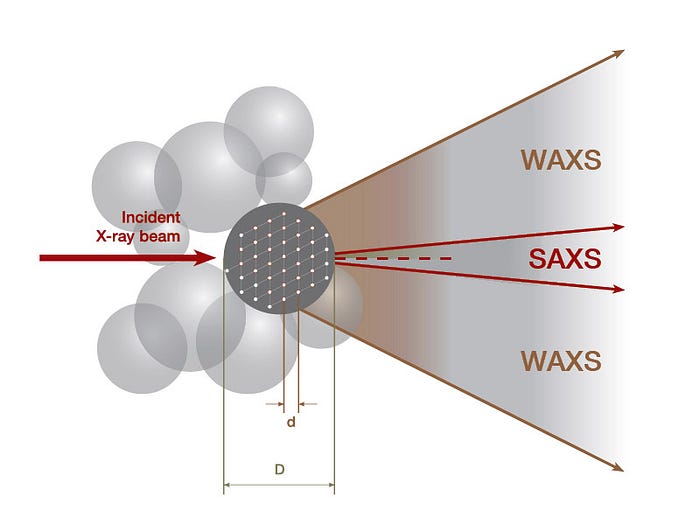 Comparaison of WAXS and SAXS. In WAXS, smaller structures are studied. Image by wiki.anton-paar.com.
WAXS is commonly used to study the crystalline and semi-crystalline structure of polymers, for analysing the atomic structure of nanomaterials, for providing information on the structure of the different phases in composite materials and the technique is equally applicable to the study of surface structures and thin films.
From the researcher team conclusion: “The experimental results are compatible with the hypothesis that the TS is a 2000-year-old relic, as supposed by Christian tradition, under the condition that it was kept at suitable levels of average secular temperature — 20.0–22.5C — and correlated relative humidity — 75–55% — for 13 centuries of unknown history, in addition to the seven centuries of known history in Europe.”
The X-ray results were reportedly “fully compatible” with measurements from a linen sample from Masada, Israel, dated between A.D. 55 and A.D. 74. The new findings contest the 1988 radiocarbon dating that suggested a medieval origin (1260–1390 CE). Researchers like Ray Rogers argue that contamination compromised the 1988 carbon tests and also raised strong concerns about the radiocarbon dating methodology.
“The degree of natural aging of the cellulose that constitutes the linen of the investigated sample, obtained by X-ray analysis, showed that the TS fabric is much older than the seven centuries proposed by the 1988 radiocarbon dating” according to the Italian scientific research team.
Other excerpts from the study:
“Our work showed that when the ancient fabrics are preserved by environmental contamination — i.e., when they were kept in the tombs where they were found — X-ray and 14C dating agree well.”
“To make the present result compatible with that of the 1988 radiocarbon test, the TS should have been conserved during its hypothetical seven centuries of life at a secular room temperature very close to the maximum values registered on the earth.”
“Finally, since X-ray dating indicates that the TS is older than its seven centuries of European history, we can also argue that it was fortunate that the TS was carried to Europe seven centuries ago” said the researchers.
“Indeed, our analysis has shown that, from the XIV century until today, the natural aging of the cellulose of the TS linen has been very low, due to the low secular European average room temperatures, thereby preventing the TS body image from fully disappearing, which would have happened at an average secular room temperature of 22.5C.”
Moreover, if the TS was two millennia old, the researchers stated that a natural aging of 90 % would have happened with an average temperature of 22.5C and humidity of 55 %.
“This value is much higher than the 60% that was experimentally determined for the TS sample. Therefore, by chance, only the recent history of the TS in Europe has prevented the TS linen from fully yellowing and the TS image from fully disappearing, thus preserving a puzzle that is very difficult for science to solve” the research team continues.
In spite of this new breakthrough further pointing to a TS relic age compatible with Jesus’ living time, the authors of the WAXS study emphasize that more systematic X-ray investigations of additional samples from the TS are necessary to validate their conclusions.
“Since the 14C dating does not agree with our results, or with the dating obtained by other works, a more accurate and systematic X-ray investigation of more samples taken from the TS fabric would be mandatory to confirm the conclusions of our study.”
The WAXS study team considers the 14C dating as somehow scientifically relevant although there is tremendous evidence that the sample investigated in 1988 is from a repaired area. Officially the 14C study date results (AD 1260–1390) matched the period in which the TS historically surfaced in France in the 1350s.
There is another crucial limitation in dating the TS using traditional radiocarbon methods. Since the image creation mechanism is still unknown, any accurate dating effort requires knowledge of the object’s conservation environment, particularly regarding a potential contamination. The carbon dating problem is that the image production mechanism may very well have altered the carbon isotope ratios in the TS that would cause significant systematic errors in dating results.
Presently there are more academic papers published in reputable scientific journals that dispute the 14C results than those that continue to support them. A quick bibliometric scan (searching Scopus, Web of Science or Google Scholar for “Shroud of Turin radiocarbon dating” between 2019‑2025) yields roughly:
- ~ 35 peer‑reviewed articles that explicitly challenge the 14C dates (often citing sampling bias, statistical re‑analysis or new non‑destructive dating attempts).
- ~ 20 peer‑reviewed articles that defend the original dates (mostly focusing on technical validation of the AMS procedure).
For the curious, Shroud Expert Joe Marino did a comprehensive work about the 14C dating and the suspicious and unscientific activities surrounded it.
Returning to the WAXS study, the Italian research team will need to analyse other ancient linens to further validate its present conclusion. It is still true that their conclusion relies on two big assumptions:
- The Shroud was kept under specific temperature and humidity conditions:
- Average temperature around 20.0–22.5C (71.6°F)
- Relative humidity of about 75–55%
- The temperature and humidity conditions would need to have been maintained for 13 centuries before its documented history
2. Their 2000 year old analogous sample is 2000 years old and analogous.
The WAXS study has successfully moved the needle from “the case is closed” to “the case is being re-examined with new evidence. It did introduced a legitimate and scientific reason to question the 14C radiocarbon date. However, it has not provided the ultimate proof of a 1st-century origin. Thus the burden of proof remains on the Italian research team to overcome the significant caveats they themselves have identified with their method.
Update: In April 2025, scientists from the Institute of Crystallography of the National Research Council (CNR) in Italy published new results. Using the same X-ray technique (WAXS) on a sample described as a “thread hidden inside the fibers,” they again concluded the cloth has a “two-thousand-year history,” dating it to around 65 AD.
Update: A comprehensive 2025 review of scientific studies in the journal Heritage concluded that while the evidence challenging the 1988 radiocarbon dating is significant, it is currently “insufficient to overturn its finding”. This review strongly endorsed the need for new samples from different parts of the TS for a second series of radiocarbon dating.
Chemical Blood Analysis (2024)
A July 2024 study by researcher Giulio Fanti (from the university of Padua) revealed the presence of earthy matter mixed with blood particles on the TS. Their paper highlighted various news of both a macroscopic and microscopic nature and their findings indicate severe physical trauma consistent with crucifixion. On the field of macroscopic observations, multiple results have been highlighted.
Firstly, the side‑wound bloodstains visible on the front image show three distinct flow directions:
1- “a vertical one with the human body in the upright position,”
2- “a second one inclined of at about 45° from the vertical,”
3- “a third one considering the corpse lying down and resting on its side”
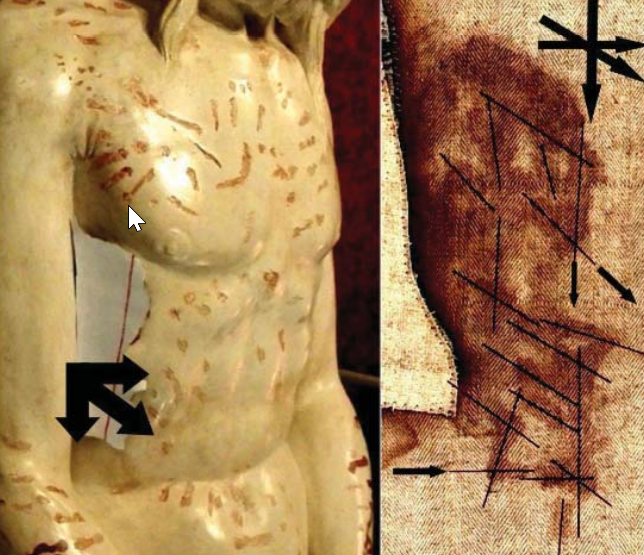 Multi-directional bloodstream paths detected on the side wound. Source: https://www.clinsurggroup.us/journals/archives-of-hematology-case-reports-and-reviews
The researchers noted that the vertical, angled and horizontal blood flow patterns match movements described during the deposition from the cross after Jesus Christ’s crucifixion.
Secondly, different kinds of hematic fluid corresponding to different periods of trauma and post-mortem events are distinguished from the bloodstains on the left arm.
Press enter or click to view image in full size 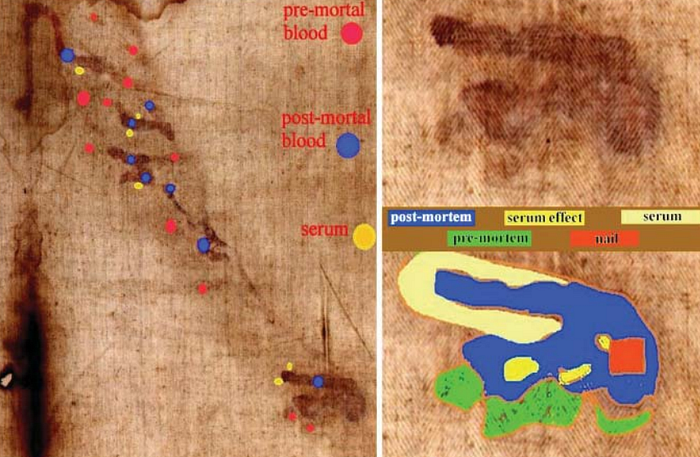 “On the left, is a proposed classification of bloodstain types on the left arm of the body image; on the right, is a detailed characterization of different bloodstains on the hand-wrist area.” Source: https://www.clinsurggroup.us/journals/archives-of-hematology-case-reports-and-reviews
1 - Pre-mortal blood (the red spots on the left picture) originated while the victim was still nailed to the cross with blood crusts assumedly dissolving due to fibrinolysis (enzyme-driven clot breakdown) in the tomb’s humid environment.
2 - Blood serum leaks (the yellow spots) produced by capillary action separating the serous component from red blood cells post-mortem (visible under UV light). These serum traces are also observed on the right foot as well as in other areas and further support the narrative of bodily repositioning after death.
3 - Post-mortal blood (the blue spots) are caused by body movement during transport or in the tomb, transferring blood in a liquid phase to the TS. These stains align with the biblical account of Jesus’ body being moved after crucifixion.
Thirdly, the study also pointed out the probable presence of a semi-transparent fluid (purportedly of pulmonary origin) leaking from the wound side.
The microscopic examination of the blood stains on the Shroud identified three types of blood reflecting different states of the same body: before death, during torture, and after death. The three types of blood investigated in their paper are classified as Type A, B and C. The research team also studied the direction of the blood flow and its distribution in the linen.
The different bloodstains are depicted as follow:
1 — More than 100 bloodstains on the body image are consistent with pre-crucifixion flagellation;
2- Bloodstained marks on the head are consistent with a “crown” of thorns;
3- Blood marks on the hands and feet are consistent with crucifixion;
4- A significant bloodstain situated between the fifth and sixth ribs on the right side of the chest that corresponds with the post-mortem spear wound described in the Bible. This wound likely pierced the pericardial sac, explaining the presence of both blood and clear fluid. This bloodstain shows evidence of a post-mortem haemorrhage with blood mass separated from plasma. This indicates that the wound occurred after death and is consistent with the Biblical account of “blood and water” emerging from Jesus’ side.
Here is a non-exhaustive list of biological nanoparticles, molecules and additional non biological particles that were discovered on the blood stains with some associated with extreme stress:
1- Microcytic anemia (Deficiency of healthy red blood cells or hemoglobin, which compromises oxygen delivery throughout the body due to smaller than normal red blood cells);
2 - High level of Urea (CO(NH₂)²) might imply renal malfunction or blockage which is a condition compatible with the intense flagellation found on the TS;
3 - Creatinine (a waste product that comes from the break down of muscles; elevated serum creatinine levels indicate impaired kidney function, as the kidneys are not effectively clearing this waste product; associated to physical stress);
4 - High levels of Ferritin (a universal protein that regulates iron levels, high levels are found in patients who have suffered severe trauma like torture; Ferritin is specifically found in human blood as a nanoparticle and is typically ranging from 10–12 nm in diameter);
5 - Fibrin (a fibrous, non-globular protein involved in the clotting of blood);
6 - Stacking of erythrocytes;
7 - Beta-activity and fluorescence in the blood samples.
8 - No traces of lactate or lactic acid (C₃H₅O₃⁻) were reported by the study. Lactate is a by-product of anaerobic metabolism which can indicate physical stress or exertion.
9- “Various sub-micrometric particles typical of a calcareous-clayey soil similar to that of Jerusalem.”
The study of G. Fanti claims that the source of the red image in the TS cannot derived from the very small-sized red pigments (like red ochre and vermillion) initially referred to as “Sub-Micron Particles” (SMP) and identified as such by Walter Cox McCrone.
Firstly, there is an insufficiency of these red pigments to produce a visible image on the TS. Furthermore, the presence of SMP is more likely due to painted copies being pressed against the relic. These painted copies would have transferred pigments to the TS. In art conservation, the transfer of materials (e.g., pigments, varnish, dust, particulate matter, moisture, framing materials..) between artworks or from their surroundings is indeed a common phenomenon.
A quantitative analysis of the composition of a bloodstain on a single coloured fibre indicated that the volume percentage of blood is greater than 90% while the volume percentage of SMP is less than 10%. Thus the majority of the red color in the stain originates from the blood itself and the SMP contribution to the overall coloration of the stain is minimal.
The red color of human bloodstains is first and foremost due to the presence of hemoglobin (the protein in red blood cells responsible for oxygen transport) and specifically to the iron-containing heme groups within hemoglobin. The heme group is a complex of a porphyrin ring coordinated with an iron ion (Fe²⁺) at its center and the porphyrin ring is a large and organic molecule that binds the iron ion.
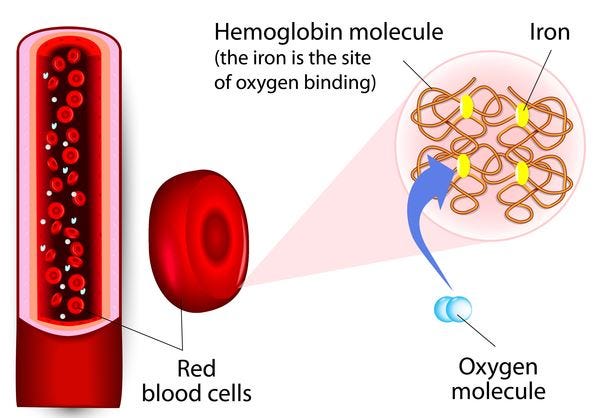 https://www.civilsdaily.com/news/haemoglobin-isnt-used-only-in-blood-scientists/ Press enter or click to view image in full size
 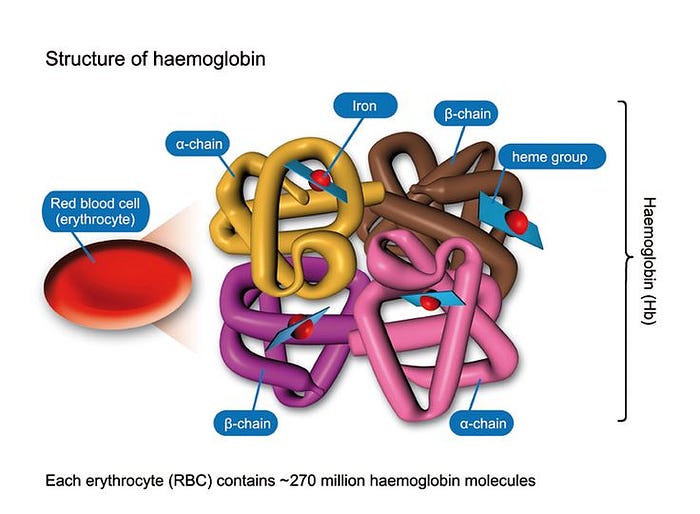 https://www.pinterest.com/pin/709105903863924926/ Press enter or click to view image in full size
 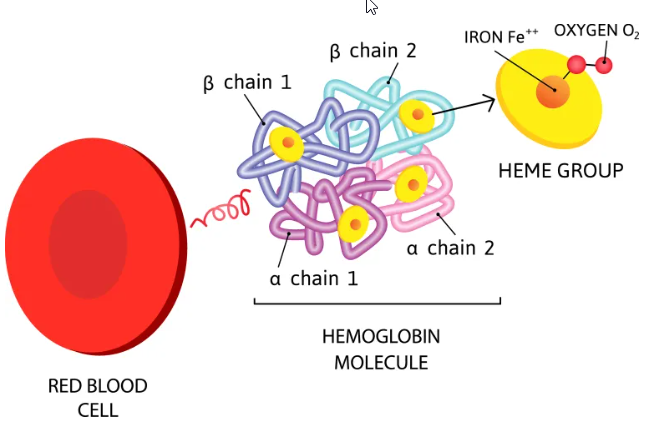 Hemoglobin and heme group. Source: https://smithhopen.com/2020/05/07/respiratory-distress-from-covid-19-hemoglobin-attack/
The porphyrin ring’s structure is the primary source of the red hue (it absorbs and reflects light) while the iron’s oxidation state (Fe²⁺ in functional hemoglobin) influences the shade (bright red when oxygenated and darker when deoxygenated). However, the researchers claim that the source of the red color of bloodstains in the TS is primarily due to the porphyrins (and not iron).
The paper also discussed the multi-secular reddish colour of the bloodstains on the relic. As such, new hypothesis were formulated to explain the enigma of the still red bloodstains:
1 - “ carbon oxide produced by the breakdown of erythrocytes (due to the torture) would have bound to hemoglobin to produce carboxyhemoglobin so as to sustain the blood’s reddish color.”
2 - “a high bilirubin content (due to torture) which, with the additional exposure of that blood to a sufficient dose of UV rays, has sustained the reddish color.”
The study eventually puts forward the hypothesis that neutron radiation altered the isotopic composition of the nitrogen and carbon atoms in the TS “reporting that, unlike common human blood which contains nitrogen (percentages by weight of the order of 10%), the blood nitrogen level of the HST is lower than the background noise of the instrument (about 1%).”
In human blood, nitrogen is present mainly in organic compounds (e.g., hemoglobin or urea). In the other hand, neutrons are electrically neutral particles and they interact with matter through collisions with atomic nuclei rather than with electrons.
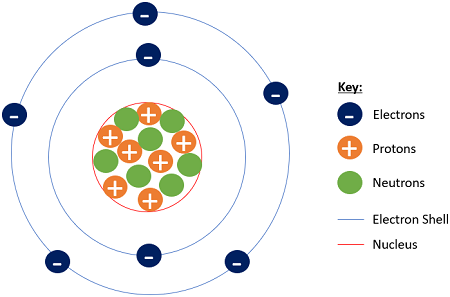 Different subatomic particles that make up the nitrogen atom. Source: https://homework.study.com/cimages/multimages/16/itrogen_aton886027429727796241.png
When neutrons interact with the nuclei of atoms in blood (like nitrogen, oxygen, or carbon), they can cause nuclear reactions, such as neutron capture, where a nucleus absorbs a neutron and becomes a different isotope. For instance, nitrogen-14 (¹⁴N), which is abundant in biological systems (e.g., in proteins like hemoglobin, amino acids or DNA), can capture a neutron and transform into a stable isotope of nitrogen-15 (¹⁵N).
In rare cases, with high-energy neutrons, it could undergo a reaction like ¹⁴N(n,p)¹⁴C, producing carbon-14 and a proton. However, these reactions typically require significant neutron flux, far beyond natural exposure levels, such as those seen in nuclear reactor settings or radiation therapy scenarios.
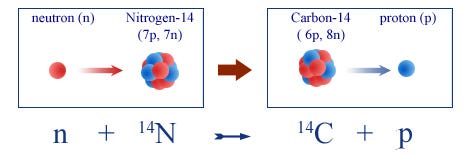 Formation of carbon-14 from atmospheric nitrogen. This reaction indicates that nitrogen-14 can interact with a neutron (n) to produce carbon-14 (C) and a proton (p). Source: http://radioactivity.eu.com/articles/laboratory/radiocarbon_dating
Not only did the study found confirmation that an extreme neutron irradiation (similar to Flash photolysis) led to the image formation but also hinted that this phenomenal neutron flux “might have also influenced the color of the blood” on the Shroud.
“It is curious to observe that the description made by some mystics such as A. K. Emmerick and M. Valtorta of the luminous wounds of the Glorious Body of Jesus could be, in some way, confirmed by the atypical characteristics of this Type A blood.”
The study also point out that the crucified man could have suffered a heart attack due to his extreme difficulty to breathe, leading to his death.
These findings suggest that the person wrapped in the ST had undergone intense torture before dying exactly as in the account of Jesus’ crucifixion in the Gospels.
Addendum: A 2023 Proteomic comparison between the TS samples and known medieval relics (e.g., the Reliquary of Saint George) showed similar protein degradation patterns, suggesting the TS organic residues have undergone comparable aging processes.
On the Origin of Flax (2024)
Flax is a textile plant used in the manufacture of clothing. Flax is precisely the plant fiber from which the linen is woven.
A 2024 isotopic study by American archaeologist William Meacham, a member of the Shroud of Turin Education and Research Association (STERA), revealed that the linen used to make the TS originated in the Middle East, more specifically in the Western Levant.
Meacham analysed five threads from the TS, originally part of a sample taken by Professor Gilbert Raes (a Belgian textile expert) in 1973, using stable isotope testing at the University of Hong Kong’s Stable Isotopes Laboratory (SHKU).
In particular, stable isotope analysis is a scientific technique used to determine the geographic origin of materials by measuring the ratios of different stable isotopes of elements (like carbon, oxygen, strontium or lead) within a sample.
Stable isotope analysis works because plants absorb water and nutrients from their local environment. This absorption locks a unique geochemical fingerprint from the soil and atmosphere into the plants tissues. As a result, a distinctive isotopic signature persists in materials like flax fibers even after harvesting and weaving.
Eventually, scientists can use a mass spectrometer to measure these isotopic ratios and compare them to geographical databases to pinpoint the region where the plant was cultivated.
Meacham’s results suggest the flax was grown in the western Levant, a region spanning modern-day Israel, Lebanon, western Jordan, and Syria. This finding aligns with samples from ancient Israel and contrasts with European flax, pointing to a Middle Eastern origin rather than a medieval European one.
This study confirms the provenance of the TS but it cannot determine the date of its weaving or the origin of the image. Yet Meacham argues this challenges the medieval European forgery narrative, as it ties the TS to a region consistent with the historical setting of Jesus’s life.
While not definitive proof, Meacham findings make the medieval forgery theory more difficult. It would require a forger in 14th-century France to have sourced a piece of high-quality, centuries-old linen from the Holy Land specifically to create a forgery, which, while not impossible, is a more far-fetched scenario.
On the Image Formation (Ongoing)
The most prevalent theory to explain the superficiality, high resolution and the presence of both the front and back imprints of the shroud body relies on an intense burst of light; specifically vacuum ultraviolet (VUV) radiation. That would be the most likely reason for the image creation without any signs of scorching or pigment application and to explain the mentioned unique features of the image.
Vacuum ultraviolet radiation (VUV) is a highly energetic form of UV light of 10–200 nm spectral range. It has strong interaction with matter and requirement for vacuum conditions due to its absorption by air. VUV photons have high energy, sufficient to break chemical bonds and induce photochemical reactions in many substances.
Among its applications, VUV is use in photolithography for semiconductor manufacturing and in scientific research; particularly for spectroscopy and the investigation of atomic and molecular excitation.
Press enter or click to view image in full size 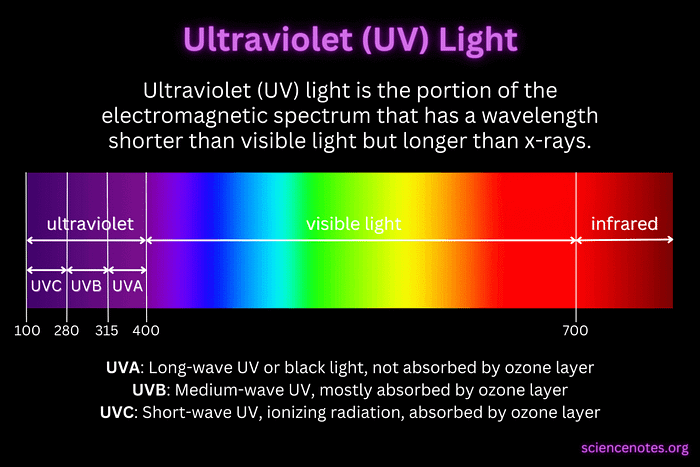 Source: https://sciencenotes.org/ultraviolet-light-or-uv-radiation/
The VUV radiation hypothesis for the ST formation suggests that:
0- The full body image imprint would have occurred without heat (that would have scorched the cloth) or pigment evidence. Lasers are useful tools for exploring the kinds of light parameters (wavelength, intensity, duration) that might have been involved here. However, laser experimental reproductions resulted in ablation or destruction of the cloth rather than the subtle coloration seen in the TS (high difficulty in replicating the effect).
1- It occurred simultaneously in all directions, creating front and back images.
2- The burst of radiation would have been extremely brief and intense. Researchers showed that VUV laser irradiation can reproduce some of the TS characteristics, such as the superficiality of the image and the colour gradient. However, they emphasize that the required energy is so high that it cannot be reproduced by any known technology or natural process today.
3- Superficial image (no deep penetration; affecting only the outermost fibers of the linen). It requires extreme energy and this is not reproducible at scale. Laboratory experiments using VUV lasers reproduced superficial discoloration on linen with characteristics similar to the Shroud’s image but the energy required is immense and far beyond what is naturally possible or technologically feasible in antiquity or in the middle age.
4- Front and back full-body image (the mechanism for simultaneous emission has not been proven). However, VUV radiation is strongly absorbed by air thus it would only affect areas where the linen was in direct contact with a body (which is a major limitation to explain distant regions).
5- 3D information in the image (not fully replicated in laboratory)
The VUV experiments help clarify the physical requirements for image formation but to this day, there are no known physical process or biological phenomenon that can explain how a human body could emit a burst of VUV radiation intense enough to create this image. The conclusion here is a partial physical model for how the TS image could be superficially imprinted on the linen.
Other theories on the TS formation:
1- The “corona discharge” hypothesis: The human body would have been floating and suspended on an intense electric field (a type of plasma) at the moment of image formation. Giulio Fanti and colleagues proposed this theory to back up the superficial coloration on the cloth. Yet Fanti admits it cannot be fully reproduced due to the enormous energy required.
2- General non-VUV radiation: X-rays, protons or even a generic burst of energy could have caused the image by affecting the linen’s surface chemistry. These theories face the same challenge as the VUV hypothesis; there is no known natural mechanism for such an occurrence.
3- X-ray-like Features: Some researchers have noted that the image displays details beneath the surface such as bones (e.g., teeth, finger bones), resembling an X-ray effect. No photographic or artistic process can account for this phenomenon. https://www.magiscenter.com/blog/shroud-turin-radiation-image
4- The kidney failure & urea sweat theory: This theory proposes that the man of the TS, having suffered acute renal failure as a result of the traumatic crush syndrome induced by scourging and crucifixion, produced urea-rich perspiration. Proponents suggest that this uremic sweat coated the linen fibers and, over time, underwent a chemical reaction such as the Maillard reaction with the cloth’s carbohydrates, causing the coating to darken and create the faint, stable image we see today.
Addendum: Researchers who support the TS authenticity continue to publish critiques. A 2025 critical analysis argues that many recent studies are incomplete or biased, often ignoring evidence like the complexity of bloodstains or the potential for neutron irradiation affecting radiocarbon dating.
More: https://0201.nccdn.net/1_2/000/000/153/e0f/evaluation-of-image-formation-hypotheses.pdf and https://www.shroudresearch.net/hproxy.php/research.html
Radiocarbon‑dating re‑evaluation (Ongoing)
In 2020, a joint Italian‑British panel revisited the 1988 radiocarbon dating which had placed the cloth between AD 1260 and 1390. By applying accelerator mass spectrometry (AMS) to newly extracted micro‑samples taken from the untouched edge of the TS, they calculated a median calibrated age of 1325 ± 30 BP, roughly AD 660 to 770.
The researchers noted that sample heterogeneity, such as possible medieval repairs or later additions, could still bias the results and they urged the development of non‑destructive dating methods, like laser‑induced breakdown spectroscopy, before any further invasive sampling.
“BP” stands for “Before Present,” where “Present” is standardized as 1 January 1950. While a radiocarbon age is calculated as 1950 — BP, this result cannot be directly used as a calendar date. This initial value must be calibrated against a curve that corrects for historical fluctuations in atmospheric carbon-14 levels.
The study reported a radiocarbon measurement of 1325 ± 30 BP.
- Radiocarbon age (via subtraction): 1950–1325 = 625 AD. This is an uncalibrated measurement.
- Correct calibrated age range: When processed through the standard IntCal20 calibration curve, this measurement corresponds to a calendar date range of approximately 646 AD — 679 AD.
Therefore, this AMS measurement points to an origin in the mid-to-late 7th century. This result, being centuries older than the 1988 medieval date but also centuries younger than the 1st century, highlights the critical issue of potential sample contamination or repair, underscoring why researchers call for more advanced and non-destructive dating methods.
Indeed, the original 1988 radiocarbon dates (1260‑1390 AD) placed the cloth firmly in the late medieval period while the re‑evaluation pushes the date back by roughly 600 years into the early medieval & late antiquity era. Because the two ranges do not overlap, the result underscores the panel’s caution: sample heterogeneity (e.g., different threads, repairs, later contaminations) could be influencing the measurements. That is why they stress the need for non‑destructive dating methods (e.g., laser‑induced breakdown spectroscopy) before drawing firm chronological conclusions.
Below are most recent peer‑reviewed works that revisit the TS radiocarbon dating (i.e., after the 2020 Entropy review):
An August 2020 study employed modern Bayesian-hierarchical modeling to reassess the original 1988 radiocarbon dating data along with three control samples. It reveals that the posterior distribution for the TS age remains broad, estimating it between approximately AD 1150 and 1400 CE, while indicating that inter-laboratory variance is considerably larger than that of the control samples.
This finding underscores the notion that the original sample set was not statistically homogeneous. It affirms that the 1988 results fail to meet current precision standards. This conclusion echoes the findings of the 2020 Entropy paper but approaches the issue through a different statistical methodology.
Later, McAvoy’s 2021 study revisited the 2020 Nature commentary that proposed neutron irradiation as a factor that could artificially lower the TS ¹⁴C age. By modeling a plausible neutron fluence of roughly 1⁰⁸ neutrons cm⁻², the paper demonstrates that such exposure could shift a genuinely medieval cloth (circa AD 30) into the 13th‑century radiocarbon range reported in 1988, while simultaneously generating detectable ³⁶Cl residues.
Neutron fluence is a measure of the total number of neutrons passing through a unit area. A fluence of approximately 1 × 1⁰⁸ neutrons cm⁻² indicates a substantial exposure to neutron radiation. In the context of radiocarbon dating and the TS, such neutron exposure could potentially alter the isotopic composition of materials, affecting measurements. Specifically, this level of neutron fluence could induce nuclear reactions that may lead to the formation of ³⁶Cl from the interaction of neutrons with stable chlorine isotopes present in the TS fibers.
This quantitative link offers a concrete physical mechanism for the “anomalously young” result and suggests a practical, non‑destructive follow‑up: targeted ³⁶Cl measurements on the TS fibers to test whether neutron‑induced enrichment occurred.
Latest Counterpoint on the Shroud Authenticity (2025)
Recent studies have challenged the idea of the TS being an authentic burial cloth. A study in Archaeometry used 3D modeling to conclude the image is more consistent with a low-relief statue than a human body.
Researcher Cicero Moraes found that draping cloth over a 3D human body created a widened, distorted image due to the “Agamemnon Mask effect,” unlike the Shroud. The image on the Shroud matched the result from a low-relief model, suggesting it was an artistic representation consistent with medieval artistry.
While this research suggests the image could be from a sculpture, it does not explain how such an image was physically transferred onto the linen, and it faces significant counterpoints from prior TS researches.
A major finding from the 1978 STURP (Shroud of Turin Research Project) investigation was that the image intensity on the TS is inversely related to the cloth-to-body distance. This depth-encoding quality is what makes the TS image appear as a perfect 3D model when analyzed with specialized software. A critique of Moraes’ study argues that a simple contact imprint from a low-relief statue is a “geometric impossibility” that cannot reproduce this sophisticated, distance-based information field.
The 2025 study focuses solely on the body image. However, independent forensic analyses of the bloodstains on the Shroud have concluded they are “totally unrealistic” for a cloth that wrapped a bleeding, crucified body. “catastrophic methodological flaws” were noted in attempts to reproduce the stains with synthetic blood and live volunteers. Any comprehensive theory must explain both the body image and the bloodstains, which the 3D modeling study does not even attempt.
A central argument from the scientific critique is that both the 3D modeling study and certain bloodstain analyses employ a reductionist approach. They attempt to explain individual features of the TS in isolation, but fail to account for the interconnected complexity of all its unique properties ; the 3D encoding, the chemical nature of the image, the blood’s characteristics and more, within a single, coherent hypothesis.
In a similar vein of challenging the TS authenticity, another research in the Journal of Medieval History uncovered the oldest known written claim (c. 1370) that the TS was a fake.
Historian Nicolas Sarzeaud analyzed a treatise by Nicole Oresme, a prominent 14th-century intellectual. Oresme singled out the Shroud from a church in Lirey, France, calling it a “clear” and “patent” fake. This discovery confirms that the Shroud’s authenticity was contested by high-level critical thinkers within decades of its first appearance.
As a leading intellectual and royal advisor, Oresme was well-positioned to know about a major religious controversy like the Shroud of Lirey. His statement confirms that the relic’s authenticity was contested by another knowledgeable figure shortly after it appeared. The 1389 letter from Bishop d’Arcis also mentioned an earlier investigation by his predecessor, Henri de Poitiers, around 1355, which had concluded the TS was a fraud.
Oresme’s text provides powerful historical context that corroborates other evidence. It aligns with the 1988 radiocarbon dating that placed the cloth in the 13th or 14th century and with the 2025 3D analysis suggesting the image came from a statue, not a human body.
However it is helpful to see Oresme’s dismissal not as a verdict based on physical proof but as a noteworthy historical testimony about the TS early reputation. According to recent historical analyses, Oresme’s conclusion was indeed not based on a forensic examination of the cloth itself, but on a form of circumstantial and pattern-based reasoning that was deemed sophisticated for his time.
Scientific and Church Stances (Today)
For decades, the Vatican has consistently encouraged veneration of the Shroud as a powerful object for contemplation without officially pronouncing on its authenticity. The Vatican’s official policy will likely remain “faith‑compatible openness”.
The Church will continue to protect the relic, fund non‑destructive research and for now, refrain from a definitive pronouncement. So far, there has been no public statements or pronouncements from the new Pope Leo XIV.
The Vatican acknowledges the 1990 Nature & Science published radiocarbon dates (AD 1260‑1390) as the best‑available measurement at the time, but it does not treat them as definitive. Official statements note that “the data are subject to the limits of the sampling method.”
For the 2025 Holy Year, the Archdiocese of Turin launched a digital exhibition of the Shroud. Cardinal Roberto Repole, the Papal Custodian of the Shroud, stated that the cloth is an “imprint of the Resurrection” and an “invitation to live a new life” . This indicates the Church’s ongoing efforts to promote its spiritual significance.
The leading scientific interpretation maintains that the TS is a medieval artifact. This conclusion is primarily drawn from the 1260–1390 AD date established by three independent radiocarbon dating laboratories during the 1988 study.
However, this conclusion is actively contested by a segment of researchers who argue that the sampled area may have been a later repair or was chemically contaminated, pointing to statistical re-analyses of the original data that highlight sample heterogeneity and to material science studies using alternative methods like spectroscopy and mechanical testing that sometimes suggest a much older age.
Furthermore, a definitive explanation for the image’s unique chemical characteristics, a superficial, non-directional, high-resolution coloration of the linen’s outermost fibers that encodes 3D information, remains elusive, with no proposed mechanism (including UV radiation, chemical or contact methods) successfully replicating all of its properties under scientifically controlled conditions, thus sustaining the debate and calls for new and non-destructive testing.
What is next for the Shroud?
The totality of the scientific evidence, when considered holistically, supports the claim that the TS is far older than the 1988 radiocarbon dating suggests and may indeed be the burial cloth of Jesus Christ. Also the complexities and limitations of individual study requires a more nuanced and interdisciplinary approach to the investigation.
There is a recognized need for a new radiocarbon dating effort that addresses the criticisms of the 1988 test. This would involve taking multiple, well-documented micro-samples from different parts of the shroud, not just the edges, and having them analyzed by multiple independent laboratories using the latest methods.
Any credible new TS dating and making claim must be built on robust sampling that documents precisely where each micro‑sample was taken, why that spot is deemed “untouched” and includes replication across multiple independent fibers to guard against heterogeneity.
It must provide methodological transparency with a full description of the protocol followed, calibration curves, error propagation and any contamination corrections so that others can repeat the analysis.
Then it should employ rigorous statistical treatment, such as hierarchical or Bayesian models, that explicitly model inter‑sample variance and compare results to control samples.
The findings need independent verification by at least one other accredited laboratory, ideally using a different detection principle (e.g., gas‑counter versus accelerator).
Non‑destructive corroboration through techniques like laser‑induced breakdown spectroscopy (LIBS) or ³⁶Cl gamma‑spectroscopy should be performed on the same fibers to ensure the sampling itself has not introduced bias.
Furthermore the work must be peer‑reviewed in a reputable archaeology, geochronology or physics journal with reviewers familiar with radiocarbon dating and the TS preservation history.
Finally, the proposed age must be contextually consistent, aligning with known early‑medieval textile production methods, dye analyses and the documented 14th‑century appearance of the TS, thereby integrating the new scientific evidence with the broader historical record.
The ultimate goal is to create a unified investigation that reconciles the TS physical and chemical properties, proposed age and historical record. As one 2025 analysis concludes, any viable theory must simultaneously satisfy over 30 specific physical and chemical requirements, a challenge no single mechanism has yet met.
TL;DR: The Resurrection of the Shroud
The scientific debate over the Shroud of Turin is more active than ever, with recent research challenging the 1988 carbon-dating that labeled it a medieval forgery and deepening the mystery of how its image was formed.
- The Case for a Much Older Shroud: A 2022/2025 study using Wide-Angle X-ray Scattering (WAXS) on linen fibers suggests an age of ~2,000 years, directly contesting the 1988 radiocarbon date of 1260–1390 AD. Researchers argue this method is less susceptible to contamination.
- Middle Eastern Origin: A 2024 isotopic analysis of the flax threads indicates the linen was grown in the Middle East (the Western Levant), not medieval Europe, making a European forgery less straightforward.
- Complex Blood Evidence: A 2024 chemical study claims the bloodstains show forensically accurate details of torture and crucifixion, including different types of blood flow (pre-mortem, post-mortem) and particles consistent with severe physical trauma. Researchers argue the blood’s unusual, persistent red color and low nitrogen content could be explained by an extreme, unexplained event like neutron radiation.
- The Image Formation: No theory can fully explain how the faint, superficial, high-resolution and 3D-information-encoded image was created. The leading scientific hypothesis involves a brief, intense burst of Vacuum Ultraviolet (VUV) radiation, but this requires energy levels far beyond any known natural or human-made technology.
The mystery is far from solved, but it is being vigorously re-investigated, leaving the question of its connection to the resurrection of Jesus Christ as compelling as ever. While the 1988 carbon date remains a strong argument for a medieval origin, a growing body of research from material science, chemistry and history provides significant evidence that the TS is older and more enigmatic than previously thought.
The scientific consensus is thus deeply fractured but the momentum stands for the authenticity of the Shroud. Since 2020, there have been about 10 notable publications supporting the TS authenticity and 7 publications disputing it. Also, there have been more than 170 peer-reviewed academic papers published about the mysterious linen since the 1980s, with many concluded it to be genuine.