
“You believe because you have seen me. Blessed are those who believe without seeing me.” John 20:29
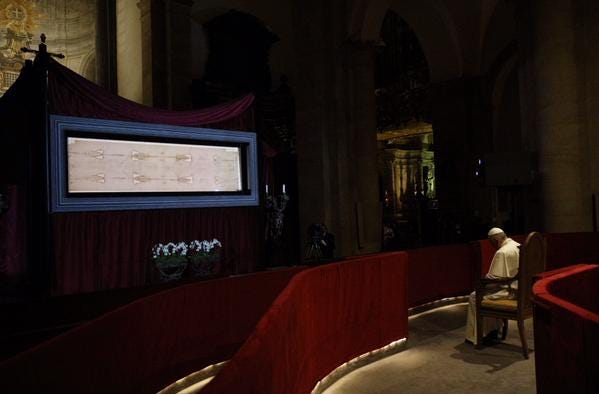
In June 2015, Pope Francis prayed before the Holy Shroud in Turin. Source: https://rb.gy/81cy1
The Shroud of Turin is the only photograph (selfie) of Jesus Christ for many Catholics. Catholicism is therefore practically the only religion to present an authentic, mathematic, and automatic image of its divinity. This burial image depicts the real human form of a tortured and crucified grown male, five feet eleven inches tall (180.34 cm).
Today, there are no other examples of a crucified man who underwent the effects of wearing a crown of thorns and having his side speared. In fact, this picture cannot exist in nature and it still exists. This is the precise definition of supernatural or miracle.
To create this 3D representation with a photographic negative effect (dark where it should be bright), the most plausible explanation was the emission of non-directional light radiation produced by the crucified body that imprinted onto the linen laid on the corpse.
As of today, after more than 500,000 hours of empirical analyses and scientific investigations, this theory remains the only plausible one.
From Science (an eternal ally of God)…
World’s most famous relic, fascinating archaeological object, silent testimony, impossible object, challenge for the human mind, mysterious presence, “a mirror of the Gospel, "resurrection flash, “Fifth Gospel” insofar as the Shroud says much more about the Man depicted than the sober texts of the New Testament evangelists…
Put simply, the Turin burial cloth is a linen canvas approximately 4.40 m long and 1.13 m wide, woven in a distinctive three-to-one herringbone twill pattern (with a fishbone design using a Z-type yarn twist, on a primitive weaving loom, using rudimentary spinning and weaving techniques).
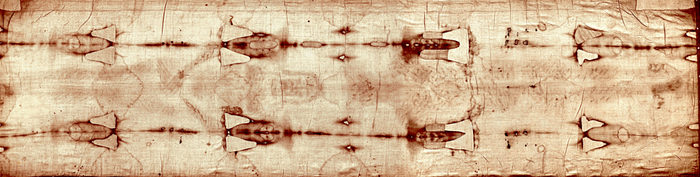
The Shroud of Turin as photographed by Giuseppe Enrie in 1931. Source: https://shorturl.at/uwDOU
The anatomy of the crucified exhibits various trace types:
- Old burn marks (four series of small L-shaped holes)
- Burns probably caused by falling drops of molten metal and dating back to the Chambéry fire of 1532
- Aureoles left by the water used to extinguish the fire of 1532 in Chambéry, or on previous occasions.
- Longitudinal streaks. A strip of the same fabric has been sewn along the top edge.
- A human silhouette. At the image center between the two scorched lines is the double imprint (front and back) of a man who appears to have been lying with his back on the shroud, the other half of which has been folded over him. On the other side of the canvas, the print is not visible.
- Stains of blood are visible at certain parts of the corpse (front, neck, wrists, feet, side). These carmine-colored stains, differing from the rest of the body, are flat, have very sharp contours (they do not fade outwards), came into contact with the canvas, and have partially embedded themselves in the fabric. The blood stains are also visible on the back of the canvas. Unlike body prints, bloodstains normally behave as photographic positives.
- From the original image to the negative photograph, visual perception becomes sharper and more detailed. The improved readability of the negative is due to the fact that the image printed on the shroud already has the characteristics of a photographic negative (with the exception of the bloodstains and wound marks).
- Excoriations on the shoulders and back due to carrying the cross pole (patibulum)
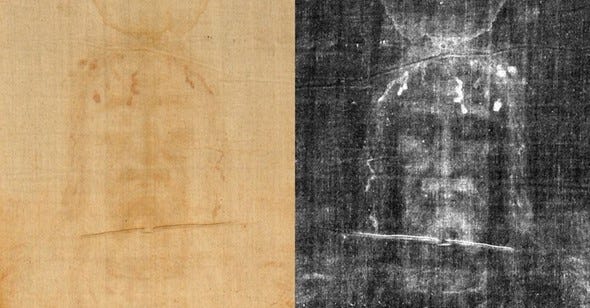
Both “positive” (naked eye) and negative (photographic) of the face of the man of the Shroud. Source: https://shorturl.at/CEGZ8
The naked eye picture on the Shroud is difficult to discern but it is still possible to recognize the features of a man with a beard, with a stain on his forehead in the shape of three garlands, with fairly clear contours that might suggest blood. The nose, mustache, chin and eyebrows are darker, indicating that the luminosity distribution of the face appears to be inverted in relation to that seen in reality.
In reality, the visible image behaves like a photographic negative. The various injuries to the face accentuate the impression of visual restraint, which is even more pronounced and obvious in the negative than in the original.
On the negative of the face, many previously blurred details stand out with great precision, as if it were not a negative but a real photograph. The 1898 photograph is a double negative, hence a positive. On the original the sides are reversed: the right appears on the left and the left on the right, whereas on the photographic negative everything is normal.
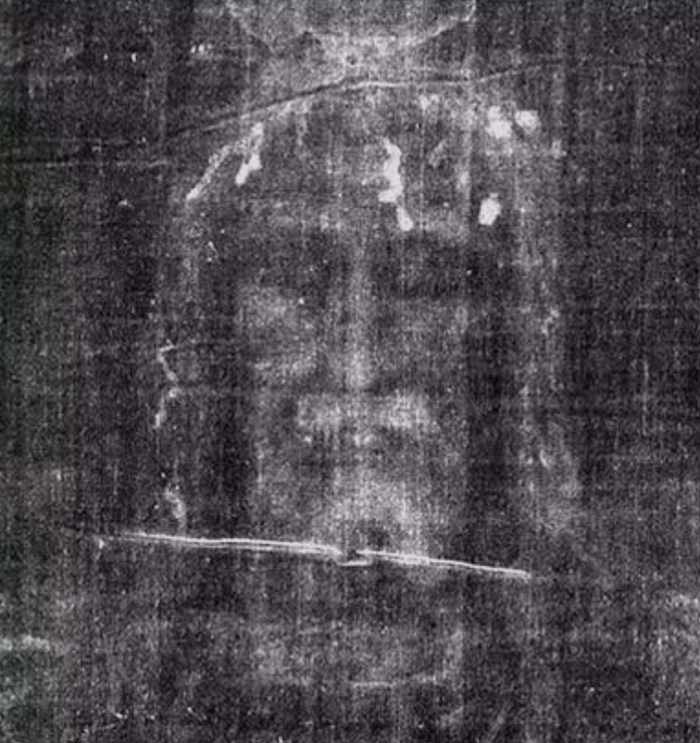
Greyscale, front face, negative image. Source: https://shorturl.at/ACEHI
The chiaroscuro is reversed and what was originally on the right now appears on the left (in particular the 3 on the forehead). There are a large number of bruises and swellings, identified as hematomas, which are particularly visible on the right cheek, which is more swollen than the left.
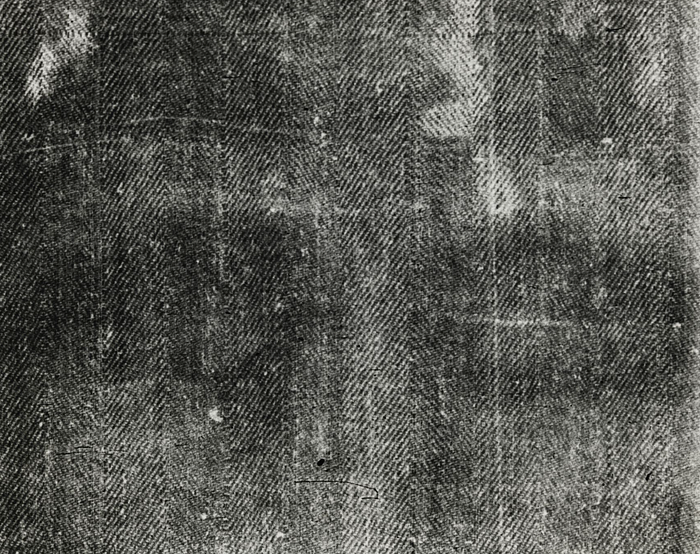
Details of the forefront on the negative. Source: https://shorturl.at/xKST9
In addition, we clearly see injuries on the eyebrows, similar to those visible in boxers. The nasal septum is deviated following a fracture. Moreover, it appears that the Man of the Shroud was savagely beaten in the hours preceding his death. The entire face is covered with drops of blood from numerous wounds, revealed by computer studies.
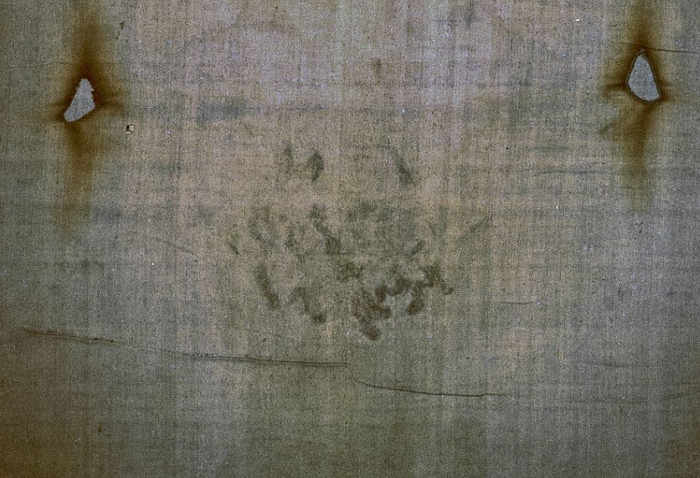
The back of the head with numerous bloodstains. Source: https://shorturl.at/xKST9
The multiple wounds on the neck and hair suggest that the top of the head was occupied by a sort of helmet of thorns which must have caused great pain. Significant hemorrhage of arterial and venous blood occurred due to the abundant vascularization (blood irrigation) of this area.
The flow on the forehead, coming from the frontal vein, is particularly singular: it follows the outline of the wrinkles caused by suffering. Hence the characteristic shape of an inverted 3. Also noteworthy is the winding or zig-zag path of the trail of blood escaping from the wound. As he bled, the crucified man took different positions on the cross, bowing his head.
All over the back, there are numerous excoriated bruises (more than 120) which can be attributed to the scourge, the flagrum, an instrument of torture used by the Romans. The whole body is riddled with these lesions except on the neck, the hands and the forearms.
The lesions appear to have been caused by two balls (probably of lead) connected together by a bar. Above the right scapula and below the left scapula, we can see two significant excoriations, caused by the friction of a rough and heavy body on the tortured person’s skin.

Greyscale, dorsal neck and shoulders, negative image. Source: https://shorturl.at/xKST9
On the right side of the thorax, there is a visible large cut and the trace of a cavity clearly caused by a sharp, pointed object (similar to a spear): the blow delivered to a man who was certainly already dead, as the forensic findings show.
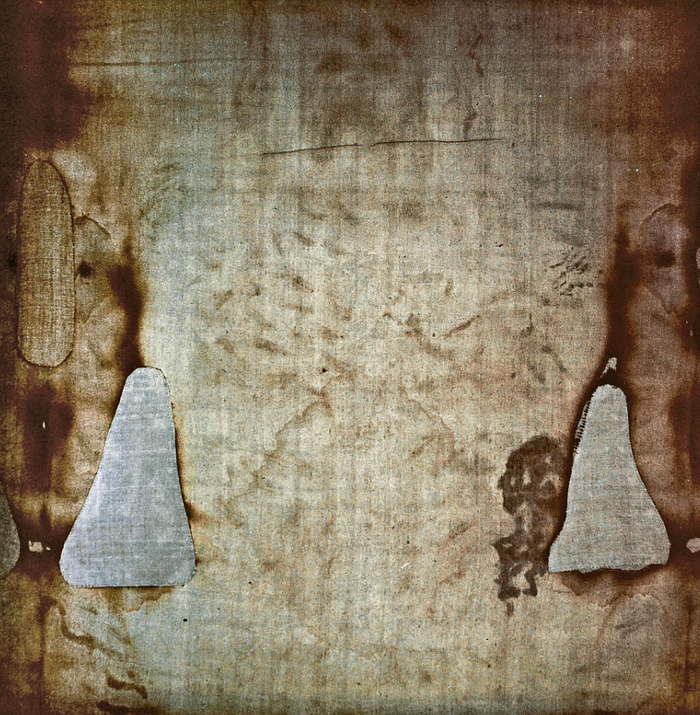
A deep wound caused by a sharp object. Source: https://shroudphotos.com/
In fact, the blood that came out of the wound was already separated into serous and corpuscular components, a phenomenon that can only be seen in a dead body. The wound also left a serum halo on the linen. The blade object penetrated deep between the fifth and sixth ribs, probably reaching the heart or stopping in the pleural cavity which could be full of blood because of the trauma already suffered to the thorax.
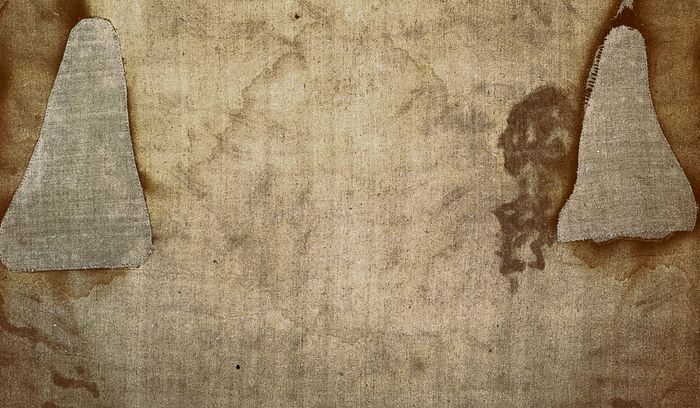
Detail of the wound. Source: https://shroudphotos.com/
On the left wrist, a bloodstain formed by two divergent flows coming out of a large oval wound caused by a large sharp instrument (like a nail). Blood flowed from this wound down the forearm and reached the elbow. A similar streak of blood on the right forearm demonstrates that a similar wound exists on the right wrist, but it cannot be seen because it is covered by the left hand. For the same reason, the Man’s private parts are not visible as well.
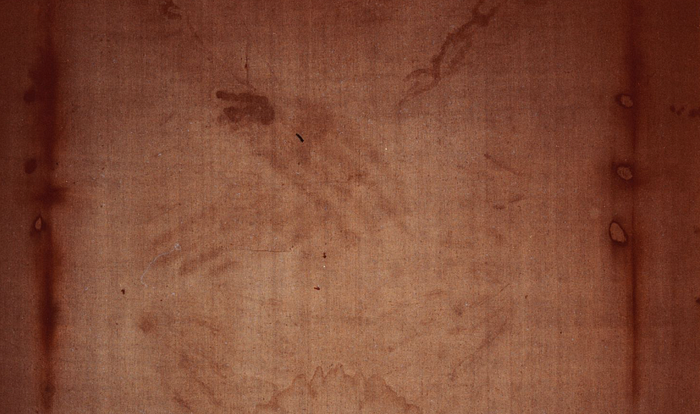
Forearms and hands on the original. Source: https://shroudphotos.com/
A similar streak of blood on the right forearm demonstrates that a similar wound exists on the right wrist, but it cannot be seen because it is covered by the left hand. The blood flows on the forearms followed an anti-gravitational direction, to the extent that, contrary to what one might expect, they flowed towards the upper part of the arms, and not towards the bottom.
This proves that the Man was in a vertical position with his arms raised. The large bloodstain on the wrist also has a pattern that can only be explained by the man’s vertical position and his repeated movements on the cross (slumping and lifting) in his attempt to breathe to stay alive.
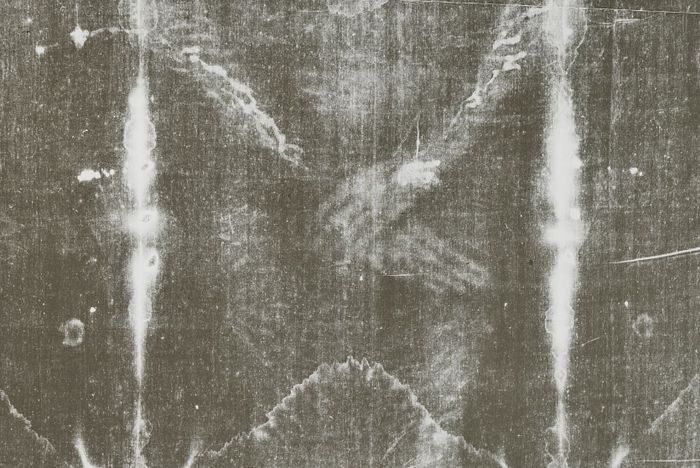
Forearms and hands on the negative. Source: https://shroudphotos.com/
The location of the wound on the upper hand, probably caused by a large nail, contradicts the official iconography of the crucifixion, which depicts Jesus Christ with his hands nailed to the cross by his palms. The nail was driven through a very precise point in the wrist bones, otherwise, the condemned man’s body would not have been able to remain on the cross, according to the forensic pathologists.
The discovery in 1968, in the vicinity of Jerusalem, of the skeleton of a 1st-century crucified man whose upper limbs had been nailed by the wrists rather than the palms confirms this view.
Another observation is that the thumb is missing. The prevailing opinion is that it is in fact bent because the nail has damaged the median nerve that controls it. For others, on the contrary, the position is simply the traditional position of a corpse with hands folded and thumbs ‘hidden’.
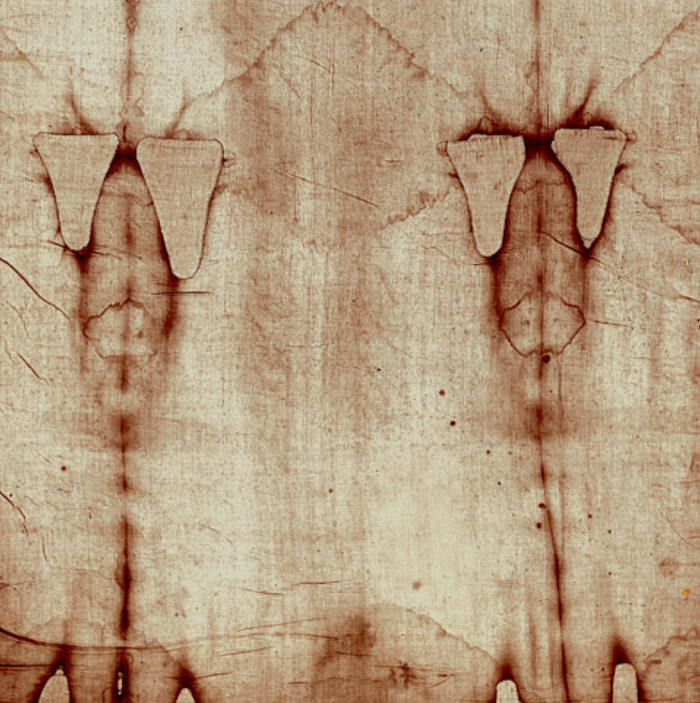
Lower limbs (original frontal image). Source: https://shroudphotos.com/
What dominates, in the central part of the legs, is the large stain left by the water. In the center, the observer’s attention is immediately drawn to two spots at knee height. These darker spots in the middle of the lower limbs are probably due to excoriations caused by one or more falls.
Indeed, examination of the Shroud reveals, exactly at this location (but also on the feet), the presence of soil. At the end of the right leg, at the height of the instep (on the right in the image), we note a large blood stain, although poorly defined. The left foot (on the left in the image) does not appear.
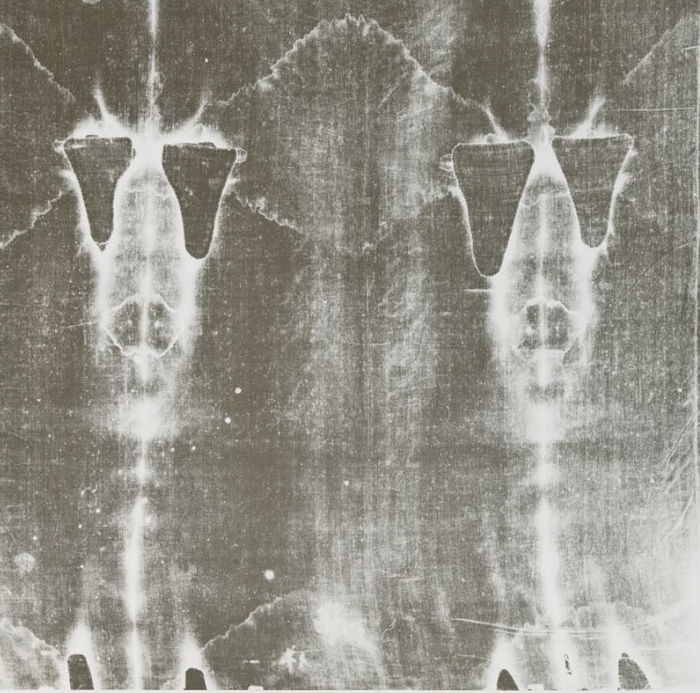
Lower limbs (negative frontal image). Source: https://shroudphotos.com/
Better delineated due to a strong hemorrhage, the large spot on the right foot which surrounds the cavity caused by the nail reasonably suggests that it is the foot that was below the other and confirms the use of a single nail to fix the two crossed legs, the left foot placed on the right foot.
Below the knee, the image of the other leg virtually disappears. This seems to be due to the strong arching of the legs and feet (on the frontal print, the length of the tibias is about 15 cm longer than on the dorsal print). The burial cloth was therefore resting on the right foot alone, which was higher up, and was not in contact with the left foot.
In contrast to the front image, both feet are clearly visible in the dorsal image. The right foot is well-defined and has a large bloodstain which is also stained on this side. On the left foot, only the heel is well-defined. This indicates that the two feet were superimposed (from left to right) and that a single nail was used for both, following a trajectory clearly identified by the forensic experts.
On the sole of the right foot, it is possible to see the exit hole of the nail, from which streams of blood escaped and flowed towards the toes. Other blood flows went towards the heel, probably during the deposition of the body and its horizontalization.
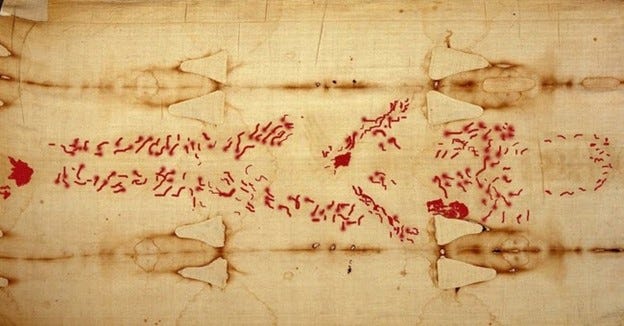
Bloodstains distribution on the original frontal view of the Shroud Man. Source: https://shorturl.at/uRS39
Signs of flagellation also appear on the rear imprints of the legs. If we look at the body of the condemned as a whole, we note that the whip fell more than 120 times on the entire body, up to the calves without interruption.
We can see that the left leg is shorter than the right, because of the rigor mortis that has fixed it in the position it had on the cross, i.e. with the knee bent to the right.
In the past, this “difference” gave rise to the hypothesis that the Crucified was lame, hence the representations in ancient paintings and the shape of Russian Orthodox crosses were clearly influenced by the Holy Shroud.
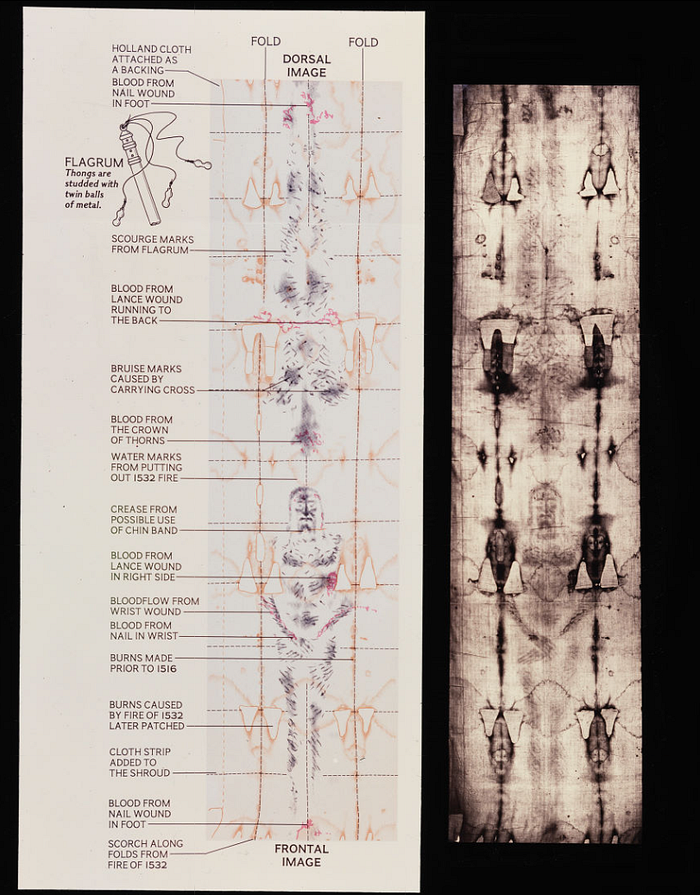
Descriptions of the frontal and dorsal images. Source: https://shorturl.at/bjwzL
Two bronze coins struck under Pontius Pilate were identified on the Shroud. These are bronze leptons (in Greek) which were worth a quarter of an Ace or quadrant. The lepton was the smallest coin in circulation and of the same type of the widow’s offering at the Temple that Jesus speaks of in the Gospel.
The trace of one coin appears on the right eye of the man in the Shroud. The second coin is situated not on the left eye but at the end of the left brow ridge, seemingly having shifted position. These antique pieces contain spelling mistakes not uncommon at the time.

Roman coins (leptons) in the Holy Shroud. Source: https://tinyurl.com/4zjszvmv
Coins have been discovered in various Palestinian tombs from the 1st century. While it was not a common practice, it did occur for significant individuals. One notable example is the opulent tomb believed to be of the high priest Joseph, also known as Caiaphas. Inside a skull within this tomb, a coin of Herod Agrippa dating back to 42 or 43 was found.
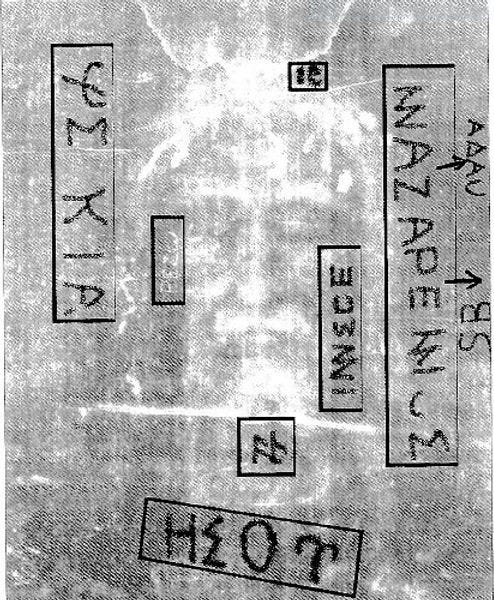
Faint writing spectra or impressions on the cloth around the head. Source: https://tinyurl.com/2v4v63th
Writing spectra have also been observed on the Shroud. These “Writing ghosts” or “Burial certificate” of Jesus the Nazarene appeared after image analysis and processing by Professor André Marion. These writings were perhaps affixed to strips of papyrus and glued to the external face of the Shroud.
It’s possible that these inscriptions were attached to papyrus strips and adhered to the exterior of the Shroud using a method reminiscent of the one utilized for labeling 2nd-century Egyptian mummies. In those cases, inscriptions were written on either linen or papyrus strips.
A synthetic text inscribed by Pilate’s notary or bailiff dated the seventh of April of the year 30 was interpreted as follows: “Jesus of Nazareth, found guilty of stirring up the people. Put to death in the 16th year of the reign of Tiberius. Was deposed at the ninth hour. (Must be returned on the month) of Adar Sheni. Made by…”
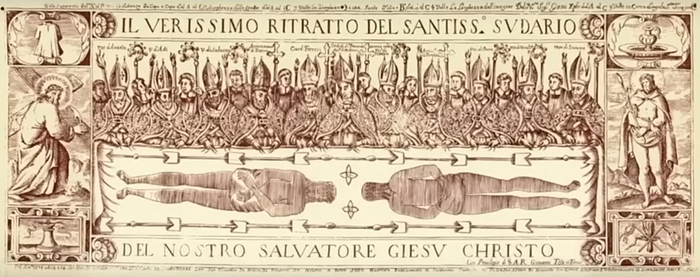
Engraving dating back to the late 16th century illustrating a demonstration of the Holy Shroud by a gathering of bishops. Source: https://shorturl.at/kmS01
Jesus was never depicted naked in the Middle Ages and even later, because complete nudity of the Christ was unthinkable. Until the 16th century, engravings depicting exposures of the Holy Shroud systematically covered the print.
Numerous representations of Christ in Christian antiquity and later include two specific features that can also be seen on the Holy Shroud: two long bands of hair and a beard. In Rome, a bearded Christ appears on the frescoes of the catacombs and the paintings of the sarcophagi from the 3rd century. This uniformity has few exceptions and is objectively difficult to explain.
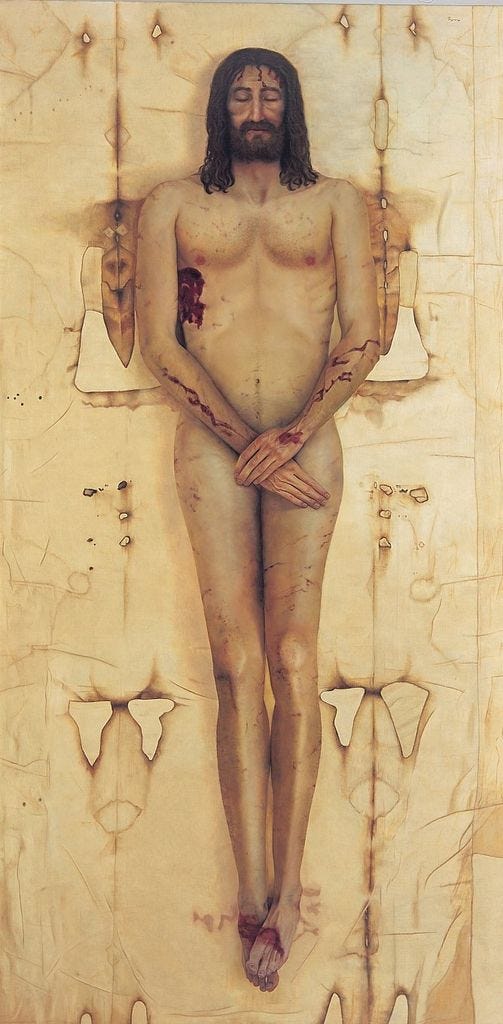
A realistic representation of the Man of the Shroud. Source: https://shorturl.at/mvAUX
From Enrie’s original grayscale photographs from 1931, holograms of the Shroud of Turin were produced as well as 3D sculptures. Computer processing, by clearly revealing the signs of torture on the face of the Man of the Shroud, provides another concordant clue to the fact that the image cannot have been painted.
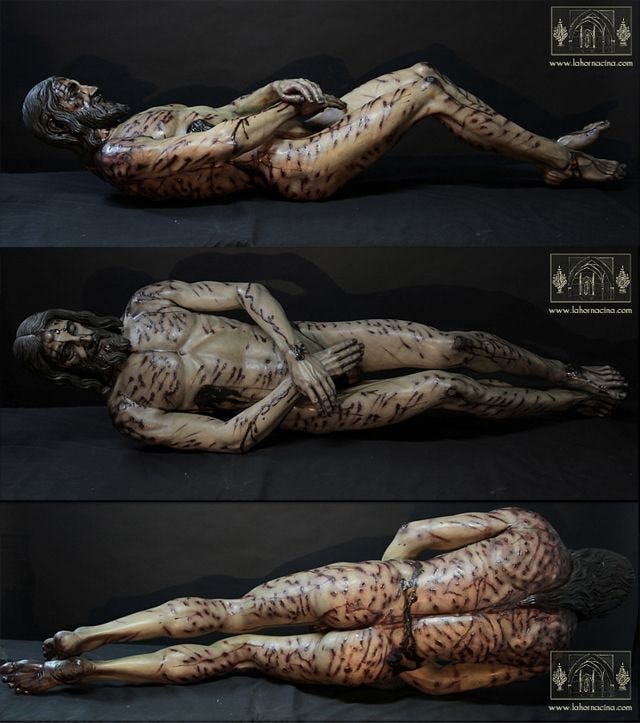
3D body reconstruction derived from the image imprinted on the Holy Shroud. Source: https://tinyurl.com/tb7hejja
Thanks to computer processing, certain details, invisible to the naked eye, have emerged (such as the pollens, travertine aragonite limestone crystals unique to Jerusalem, the writing in Greek, Latin and Hebrew, the leptons placed here over the eyes of the deceased, traces of Myrrh and Aloe…).
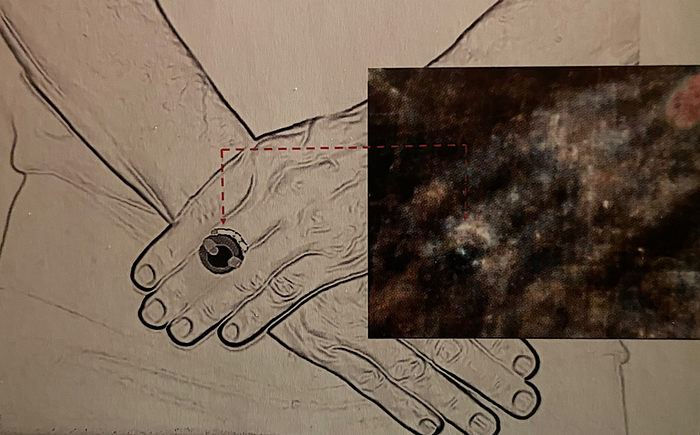
The presence of a ring on the middle finger of the left hand was identified by Thierry Castex. Source: https://tinyurl.com/muzpdj7m
These details were inaccessible to the unknown painter who would have reproduced the Holy Shroud in the Middle Ages. In addition to other factors, these details discredit the notion of a medieval forgery and raise doubts about the flawed carbon-14 study conducted in 1988.
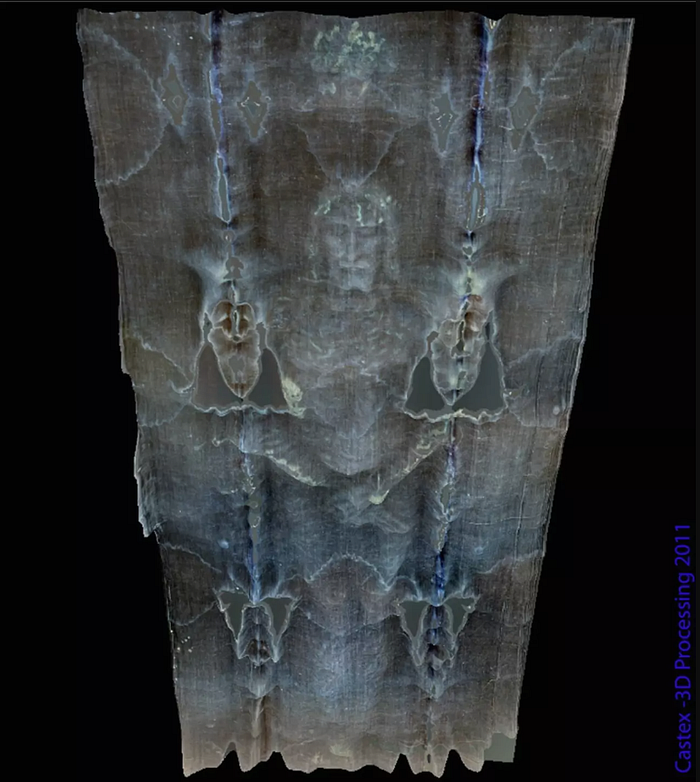
Contemporary 3D reconstruction of the burial shroud by Thierry Castex, a French engineer. Source: https://shorturl.at/cDNQS
The recurring question of the probability of the Holy Shroud’s authenticity can also be answered by calculating probabilities. In the crucifixion of Jesus Christ, seven cardinal points are reported in the gospels:
- The body was wrapped in a shroud;
- The head received a crown of thorns;
- The crucified man carried his cross;
- He was nailed to the cross;
- He was speared in the side after his death;
- He was wrapped in his shroud, without being cleaned;
- He remained in his shroud for less than a few dozen hours, and so on.
The probability that these points could be common to those of another crucified person has been estimated. According to mathematical calculations, out of 200 billion other crucified people, only one can have all seven characteristics of Christ’s crucifixion.
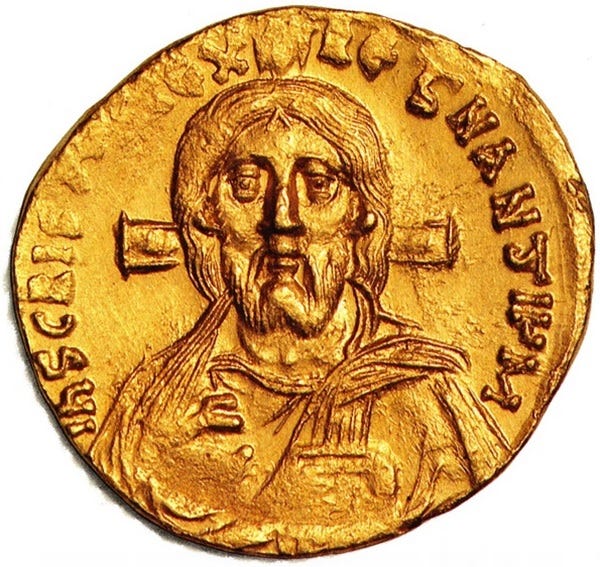
This AD 692 Byzantine Solidus displays the image of Jesus on a cross with a stark resemblance to the Shroud’s face. In particular the bifid beard (torn off) and the lock on the forehead (blood flow). Source: https://shorturl.at/bDLOQ
If, in history, there could have been (but obviously this is not the case) 200 billion crucified people, the maximum probability would be close to zero. The Man of the Holy Shroud can therefore only be unique, there can be no other. The calculation of probabilities tells us that the hypothesis that the Man of the Holy Shroud and Christ coincide is not only well-founded but also proven.
The Sudarium of Oviedo (the cloth that covered the head of Jesus Christ after his crucifixion) and the Tunic of Argenteuil (the garment worn by Jesus Christ during his crucifixion) are two other important relics strongly related to the Holy Shroud.
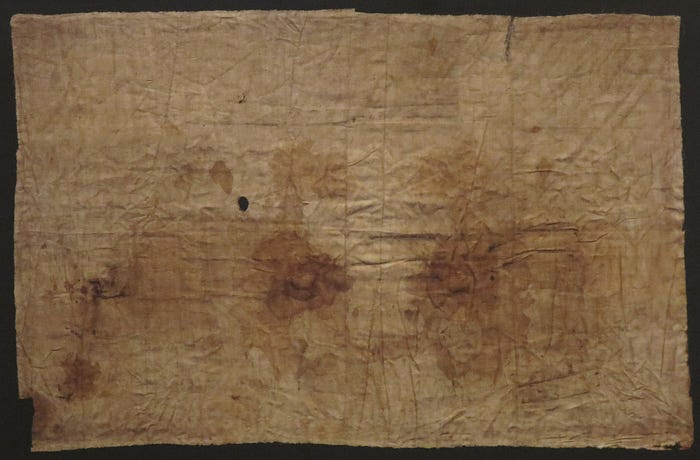
The Sudarium of Oviedo. Source: https://tinyurl.com/ynb3fzev
The three tissues share the same AB blood group and their superpositions match in particular at the level of the blood spots.

The Holy Tunic of Argenteuil after restoration in 2016. Source: https://tinyurl.com/6y2fphfy
The genetic material within the bloodstains on the Holy Shroud indicates that the individual enveloped within it possessed a male gender, as evidenced by the presence of a Y chromosome.
Moreover, the methods of weaving and sewing examinations do not rule out the possibility that the Shroud of Turin may have been a high-quality product produced in a 1st-century AD facility.
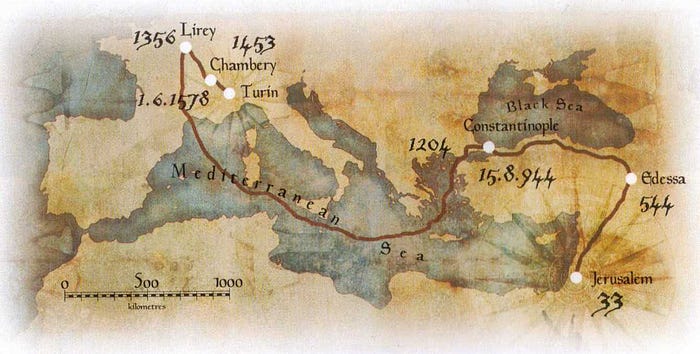
The estimated journey of the Holy Shroud from 30 AD to today. Source: https://tinyurl.com/3p2bjub9
It’s noteworthy that the individuals who had the last visual encounter with the face of Christ just prior to His burial were specific individuals: His mother the Virgin Mary, the accompanying women, St. John, and Joseph of Arimathea. Interestingly, it took over 18 centuries until we could witness that same face through the photograph captured by knight Secondo Pia on 8 May 1898.
…To Jesus Christ, The Gospel Verses and Faith
In scripture (Old and New Testaments), there is an abundance of verses that cite the Passion, Crucifixion and Resurrection of Christ. Some of these passages are announced in the Genesis book (Genesis 22:1–19), by the Prophets (Isaiah 53:3, Zechariah 12:10, Jonah 1:17–2:10, Hosea 6:1–2, Daniel 12:2), in the Psalms (Psalm 22, Psalm 16:8–11, Psalm 118:22–24), in the book of Wisdom (Wisdom of Solomon 2:12–20) and by Jesus himself as reported by the evangelists.
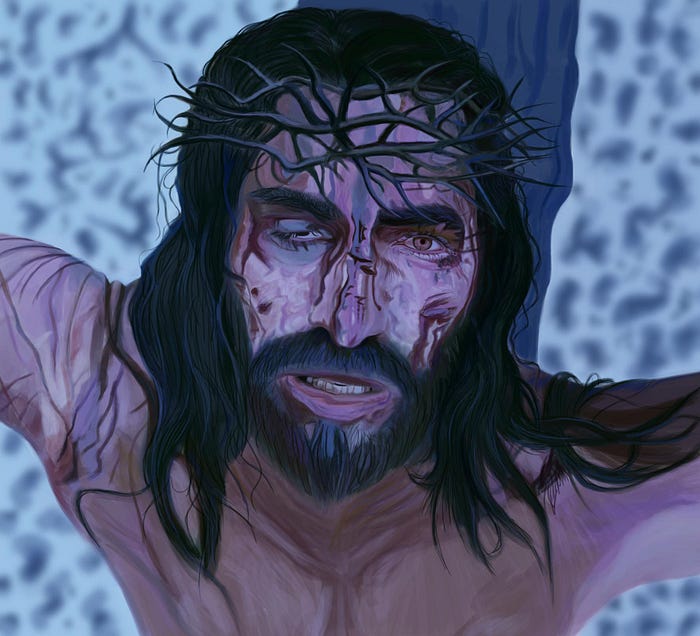
Digital painting of Jesus Christ based on Mel Gibson’s Passion. Source: https://shorturl.at/bJO69
Here is a non-comprehensive list of mentions about suffering, death, resurrection and the existence of the Shroud in the Bible:
“Now the Lord provided a huge fish to swallow Jonah, and Jonah was in the belly of the fish for three days and three nights. From inside the fish, Jonah prayed to the Lord his God…. And the Lord commanded the fish, and it vomited Jonah onto dry land.” Jonah 1:17–2:10
“He answered, ‘A wicked and adulterous generation asks for a sign! But none will be given it except the sign of the prophet Jonah. For as Jonah was three days and three nights in the belly of a huge fish, so the Son of Man will be three days and three nights in the heart of the earth. The men of Nineveh will stand up at the judgment with this generation and condemn it; for they repented at the preaching of Jonah, and now something greater than Jonah is here.’” Matthew, 12:39–41, Mark 8:12
2- Jesus hinted figuratively that he would be destroyed and revitalized
“Tear down this temple, and I’ll rebuild it in three days.” John 2:19
3- In the Burning Bush story, the Holy Shroud is superficially “burned” by light but not consumed
“Now Moses was tending the flock of Jethro his father-in-law, the priest of Midian, and he led the flock to the far side of the wilderness and came to Horeb, the mountain of God. There the angel of the Lord appeared to him in flames of fire from within a bush. Moses saw that though the bush was on fire it did not burn up. So Moses thought, ‘I will go over and see this strange sight — why the bush does not burn up.’ When the Lord saw that he had gone over to look, God called to him from within the bush, ‘Moses! Moses!’”
4- Allusions to suffering
“I gave my back to those who struck me, and my cheeks to those who tore off my beard; I did not hide my face from shame and spitting.” Isaiah 50:6
“But he was wounded for our transgressions, he was bruised for our iniquities: the chastisement of our peace was upon him; and with his stripes we are healed.” Isaiah 53:5
“No bone of his shall be broken.” John 19:31–37
“But I say to you, do not resist the wicked. If anyone strikes you on the right cheek, turn to him the other also.” Matthew 5:39
“From that time on Jesus began to show His disciples that He must go to Jerusalem and suffer many things at the hands of the elders, chief priests, and scribes, and that He must be killed and on the third day be raised to life.” Matthew 16:21
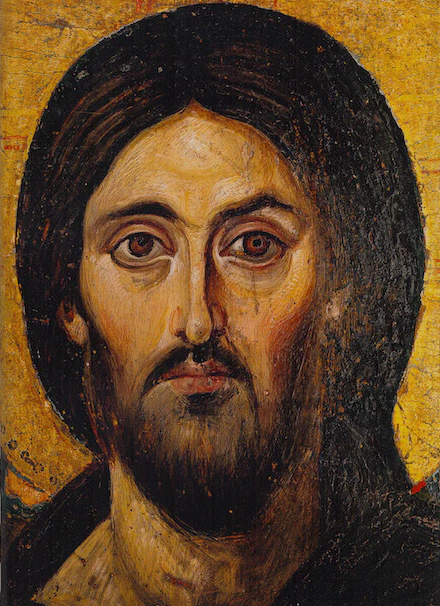
Close-up on the face of the famous icon of Christ Pantocrator (6th century). There is a significant alignment of features of no fewer than 250 points of similarity with the face depicted on the Holy Shroud. Source: https://shorturl.at/ilvxQ
5- References to Jesus’s death, the Shroud and the Resurrection:
“Joseph of Arimathea, a highly regarded member of the council, who was himself looking forward to the kingdom of God, went boldly to Pilate and asked for the body of Jesus. Pilate was surprised that he was already dead. He called the centurion and asked him if he had been dead for some time. When Pilate was informed by the centurion, he gave the body to Joseph. After Joseph bought a linen cloth and took down the body, he wrapped it in the linen and placed it in a tomb cut out of the rock. ” Mark 15:43–46
“But in the account of the burning bush, even Moses showed that the dead rise, for he calls the Lord ‘the God of Abraham, and the God of Isaac, and the God of Jacob.’” Luke 20:37
“He said to him, ‘If they do not listen to Moses and the Prophets, they will not be convinced even if someone rises from the dead.’” Luke 16:31
“Jesus said to her, ‘I am the resurrection and the life. The one who believes in me will live, even though they die; and whoever lives by believing in me will never die. Do you believe this?’” John 11:25–26
“So Peter and the other disciple started for the tomb. Both were running, but the other disciple outran Peter and reached the tomb first. He bent over and looked in at the strips of linen lying there but did not go in. Then Simon Peter, who was behind him, arrived and went into the tomb. He saw the strips of linen lying there, as well as the burial cloth that had been around Jesus’ head. The cloth was folded up by itself, separate from the linen. Finally, the other disciple, who had reached the tomb first, also went inside. He saw and believed.” John 20:1–8
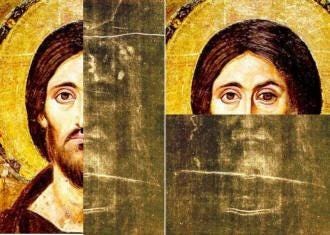
Combining the Pantocrator artwork with the Turin Shroud image. The facial features align with those seen in this early depiction of Jesus. Source: https://shorturl.at/swEPW
“Why are you looking among the dead for one who is alive? He is not here; he has been raised. Remember what he said to you while he was in Galilee: ‘The Son of Man must be handed over to sinners, be crucified, and three days later rise to life.’” Luke 24:1–12
6- The two small coins story (the same type that were laid on Jesus’s eyes before his burial):
“Jesus sat down opposite the place where the offerings were put and watched the crowd putting their money into the temple treasury. Many rich people threw in large amounts. But a poor widow came and put in two very small copper coins, making a quarter of a penny. Calling his disciples to him, Jesus said, ‘Truly I tell you, this poor widow has put more into the treasury than all the others. They all gave out of their wealth; but she, out of her poverty, put in everything — all she had to live on.’” Mark 12:41–44
What Most Likely Happened
“Science can purify religion of error and superstition; religion can purify science of idolatry and absolute falsities.” John Paul II
The Shroud of Turin Research Project (STURP, 300000 hours of work on the Holy Shroud since 1978) is one of the greatest scientific research projects and it delivered its final report in 1981. The project carried out a multidisciplinary approach and cutting-edge scientific methodologies and techniques to unlock the mystery of the Man of the Shroud. Here is its definitive conclusion.
“We can conclude for now that the Shroud image is that of a real human form of a scourged, crucified man. It is not the product of an artist. The blood stains are composed of hemoglobin and also give a positive test for serum albumin. The image is an ongoing mystery and until further chemical studies are made, perhaps by this group of scientists, or perhaps by some scientists in the future, the problem remains unsolved.”
Basically, the STURP report leaves us with two unresolved questions:
1- How was the image created on the centuries-old linen cloth?
2- How was the body separated from the Shroud?
It is here that a 20th-century Italian mystic by the name of Maria Valtorta made her entrance.
Maria Valtorta is a Catholic member of the Third Order of the Servants of Mary and she is the writer of The Gospel as Revealed to Me. Maria will follow the spiritual journey of Saint Thérèse of Lisieux, also known as Saint Thérèse of the Child Jesus and the Holy Face, a French Carmelite who venerated the holy face of the Lord and who died in 1897 just a year before the image of the Holy Shroud.
Suffering from a paralyzing illness, Marian remained bedridden at the age of 37. Amidst her profound suffering, she encountered the love of God and received solace through miraculous blessings.
Jesus described his life to her, which she received through visions and dictations, and she wrote fifteen thousand pages of notebooks that are harmoniously integrated into the Holy Scriptures from 1943 (1st vision on Maundy Thursday) to 1947.
Born in 1897, Maria Valtorta died on October 12, 1961. On her tomb in Florence is inscribed “Divinarum rerum scriptix” (historian of the divine). She is in the process of being beatified.
Here are some summarized extracts of Valtorta's 𝐑𝐞𝐬𝐮𝐫𝐫𝐞𝐜𝐭𝐢𝐨n Vision:
“While the fatigued guards were stationed at the tomb, the tomb’s stone door had been fortified with lime at its edges, resembling a buttress and the door was imprinted with the Temple’s seal. Morning approaches but there are no rays of sunshine in the sky yet.
A brilliant meteor descends from the unknown, shining intensely and leaving an incandescent trail. Its light, which surpasses the beauty of dawn, astonishes the guards.
Accompanied by a harmonious, majestic roar, it symbolizes the return of the spirit of Christ in glorious flesh, echoing from the depths of paradise.
The meteor smashes into the tomb’s closure, terrifying the guards and causing an earthquake. It illuminates the tomb with an incredible light and symbolizes the return of the Spirit to Christ’s body. This astonishing sequence unfolds in a fraction of a minute.
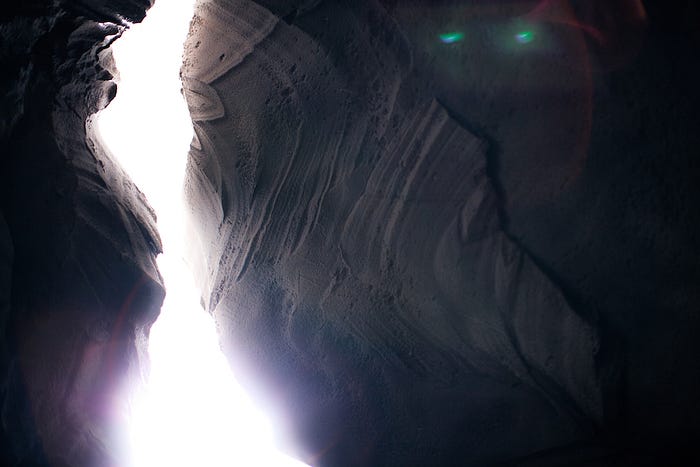 The meteor rips the stone from the tomb and throws it to the ground. Source: https://shorturl.at/luyLQ
The divine Spirit’s approval of uniting with flesh is silent, given as an order from the Essence to inert matter. The flesh complies with a profound sigh, and there is a brief period of quietude for a few minutes.
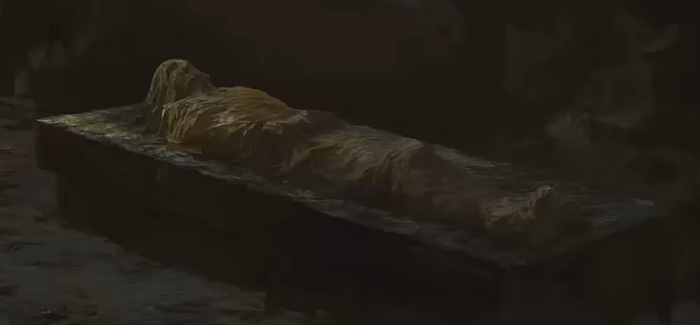 Step 1: The flesh receives the command and obeys it with a deep sigh. [Snapshot, Source: https://tinyurl.com/4e8uv73x]
Beneath the shroud (the linen napkin that envelops the dead man’s face) and the shroud (the long sheet that covers the body), the glorious flesh is recomposed in eternal beauty, awakens from the sleep of death, returns from the “nothing” where it was, lives after having been dead.
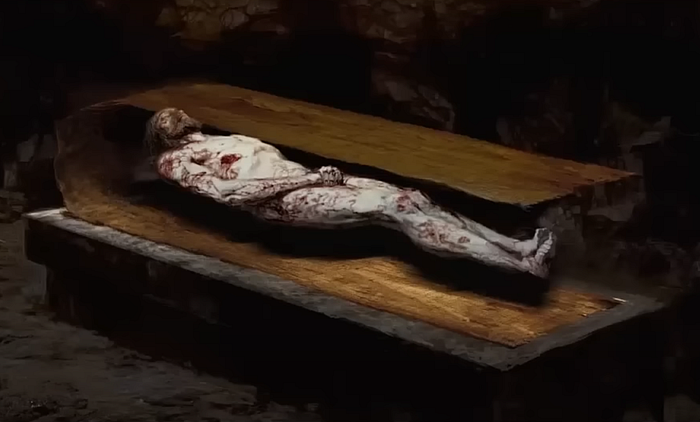 Step 2: The heart reawakens blood circulation and restores the body that was once lifeless. [Snapshot, Source: https://tinyurl.com/4e8uv73x]
After a moment, there is a sudden movement under the heavy shroud. It is so sudden, from the moment Jesus moves his folded hands to the moment he stands majestic in his garment of immaterial matter, supernaturally beautiful and imposing, with a gravity that changes and elevates him while leaving him being himself, that the eye barely has time to follow its development.
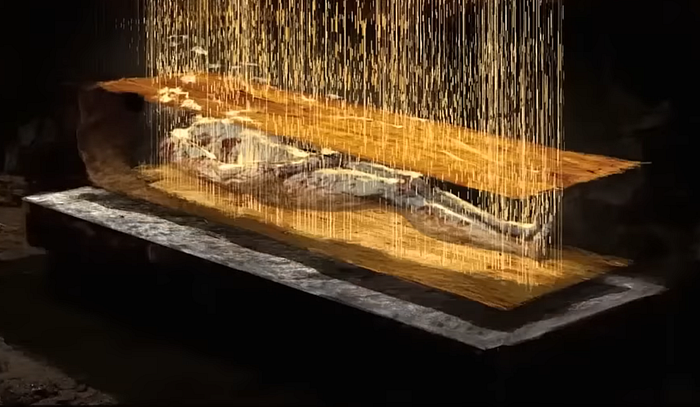 Step 3: Flash of light which dematerializes the body outside the suspended envelope. [Snapshot, Source: https://tinyurl.com/3as5spm2]
Jesus is very different from what the mind can recall, he is in full form, without wounds or blood, but only dazzling with the light that pours from the five wounds and emerges from every pore of his skin.
He initiates his first step and as he moves, beams emanate from his hands and feet, enveloping him in shafts of light from his head, wrapped in a crown made of countless wounds from the crown of thorns that no longer give blood but only splendor, to the hem of his garment where opening the arms he has crossed over his chest, he discovers the zone of very bright light filtering through his garment, giving him the radiance of a sun at the height of the heart. It was then that the “Light” really took shape.
When he moves towards the exit, and as soon as the eye can see something other than its brightness, two very beautiful lights appear to me, but similar to stars compared to the sun, each on one side of the threshold, prostrated in adoration for their God who passes, enveloped in his light, with a smile that beatified.
He leaves the funeral cave and returns to tread the earth that joy awakens and which shines under its dew, among the colors of the herbs and the rose bushes, under the countless corollas of the apple trees which open by wonder at the first rays of the sun which strike them. , and to the eternal Sun which advances beneath them.
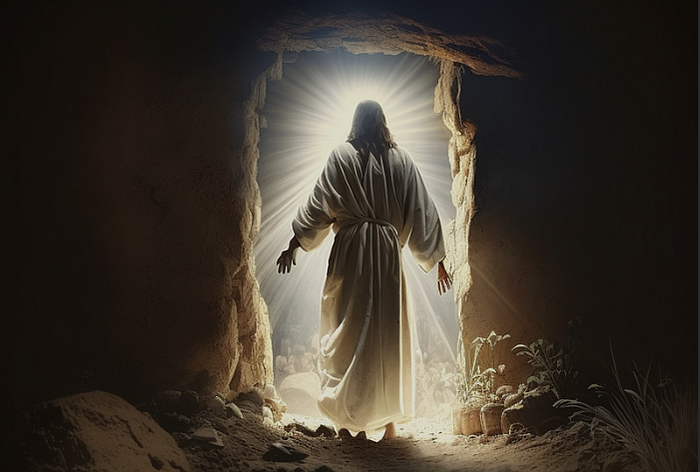 The Man-God quits the tomb now enveloped in the light of his glory. Source: https://shorturl.at/sGJRT
The guards have fainted… The corrupt forces of man do not see God while the pure forces of the universe, the flowers, the herbs, and the birds admire and revere the Mighty One who passes, enveloped in his own Light and that of the sun. Jesus raises his hand and blesses and then, as the birds sing louder and the wind carries its fragrances, he disappears.”
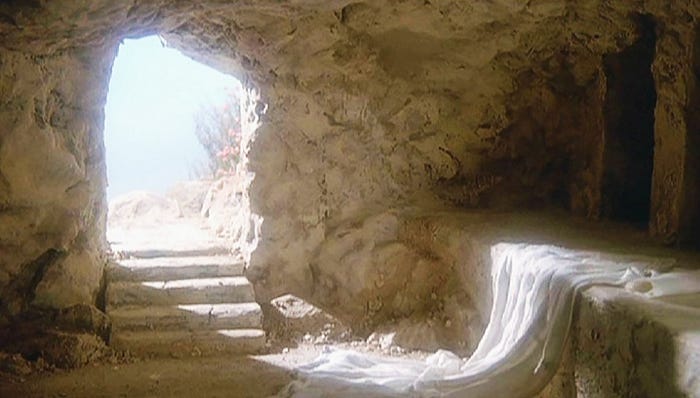 Jean will later see, piled up on the ground, the linens placed on the shroud. Source: https://shorturl.at/sGJRT
Conclusion
“And you — who do you say I am?” Matthew 16:13–16, Mark 8:27–29, and Luke 9:18–20
How much evidence is enough evidence for modern-day “doubting Thomas”?
On June 12, 1993, the CIELT’s Rome Symposium concluded that the burial linen was scientifically authentic: “The only scientific status of the Shroud of Turin compatible with the current state of scientific research on this object is that of the authentic Shroud that wrapped the body of Jesus of Nazareth, a historical figure who died crucified around 30 A.D.”
David Rolfe, a filmmaker who offered a $1m challenge to the British Museum said ‘If the Turin Shroud is a forgery, show how it was done. Because from all the evidence I’ve seen, if this is a forgery it’s the most ingenious forgery in history — and of course, it dates back almost 2,000 years, to a time of far less sophisticated forgery techniques.’
Indeed, the image contains such a multitude of details that the saying “the devil is in the details” takes on a playful twist. The amount of information is massive and is a wink to the last verse of John’s gospel. “There are still many other things that Jesus did; if they were written down in detail, I don’t think the whole world could contain the books that would be written.” John 21:25
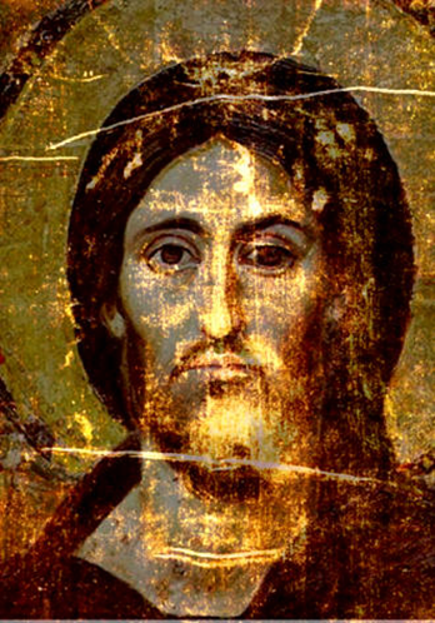
A blend of the Holy Face and the 6th-century icon of Christ The Pantocrator. Source: https://shorturl.at/dmpKN
Regardless, an extensive body of evidence will never satisfy individuals unwilling to believe, as human beliefs are often shaped by personal desires. This aspect isn’t up for debate, as the Holy Shroud does not alter one’s faith in God.
Jesus Christ asks for adhesion to him first, he asks men to love him not just to be aware of his existence. On the other hand, the Holy Shroud definitely and amusingly complicates non-belief in the existence of Jesus Christ from a scientific and historical point of view.
Jesus says that faith in him depends not only on the physical evidence of his resurrection but also on the willingness to believe in him and his teachings. Jesus placed faith and trust in God first, rather than relying solely on material evidence.
“You believe that there is one God, you do well; the demons also believe it, and they tremble.” James 2:19
Moreover, Jesus also wants to warn against unbelief and hardening of the heart, which also prevent people from seeing the truth even though it’s right in front of them. Despite performing many miracles, including healing the sick, multiplying the loaves, and raising the dead, the religious authorities of the day (mainly the prevalent sect of the Pharisees) refused to believe in Jesus and condemned him to death.
The Shroud of Turin is the irrefutable and ultimate proof of the Passion, Crucifixion and Resurrection of Jesus Christ. It is also the centerpiece of the most important crime scene in History. Moreover, it is the absolute confirmation of the Catholic Doctrine by scientific consolidation of the Passion narrative thanks to the total concordance, without the slightest error, between the Gospels and the Holy Shroud.
The position of the Church is that the Holy Shroud is not a component of the deposit of faith. Hence it is not necessary for salvation. However, the Holy Shroud is displayed during public exhibitions, allowing believers to honor it by engaging in prayer, reflection, and contemplation.
In our era that remains marked by agnosticism, cynicism, doubt and fear, the Holy Shroud is a gift offered to humanity to carry out a new inversion of principles or rather a double inversion (conversion) to return to the Truth. As the cliché of the shroud is a double negative, we can also deduce that we must also reverse our view of reality in order to see correctly.
“I have told you these things so that you may have peace in me. You will have tribulation in the world, but take heart, I have overcome the world.” John 16:33
[TLDR] Non-Exhaustive Features Of The Mortuary Linen
- The most studied historical artifact in the world.
- Ancient relic (first attested in 544 AD) and approximately 2000 years old (X-ray analysis of 2022)
- Acheiropoieta, Acheiropoietos, Αχειροποίητος (not made by human hands)
- Isotropic staining (same physical properties without directional effect)
- Monochromatic picture (shades of the same sepia color)
- Indelible imprint resistant to heat and water (the Shroud of Turin survived two fires in 1532 and 1997 and was saved almost at the last minute)
- Bloodstains contain blood components ( hemoglobin, albumin, and immunoglobulin)
- Type AB+ blood is the rarest in the human population (4%). Coinciding with the Sudarium of Oviedo.
- Bloodstains remained of carmine (red) color due to bilirubin (product of hemoglobin breakdown)
- Original image reversal (the right side appears on the left and the left side on the right)
- Body weightlessness explains the image formation (same intensity of coloring on ventral and dorsal parts; no tearing of the linen fibrils which would have been necessary because of the blood that dried and stuck the body with the shroud)
- Three-dimensional image (the image is a function of the distance from the linen as if it had been projected from the dead body)
- The man in the image has a significantly tall stature for an era when the average height for men was less than 1.68 meters (5 feet 6 inches).
- Unique (probability of 1 in 200 billion) and Authentic relic (The original as opposed to a forgery, counterfeiting, painting,…). Ultimately, the authenticity of the Shroud of Turin, like the Oviedo Shroud, remains a matter of religious belief and personal interpretation. But it is not anymore an authenticity matter for science. Fake Holy Shroud? “One chance in 200 billion” according to André Magne, a French mathematician and lecturer. “Its existence is like a thorn in the side of non-believers”. In statistics, too many coincidences create an obvious fact.






