
Cardano is a blockchain platform which is Open-source, decentralized and uses Proof-of-Stake to reach consensus. The native token of the blockchain is ADA.
The coin is named "ADA" after Ada Lovelace. She was the daughter of Lord Byron and was known for creating the first ever computer algorithm. Ada is a cryptocurrency that actually has lots of real-world uses (and is actually being built around that purpose) and has strong base with great team working on it. DYOR, but in my opinion, Cardano is the one great cryptocurrency which will definitely be here thriving with great technology and real world applications when all the altcoins and memecoin hype will die.
Vitalik Buterin, co-founder of Ethereum, did a poll on twitter few days ago. Here's the link to the poll and the results:
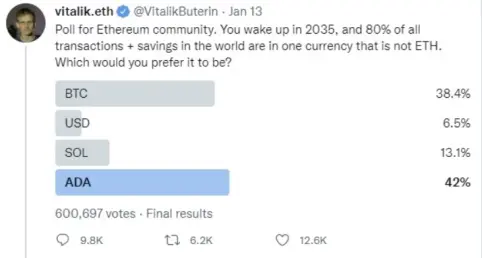
The currency has been touted to follow "Slow and steady approach" for its development. And it makes sense. It is better to spend more time on perfectly implementing some features then to implement them in haste (maybe to keep up the hype) and keep on modifying the underlying architecture indefinitely because the original implementation was broken.
Cardano calls itself a 3rd-generation public blockchain. It was created by a team led by Charles Hoskinson. He was one of the co-founders of Ethereum. You may not like the guy but it cannot be denied that he is a genius. Cardano has even partnered with Education ministry of Ethiopia to create Digital Identities for the students to record their performances etc.
But How does it work and what does it do differently?
So, there are 3 main parts that contribute and develop Cardano:
1. The Cardano Foundation: It is a Non-Profit Foundation which supervises the advancement of the Cardano blockchain. The Foundation ensures the development and also works on promoting the blockchain.
2. IOHK: Founded by Charles Hoskinson and Jeremy wood, it is a decentralized remote working organisation which works in conjunction with various universties around the world for research and development of the blockchain infrastructure.
3. Emurgo: Yet another seperate company. This one works on blockchain and tries to woo the commercial activites on Cardano. Basically they work on driving the adoption of the blockchain. "Yoroi wallet" is a perfect example.
So, Every update and upgrade on the Cardano's blockchain are agreed upon by the researchers across the world before being used.
Ada uses Proof-of-Stake. So, the energy consumption is drastically lower. Various stake pools(server node) are up and running on the network. These pools are responsible for processing transactions and producing new blocks. And unlike some of the competitors (*coughs* Solana), the requirements actually makes sense for setting-up a node. A user can delegate his/her ADA into a pool and earn staking rewards.
To prevent the pool from being over-saturated (51% Attack), the algorithm enforces capping of reward. That is, if a pool get bigger than maximum cap set by the algorithm, they will recieve less rewards. So It does not make any sense to delegate your coin in a pool which has already reached its maximum cap. The node operator can decide a cut (for the operating costs of the pool and some profit) from the amount of block reward, which they will keep for themselves.
A user before staking in any pool can see the amount of ADA already staked in the pool and reward percentage the node operator is going to take as his cut. So, if a person runs a pool where he will keep 50% of profit for himself, then no sensible person will stake his/her tokens in his pool. Also, your delegated ADA are not locked, you are free to transfer them. They took years to implement staking and then they did it perfectly.
And the consensus algorithm used is "Ouroboros". In a nutshell, this is how Cardano network processes transactions. The Ouroboros divides transactions into epoch and they are further divided into time slots. Each Epoch currently runs for 5 days and has 432,000 slots. Different slot leader is elected for each time slot and they will be responsible for adding the block in blockchain. A certain number of old blocks are treated to be un-settled (transient) when the leader is going to add new block. Only the blocks before those transient are treated as settled and verified blocks.
So, when a pool adds a block they will get the block reward. Ouroboros also provides mathematical security (Won't go into the proof) that the validators will be chose at random. This ensures that every node has a fair and unbiased chance of mining the block on the blockchain. The block rewards that a pool gets will be shared among the delegators in the pool.
For HODLing ADA, there are two official wallets:
1. Daedalus: A full fledged Open-source Desktop wallet. It works as a full node. So, it will download the whole blockchain onto the computer and will verify transactions on the network independently instead of relying on a 3rd-party server.
2. Yoroi: Light weight Open-source wallet and so it will not download the blockchain. But that is what it is intended for. It is built to complement Daedalus. Simply create wallet and instant send/recieve from a mobile device is its purpose. And it serves it well.
It has already been a long enough article and I have barely scratched the surface of what Cardano is. Will try to cover more in further article. As of Today (18-Jan), Cardano has officially surpassed Solana and now it is 5th largest crypto currency as per the market cap. And for my final point, Here is a comparison of blockchain size of various Crypto currencies. Just look at ADA!!!. Here's the link for the tweet.

That's it for this article. As always, do point out any mistake and sharing is caring. Peace!






