
Deposy is an innovative deposit system and a new way of dealing with waste. State-of-the-art technology enables more effective environmental and climate protection. The Deposy System is socially acceptable in global operations as well as on a small scale.
Interview
(The questions from the interview were answered by the Deposy team.)
Please describe the project briefly and simply
With Deposy we want to redefine waste recycling. The aim is to sort the packaging by type. In order to achieve this, we want to give people a financial incentive to bring the plastic packaging back or to collect it from the environment.
How did the idea come about?
The idea for this came from Markus Gebhardt, who was shocked by the immense pollution on a beach during summer vacation and then thought about how to contain the global garbage flood. He then wrote down his idea on his public IOTA blog and looked for supporters for the project. This is how our small, motivated team came about.
What vision is the project based on?
The ‘Deposy’ project aims to use a specially developed deposit system to provide pure plastic waste and also give people an incentive to collect and sort. So we hope to contain the global garbage flood.
Does the project have specific goals? If yes, which?
Deposy can be used to collect reusable plastic and actually reuse it. For example, when using plastic cups, if the overall ecological balance makes sense and this leads to significant CO2 savings. Furthermore, it can lead to the disposal of pure plastic waste, which can be sent for sensible recycling. Recycling not only protects our natural resources by recovering valuable raw materials, it also relieves the climate. The use of secondary raw materials lowers the energy requirement in the production of plastic products by up to 50 percent. Another contribution to climate protection is that, thanks to high-quality recyclate, manufacturers can do without new plastic made from crude oil. Both have a positive impact on the CO2 balance. So ‘deposy’ can help to achieve the set climate targets.
Technical part
Where are IOTA technologies used?
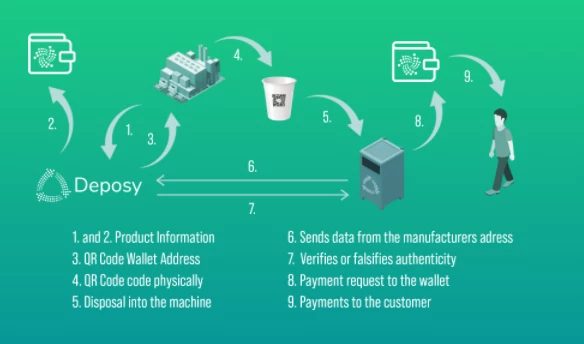
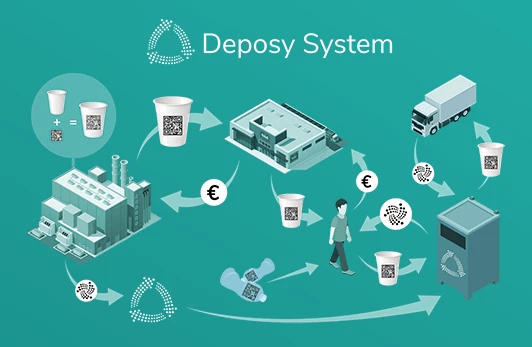
IOTA is used for payments because transaction fees are avoided here, and the transfer and validation of product data is handled via the Tangle. This gives the plastic packaging a kind of identity that is held unchangeable.
Which IOTA technologies are used? (Libraries, tools, etc.)
Trinity Wallet, selective Permanodes and the Python library Pyota are currently in focus. However, a number of things can be added in the course of development.
What other hardware and software is used?
We are currently building our prototype on a Raspberry Pi as a Python program and have chosen two cameras for recording the QR codes, one with infrared and a normal webcam, the whole thing we transfer to an external screen. We also consider external options from our partners, such as an API from Omoku and a hardware / software solution from Lidbot.
What is the main reason for choosing IOTA?
The system developed is based on the properties of IOTA, a distributed ledger technology, which are entirely suitable for this purpose. IOTA is a young cryptocurrency that enables fast, secure and free transfer of data and finance. A conventional system, which would be processed through banks, would not meet the demands on the system. The basic requirement for a successful implementation is scalability without exponentially increasing costs, the transparency of the system and the decentralized, safe control of the processes. Micro payments could be made along with data exchange.
What motivated you to move the project forward? What motivates you to continue the project?
Our passion for IOTA technology and the desire to help shape a sustainable world drives us to always get the best out of us. The positive feedback when we went public with the idea gave us another push to go full throttle.
Can the community help you? If yes how?
First and foremost, it is important to spread the idea and raise awareness among the masses. In addition, we are currently still dependent on donations to be able to cover the costs and a first prototype. Constructive criticism and suggestions for improvement are of course always welcome.
In summary ...
Deposy offers an incentive to return the used packaging. When purchasing a product with a special QR code, an additional deposit will be charged. After use, it can be handed over to a Deposy machine. Whoever brings it back will receive the deposit e.g. as an IOTA payment on his digital wallet. The amount can also be paid to his account in local currency via cooperation partners.
Website: www.deposy.org/
Twitter: https://twitter.com/deposyproject





