Before the COVID-19 Pandemic, CEEK developed a blockchain-based streaming platform for virtual reality events and experiences that enables performers and content creators to expand the reach of their content. Artists, performers, educators, and others use the CEEK platform to connect with their audience and make experiences that were not possible before.
Think of it as CEEK like iTunes: a virtual reality headset (VR) is like an iPod that lets you play content.
CEEK-symbolized virtual tickets give music artists and content creators access to an untapped, unlimited source of revenue driven by their fans. The CEEK platform enables content creators to generate revenue from their user base by selling authenticated virtual tickets through the blockchain, a verified digital asset. Today, the platform looks like Ticketmaster for virtual events but is actually a decentralized marketplace for content creators.
CEEK VR creates, curates, and distributes live streams of concert and virtual reality content from high-profile partners with patented headsets and the CEEK VR platform. CEEK is a virtual event streaming platform that enables music artists, sports teams, and other content creators to earn direct revenues from their fans. CEEK is the streaming service for virtual events and experiences that enables authors of live event content to generate revenue and extend its reach to multiple devices such as mobile phones, mobile phones, virtual reality headsets, game consoles, desktops, tablets, and smart televisions.
CEEK addresses some of the most important challenges facing artists and performers today. Users can earn ONG1 for being active on their platform by posting and getting likes. The CEEK Smart VR tokens (CEEK) are a type of ERC-20 and BEP-20 asset that can be found on multiple central and decentralized exchange platforms and can be used in the CEEK product landscape for a variety of purposes, such as purchasing tickets for virtual events, purchasing digital goods and securing VIP interactions with end-users and their favorite artists.
CEEK announced the collaboration between UME and CEEK VR to release world-class virtual concerts on the streaming platform CEEK Content. To gain access to opportunities with UMG's top artists, "CEEKers" or users of the CEEK platform will be offered behind-the-scenes content and exclusive interviews. CEEK is an award-winning, blockchain-enabled virtual reality streaming platform that consists of a portfolio of patented products and services designed to bring the world of VR to the masses for entertainment, education, and health. CEEK has held virtual events with some of Ghana's best artists, with more than 1 million people simultaneously trying to access content via the company's website and virtual reality app. The platform also allows content creators to earn native tokens on the platform, known as CEEK Plus, by creating virtual worlds and digital assets and making them available in the platform's ecosystem. This year, Bon Jovi s relationship with UME allowed access to a list of performers. Bon Jovi filmed a virtual 360-degree experience on the platform, including a song from his upcoming album "Bon Jovi 2020", a behind-the-scenes look at his music videos, and a candid interview with the artist.
After attracting more than 4 million registered users in three years, the award-winning Electronum has made great strides to become the world’s leading crypto-useability. There are over 1,900 merchants in 170 countries around the world that accept ETN payments. any task is the worldwide freelance platform of Electronums, where 465,600 people have registered as buyers and sellers with over 7,500 listed tasks. It created an Open Economic Framework (OEF) which serves as a decentralized search and value exchange platform for various autonomous economic actors.
The 360VR experiences on the CEEK platform are available for download on iOS, Android, Facebook, and Oculus. Last year, CEEK has integrated Apple's iTunes Card into the CEEK Virtual Reality Card, which is available with all CEEK products, simplifying the access for CEEKers to the platform. With 360 VR videos in real 3D and 180 immersive images, CEEK delivers compelling experiences enhanced by our award-winning, patented 4D virtual reality audio, KI, and visual technologies.
Not surprisingly, the platform has become a favorite of international stars like Lady Gaga, Katy Perry, and Ziggy Marley. In this episode of Profit People, Mary welcomes us to learn about her amazing journey from working at Mcdonald's to becoming a successful founder. Artists and fans use CEEK to share their content on their platforms, creating a viral network effect. The CEEK-based system enables tasks such as the validation of content streams and payments to be completed quickly and securely.
Michael Owusu-Addo received 92 awards and 165 nominations at the Ghana Music Awards, Guba Bet, MTV Africa Music Awards. The virtual concert was an explosive start for Harmony U2019s connection to CEEK. But it was a whole other level of live performance.
BEHIND CEEK AND ITS PARTNERSHIPS
The Creek VR is seriously underrated and not well known to the public, therefore it's not a mainstream platform yet.
If the crypto community and especially the investors had the attention on CEEK they will know that CEEK truly is a sleeping giant ready to burst at any moment.
CEEK’s biggest weapon is the team behind it and its partnerships. CEEK is in partnerships with globally-renowned industry leaders and the biggest tech innovators such as Universal Music, Apple, T-Mobile, and Baptist Health.
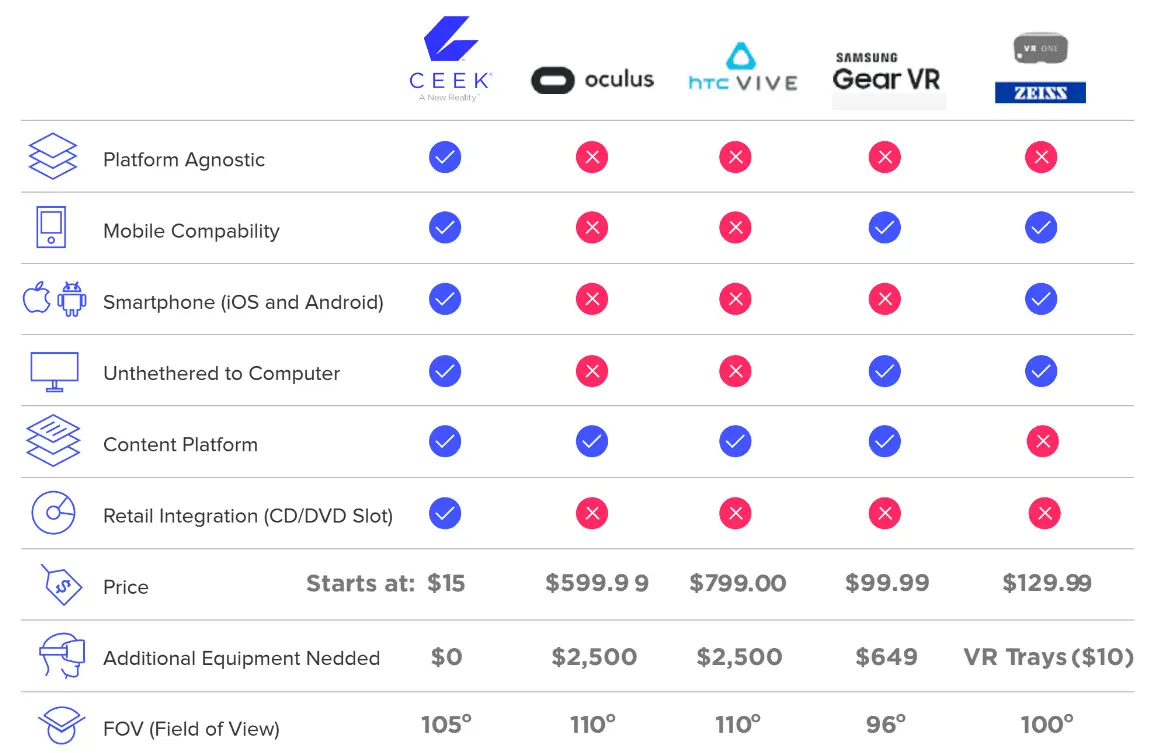
CEEK’s have also a patent-awarded VR bundle that is currently being sold nationwide in the US through major retailers including Best Buy and Target and is widely recognized as one of the best “mobile-ready” VR hardware devices on the market today, period...
LET'S TALK ABOUT WHAT MATTERS THE MOST:
THE CEEK VR HARDWARE & CONTENT ECOSYSTEM
If you asked the team behind CEEK, there are a number of considerations within today's virtual reality hardware and content ecosystem that are hindering mainstream adoption of virtual reality:
1. Desktop VR, such as the HTC Vive, are tethered devices and require an expensive gaming computer to work. This is far too expensive for most people. Moreover, desktop VR is impractical for movement. CEEK simulates the communal experience of attending a live concert, being in a classroom, attending a sporting event and other "money can’t buy" exclusive experiences with friends. After the token launch, end-users will be able to use their CEEK tokens for making purchases, vote for content, control the programming, and much, much more.
2. Console VR, such as PlayStation VR (PSVR), requires the added expense of a gaming console, therefore also priced too high for many consumers and not practical for movement. Both are geared more towards gaming, which limits the practical application and ability for the mainstream adoption of virtual reality. CEEK is going to change that.
3. Many headsets are too complex and have a difficult time selling without relevant content.(9)Mobile VR is the most cogent mechanism for delivering VR entertainment for everyday users. CEEK offers simple, ready-to-use mobile VR headsets requiring no setup, no wires (no tethers!), and, most importantly, are cost-effective. People will be able to use the mobile phone they already own. Imagine that.
MOBILE-POWERED VR IS A FUTURE CHALLENGE THAT CEEK HAVE FIXED
The most obvious and well-discussed challenge facing mobile VR applications is the much more limited power budget and thermal constraints when compared to its superior twin, the desktop PC equivalent.
The current VR tech is normally seriously intensive in graphics and their applications. Running from a battery means that lower power components and efficient use of energy are required to preserve battery life. In addition, the proximity of processing hardware to the wearer means that the thermal budget can’t be pushed any higher either.
For comparison, mobile VR is typically operating within a sub-4 watt limit, while a desktop VR GPU can easily consume 150 watts or more.
Looking back at your typical mobile SoC, this creates additional problems that are less often appreciated. Although mobile SoCs can pack in a decent octa-core CPU arrangement and some notable GPU power, it’s not possible to run these chips at full tilt, due to both the power consumption and thermal constraints mentioned previously.
In reality, the CPU in a mobile VR instance wants to run for as little time as possible, freeing up the GPU to consume the bulk of the limited power budget. Not only does this limit the resources available for VR logic, physics calculations, and even background mobile processes, but also puts a burden on essential VR tasks, such as "draw calls" for stereoscopic rendering.
DRAW CALLS?
AT THIS POINT IN THE ARTICLE, IT'S ALMOST SAFE TO ASSUME THAT THE TERM "DRAW CALLS",
NEEDS TO BE EXPLAINED FURTHER
Put it simply:
draw calls are commands the CPU sends to your GPU to draw geometry on your screen.
Your CPU knows what is to be drawn. After all, that's what your VR scene contains.
At the same time, your GPU shows how to draw it.
The bridge between CPU and GPU that gets your scene rendered are the draw calls.
Think of draw calls as the engine behind CEEK saying: "draw this here, draw that there".
They are like workers, but with a different rank and purpose. No one can function without the other.
So the more of those "draw calls" you have, the more overhead you're putting on your CPU.
The reason is simple: preparing and submitting draw calls is expensive for your CPU.
Therefore it's near impossible to try running content-rich VR applications on a CPU alone with the current tech.
THE SOLUTION ARE COMMING
The industry is already working on solutions for this, which don’t just apply to mobile. Multiview rendering is supported in OpenGL 3.0 and ES 3.0 and was developed by contributors from Oculus, Qualcomm, Nvidia, Google, Epic, ARM, and Sony. Multiview allows for stereoscopic rendering with just a single draw call, rather than one for each viewpoint, reducing the CPU requirements and also shrinking the GPU vertex job too. This technology can improve performance by between 40 and 50 percent. In the mobile space, Multiview is already supported by a number of ARM Mali and Qualcomm Adreno devices. Another innovation expected to appear in upcoming mobile VR products is foveated rendering. Used in conjunction with eye-tracking technology, foveated rendering lightens the load on a GPU by only rendering the user’s exact focal point at full resolution and reducing the resolution of objects in the peripheral vision. The complements the human vision system nicely and can significantly reduce GPU load, thereby saving on power and/or freeing up more power for other CPU or GPU tasks.
ANOTHER PROBLEM IS BANDWIDTH AND HIGH-RESOLUTIONS
While processing power is limited in mobile VR situations, the platform is still beholden to the same requirements as other virtual reality platforms, including the demands of low latency, high-resolution display panels. Even those who have viewed VR displays that boast a QHD (2560 x 1440) resolution or the Rift headset’s 1080×1200 resolution per eye will probably have been a little underwhelmed by the image clarity. Aliasing is especially problematic given that our eyes are so close to the screen, with edges appearing particularly rough-looking or jagged during motion. The brute force solution is to increase the display resolution, with 4K being the next logical progression. However, devices need to maintain a high refresh rate regardless of resolution, with 60Hz considered the minimum but 90 or even 120Hz being much more preferable. This puts a large burden on system memory, with anywhere from two to eight times more than today’s devices. Memory bandwidth is already more limited in mobile VR than it is in desktop products, which use faster-dedicated graphics memory rather than a shared pool.
Possible solutions to save on graphics bandwidth include the use of compression technologies, such as ARM and AMD’s Adaptive Scalable Texture Compression (ASTC) standard or the lossless Ericsson Texture Compression format, both of which are official extensions of OpenGL and OpenGL ES. ASTC is also supported in hardware in ARM’s latest Mali GPUs, Nvidia’s Kepler and Maxwell Tegra SoCs, and Intel’s latest integrated GPUs, and can save on more than 50 percent bandwidth in some scenarios versus the use of uncompressed textures. Image credit: Android Authority
Alternatively, developers can make sacrifices to image quality in order to reduce the stress on the system bandwidth.
Geometry density can be sacrificed or more aggressive culling used to reduce the load, and vertex data resolution can be lowered to 16-bit, down from the traditionally used 32-bit accuracy.
Many of these techniques are already being used in various mobile packages, and together they can help reduce the strain on bandwidth. Not only is memory a major constraint in the mobile VR space, but it’s also a rather large consumer of power too, often equal to the consumption of the CPU or GPU. By making savings on memory bandwidth and usage, portable virtual reality solutions should see longer battery life.
LOW LATENCY AND DISPLAY PANELS
Displays are particularly! an
important part in the overall latency of a virtual reality system, often making the difference between a seamless and a sub-par experience. In an ideal system, motion to-photon latency – the time taken between moving your head and the display responding– should be less than 20 milliseconds. Clearly, a 50ms display is no good here. Ideally, panels need to be sub-5ms in order to accommodate sensor and processing latency as well.Currently, there’s a cost-performance trade-off that favors OLED, but this could soon change. LCD panels with support for higher refresh rates and low black-to-white response times which make use of cutting edge techniques, such as blinking backlights, could fit the bill nicely. Japan display showed off just such a panel last year, and we may see other manufacturers announce similar technologies too.
AUDIO AND SENSORS
Although audio in virtual reality is a critical factor, it is largely ignored!.
With CEEK’s innovative and technical expertise, they deliver a considerably enhanced listening encounter. Great image quality without high-fidelity and positionally accurate 3D audio, along with low-latency sensors, leave many VR experiences lacking.
Playback of spatial audio on mobile devices is primarily being done with plug-ins and sound objects, all on a restricted mobile power budget.
This affects the CPU, GPU, and memory, presenting further challenges. (12)What You Hear is What You SeeThe human brain requires audio-visual sync for generating a feeling of presence and emotion, making our auditory and visual senses the most important factors in creating true immersion. What we see and feel is largely dictated by what we hear.
The CEEK 4D audio technology combines haptic feedback and proprietary physics-based 3D audio technology with the visuals rendered in immersive VR environments creating an appreciably enhanced degree of depth and interactivity, along with producing rich and engulfing soundscapes. This all combines in creating what is rightfully described as audio bliss.
CEEK has proprietary 4D Audio Visualization software and hardware.
Additionally, it has integrated 3rd-party 3D audio decoders for enhanced audio capabilities. The CEEK 4D audio technology combines original sound files with geometry data for visualizing audio within the VR environment. Unlike other 3D techniques using sound objects positioned statically in pre-set locations in the environment, our approach enables sound to be dynamically rendered. Furthermore, it does not require the content creator to learn new software or plug-ins, since the output is compatible with most existing sound systems and does not require custom audio playback systems.
The typical head-related transfer function (HRTF) and convolution reverb processing required for realistic-sounding source positioning are very processor-intensive when performed with the CPU. Our approach is much more effective as it involves creating and offering a dedicated Digital Signal Processor (DSP) with efficient processing time and power for 4D positional audio.
This tech is the gamechanger that will bring CEEK miles ahead of the rest of the pack.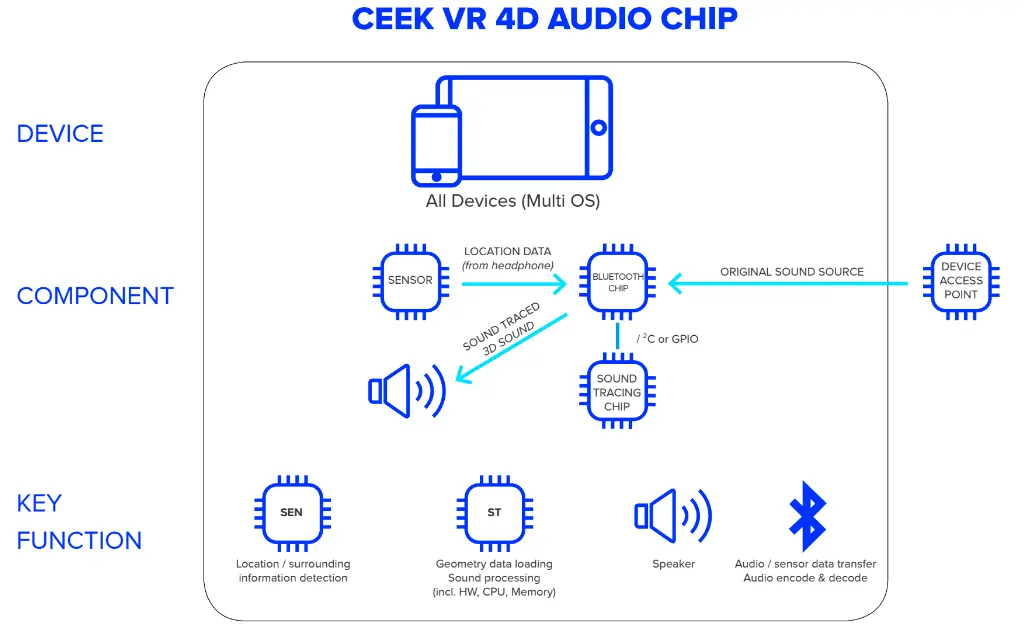
Image credit: CEEK
DEVELOPERS AND THE SOFTWARE ECOSYSTEM BEHIND CEEK
Finally, none of these hardware advancements are much good without software suites, game engines, and SDKs to support developers.
After all, they can’t count on that every developer reinventing the wheel for every application on the platform.
Keeping development costs low and speeds as fast as possible is key if CEEK is going to see a wide range of applications. SDKs in particular are essential for implementing key VR processing tasks, such as Asynchronous Timewarp, lens distortion correction, and stereoscopic rendering.
Not to mention power, thermal, and processing management in heterogeneous hardware setups. CEEK has thought of that as well and will offer open SDKs to streamline and accelerate these key processing tasks for application developers.
Nice move CEEK!, you have done your homework.
Additionally, CEEK will include an SDK with multi-language support, wallets, and payment gateways that are available as completely open source solutions that allow developers to customize their VR environment for music, entertainment, gaming experiences, and more.
Fortunately, all major hardware platform manufacturers offer SDKs to developers, although the market is rather fragmented resulting in a lack of cross-platform support.
For example:
Google has its VR SDK for Android and a dedicated SDK for the popular Unity engine.
Oculus has its Mobile SDK built in conjunction with Samsung for the Gear VR. Importantly.
Khronos group recently unveiled its OpenXR initiative which is aiming to provide an API to cover all of the major platforms at both the device and application level layers, in order to facilitate easier cross-platform development.
CEEK leverages OpenXR, along with an open SDK to offer a better cross-platform, streamlined solution for developers.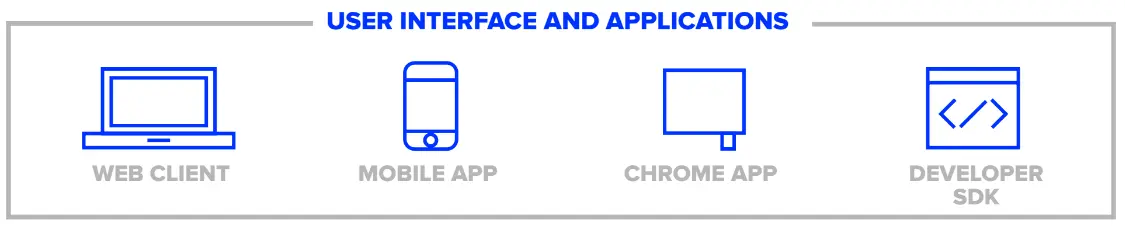
 Image Image credit: CEEK
THE PROBLEM HAS BEEN FIXED PROPERLY BY CEEK
Without a cross-platform standard, VR applications, games, and engines must port each vendor’s API. In turn, this means that each VR device can only run the apps that have been ported for its SDK.
The result is high development costs and confused customers, thereby limiting the market growth: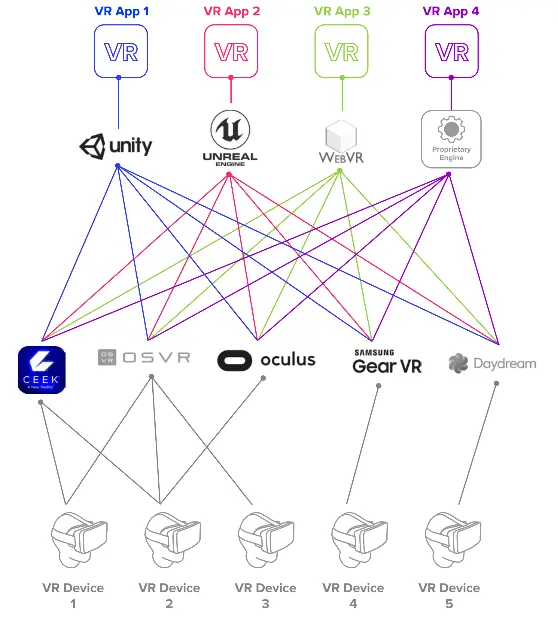
THE INNOVATIVE SOLUTION FROM CEEK
The cross-platform VR standard eliminates industry fragmentation by enabling applications to be written once and will then run on any VR system.
This allows access to VR devices and integration into those VR systems used by their applications: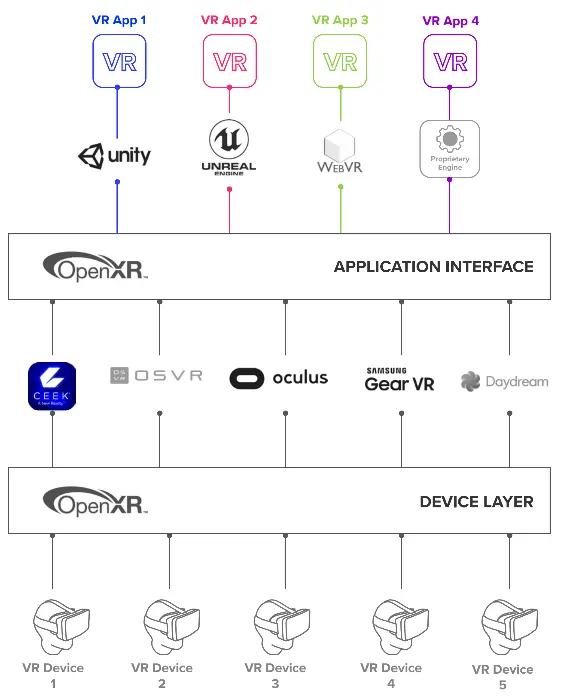
AN ECOSYSTEM CATALYST
CEEK IS AN ECOSYSTEM CATALYST WITH STRONG EARLY-MOVER MARKET POSITIONING IN VR, WHO WILL NOW BE ABLE TO EXPAND THESE CAPABILITIES BY PROVIDING INCREASED FUNCTIONALITY USING BLOCKCHAIN TECHNOLOGY.
THE FUTURE OF IMMERSIVE HIGH-QUALITY VR CONTENT IS LOOKING VERY GOOD THANKS TO CEEK AND THE TEAM BEHIND IT.