
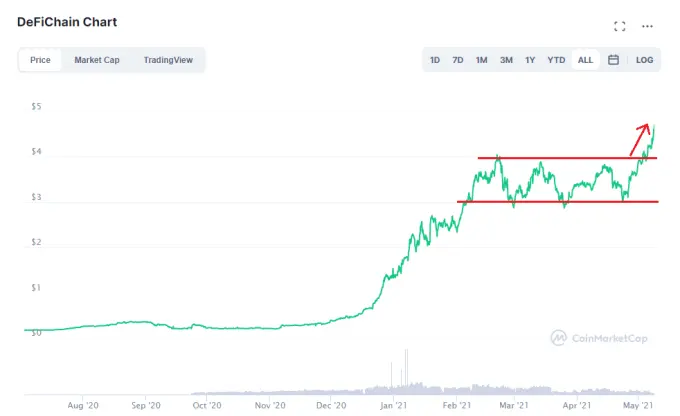
Welcome back to part 2 of my DeFiChain series, where I'll be sharing what I've researched on DeFiChain, and why I believe it is going to be a great project. Before we get into it, I'd just like to recap that as I mentioned in the last post, the DFI token has broken out of its prior resistance at the ATH ($4) and is currently in price discovery, albeit slightly hampered by a small bitcoin correction at the time of writing.
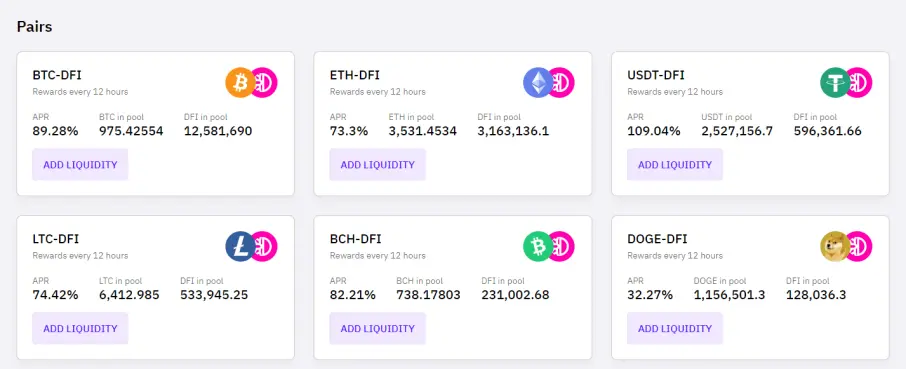
If you haven't been living under a rock in the crypto space, you have probably heard of a highly lucrative venture called liquidity mining for Decentralized Exchanges. Many DEXs provide returns of above 100%, such as the one I'm using with Cake DeFi.
So what's the downside? Other than the 2 biggest risks that are easily understood, namely a DEX collapsing and smart contract risk (chances of happening for both are negligible), a third risk that is more difficult to explain is impermanent loss. Putting it in the simplest terms, impermanent loss is the loss that occurs in providing liquidity compared to simply holding the asset.
Let's say that 1 Bitcoin is currently equal to 10,000 DFI.
And let's assume that the current liquidity pool size is 9 BTC : 90,000 DFI (18 BTC in the pool).
If you now add 1 BTC and 10,000 DFI (2 BTC) to the liquidity pool, you contribute 10% of the liquidity and are entitled to 10% of the Liquidity Mining Rewards. So the new liquidity pool size is 10 BTC : 100,000 DFI (20 BTC in the pool). This should be easy to grasp.
Then, let's assume someone uses the DEX to buy 10,000 DFI with 1 BTC, so the pool becomes 11 BTC : 90,000 DFI. If you want to withdraw your liquidity shares, it's easy to calculate that your 10% share is 1.1 BTC and 9000 DFI. In this scenario where the price of DFI is still the same as when you provided liquidity (1 BTC to 10,000 DFI), there is no impermanent loss because the total value of your assets is still 2 BTC.
But what if the price of DFI doubles relative to Bitcoin, so that 1 Bitcoin is equal to 5,000 DFI?
Using the same 11 BTC : 90,000 DFI ratio in the pool, the DFI is now worth 18 BTC, and the total pool is worth 29 BTC. At this point, arbitrageurs will use the DEX to balance out the value, which leaves us with 14.5 BTC and 72,500 DFI in the pool. If you want to withdraw your liquidity now, you will still get 10% of the pool, which is 1.45 BTC and 7,250 DFI. However, because the value of DFI has increased, your total assets are now worth 1.45 BTC plus another 1.45 BTC in DFI = 2.9 BTC. Hence, you have "lost" 0.1 BTC in value compared with the scenario where you just held BTC and DFI tokens (which would be 3 BTC) without providing liquidity. As you can see, this is not a huge loss, given the fact that Cake Defi gives you up to more than 100% APR on your assets.
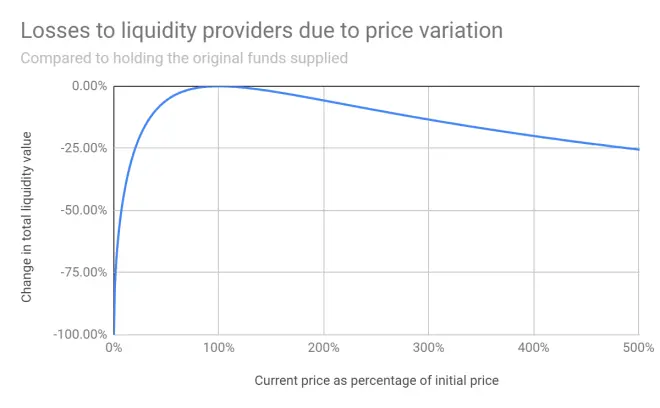
This graph illustrates how much impermanent loss can occur when the assets you mine liquidity for increases in value. There is also an impermanent loss calculator you can use to forecast how much your loss is, depending on how much the asset appreciates.
In summary, as much as I am bullish on DeFiChain and their DFI token in general, I don't foresee the price of DFI to rise so much this market cycle as to negate the 109% APY that Cake gives. I'm predicting that DFI could go to around $6-10 before the whole cryptocurrency market starts to crash, and will be gradually DCA-ing my way out.
Again, I'll end this post off by saying that Cake Defi is having a promotion for joining their pool and you can get free $30 worth of 6-month locked DFI (which will be earning interest too) by using my referral link here and depositing $50 or more.





