
Wealthy individuals have long used a simple but powerful strategy: they rarely sell their appreciating assets. Instead, they borrow against them. This approach — sometimes summarized as “buy, borrow, die” — lets them access liquidity while deferring or minimizing capital gains taxes, retaining ownership of assets that continue to grow, and ultimately passing wealth to heirs with stepped-up basis in many jurisdictions.
DigiByte’s DigiDollar, activated on mainnet in July 2026, applies a parallel concept directly on a blockchain. Users lock DigiByte (DGB) as over-collateralized, time-locked collateral in on-chain vaults and mint DigiDollars — a USD-pegged stablecoin native to the DigiByte protocol. No centralized issuer, no bank reserves, and no forced liquidations. The result is non-custodial, dollar-like liquidity while users keep exposure to their underlying DGB. Here is a clear comparison of the two approaches, their benefits, key differences, and what DigiByte is working to achieve.
The Traditional Strategy: Borrowing Against Assets
High-net-worth individuals and institutions commonly hold stocks, real estate, private equity, or other assets. When they need cash for living expenses, investments, or lifestyle, they take out loans or lines of credit secured by those holdings.
- Loans are generally not treated as taxable income.
- The underlying assets stay in place and can continue appreciating.
- Interest may be deductible in certain cases.
- At death, heirs often receive a stepped-up cost basis, reducing or eliminating capital gains tax on prior unrealized gains.
This works well for those with substantial, relatively stable or diversified collateral and access to favorable lending terms from banks or private lenders. It requires ongoing relationships with financial institutions, credit checks, paperwork, and the risk of margin calls or forced sales if collateral values drop sharply.
DigiDollar: Bringing Asset-Backed Liquidity On-Chain
DigiDollar is DigiByte’s protocol-native, non-custodial stablecoin. It is the first of its kind built directly into a UTXO blockchain’s consensus rules rather than relying on a company issuer or smart-contract platform.
Users lock DGB into special Taproot time-locked collateral vaults they control with their own private keys. Against that locked collateral they mint DigiDollars pegged to the U.S. dollar. The system is deliberately over-collateralized (ratios typically range from 200% to 1000% depending on the chosen lock period, with longer locks allowing lower ratios). Price data comes from a decentralized oracle roster using MuSig2 signatures so no single party controls the feed.
When the time-lock expires, users can burn DigiDollars to unlock their original DGB (plus any appreciation). There is no liquidation engine — positions are not force-sold during volatility. The design relies on high collateral ratios, dynamic adjustments, emergency redemption mechanics, and temporary freezes during extreme price swings to protect the system.
Everything happens inside DigiByte Core or compatible wallets. Users never surrender private keys or hand assets to a third party. DigiDollar transfers settle on DigiByte’s ~15-second blocks.
Side-by-Side Comparison
Similarity in core idea
Both approaches let asset owners access spending power or liquidity without selling the underlying asset. In the traditional model you keep stocks or real estate and borrow cash. With DigiDollar you keep your DGB exposure and mint stable DigiDollars.Benefits shared or analogous
- Liquidity without a sale (and the associated taxable event in many cases).
- Continued ownership of the appreciating asset.
- Ability to use the proceeds for spending, investing, or other needs.
- Potential to hold the asset long-term or indefinitely.
Key differences
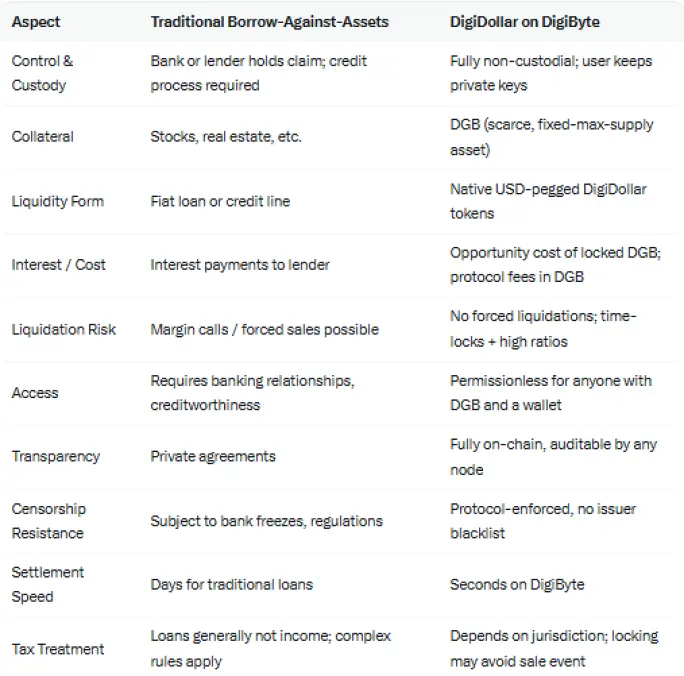
DigiDollar is closer to creating a self-custodied, over-collateralized position than to taking a traditional bank loan. There is no counterparty charging interest in the conventional sense, but users forgo the ability to spend or transfer the locked DGB during the chosen period (from short test locks up to multi-year terms).
Benefits of the DigiDollar Approach
- Non-custodial and permissionless: No bank, no issuer, no admin keys that can freeze funds.
- Retained upside: DGB remains yours; any price appreciation accrues to you when you redeem.
- Stable spending power: DigiDollars track the dollar for everyday use, transfers, or commerce without crypto volatility.
- On-chain transparency and auditability: Every vault and the aggregate collateral ratio can be verified by any full node.
- No forced liquidations: The time-lock model plus high over-collateralization reduces cascading failure risks common in some DeFi systems.
- Scarcity feedback: Locking DGB removes it from circulating supply for the duration, which can support DGB’s value proposition as a strategic reserve asset.
- Speed and low friction: Mint, transfer, and redeem settle in DigiByte’s fast blocks.
What DigiByte Is Set to Achieve DigiByte aims to make dollar-like stability and liquidity available in a fully decentralized, UTXO-native form that inherits the network’s long track record (uninterrupted since 2014), multi-algorithm proof-of-work security, and 15-second blocks.
By turning DGB into productive collateral for a native stablecoin, the project seeks to:
- Give everyday users and DGB holders a practical way to access stable value without selling or relying on centralized stablecoins (USDT, USDC, etc.) that carry issuer and custody risk.
- Increase utility and demand for DGB itself by creating a reason to lock it long-term.
- Demonstrate that a mature UTXO chain can host a robust, protocol-level stablecoin without smart-contract platforms or custodial reserves.
- Offer a censorship-resistant, transparent alternative for payments and savings that settles quickly and remains under user control.
- Expand DigiByte’s role beyond a pure store of value or medium of exchange into a foundation for non-custodial financial tools.
DigiDollar does not replicate every feature of traditional private banking (there is no revolving credit line in the classic sense, and lock periods apply). It also carries crypto-native risks: oracle integrity, collateral volatility (mitigated by high ratios), and the need for users to manage their own keys and time-locks carefully. Tax treatment of locking versus selling varies by country and should be evaluated individually.
Still, the conceptual parallel is strong. Just as the wealthy have long preferred borrowing against assets rather than selling them, DigiDollar lets DGB holders lock their holdings and mint stable liquidity while remaining in full control. It is an on-chain expression of the same preference for ownership, optionality, and deferred realization of gains — available to anyone with DigiByte and a compatible wallet.
In short, DigiByte is not merely copying a traditional wealth technique. It is adapting the underlying principle — access liquidity without relinquishing the asset — to a decentralized, transparent, and permissionless environment.





