
Coinbase recently expanded its crypto-backed lending product, allowing users to borrow USDC against Bitcoin without selling it. The service (powered by Morpho on Base) has grown significantly, with both variable- and fixed-rate options now available. On the surface it offers liquidity while keeping Bitcoin exposure. Dig deeper, however, and a clear contrast emerges with DigiByte and its native DigiDollar (DD).DigiDollar is a protocol-level, USD-pegged stablecoin launched on DigiByte mainnet in July 2026. It lets users generate stable value directly from their DGB holdings in a fully non-custodial way. When the two approaches are placed side by side, DigiByte and DigiDollar better embody the original spirit of cryptocurrency.
How Coinbase’s Bitcoin Loans Actually Work
Users pledge Bitcoin as collateral. Coinbase converts it 1:1 into cbBTC (Coinbase Wrapped Bitcoin) and moves it on-chain into Morpho smart contracts on the Base network. In return, the user receives USDC. The process is fast and user-friendly inside the Coinbase app. The trade-offs are significant:
- Custody of the Bitcoin is temporarily surrendered to Coinbase and then to Morpho contracts.
- The loan is over-collateralized and subject to liquidation if the loan-to-value ratio deteriorates.
- Interest rates apply (variable or fixed, depending on the product).
- The borrowed asset is USDC, a centralized stablecoin issued by Circle that relies on traditional banking reserves and can be frozen or restricted.
- Users must trust Coinbase’s interface, Morpho’s smart contracts, Base’s infrastructure, and the claim that everything remains properly backed.
It is convenient TradFi-style credit wrapped in crypto clothing.
How DigiDollar Works on DigiByte
DigiDollar is built natively into DigiByte’s UTXO protocol (not a smart-contract token on a separate layer). The process is straightforward and remains entirely under the user’s control:
- In your own DigiByte Core wallet (or compatible DigiDollar-aware wallet), you lock DGB into a time-locked Pay-to-Taproot (P2TR) collateral vault on-chain.
- The protocol uses a decentralized oracle feed (MuSig2 threshold signatures from a roster of independent oracles) to determine the current DGB/USD value.
- You mint DigiDollars against that locked collateral at an over-collateralized ratio (typically 200–1000% depending on the lock period chosen).
- The DigiDollars appear in your wallet and can be spent or transferred immediately.
- To redeem, you burn the DigiDollars and the time-locked DGB is released back to you once the lock expires (or under the protocol’s redemption rules).
Key design choices:
- No third-party custodian ever takes control of your DGB.
- No company issues the stablecoin.
- No forced liquidations — the system relies on high over-collateralization and time-locks instead of margin calls.
- Everything settles on DigiByte’s 15-second blocks with ordinary network fees.
- Full transparency: anyone running a node can independently verify the collateral behind every DigiDollar.
Bitcoin’s Original Vision and the Reality of Partial Decentralization
Satoshi Nakamoto designed Bitcoin as a peer-to-peer electronic cash system that removes the need to trust third parties. “Don’t trust, verify” became the guiding principle. Users were meant to run their own nodes, hold their own keys, and settle transactions without intermediaries.
When you use Coinbase’s Bitcoin-backed loans, that vision is compromised. You hand custody of your BTC to a centralized exchange, which then wraps it and deposits it into smart contracts managed by another protocol. You must trust Coinbase’s operational security, Morpho’s code, the Base network, and the broader ecosystem that the collateral remains intact and that liquidation rules will be enforced fairly. The Bitcoin itself no longer sits solely under your private keys. This is partial decentralization at best — convenient, but a step away from Satoshi’s original design.
DigiByte and DigiDollar restore the pure definition of decentralization that Satoshi had in mind. You run your own node. You are the issuer of your own DigiDollars. You keep full custody of your DGB the entire time you mint DigiDollar. Nothing leaves your wallet except the cryptographic lock enforced by the protocol itself. You do not have to trust marketing claims that assets are “backed 1:1.” You verify the collateral, the time-locks, and the oracle data directly on-chain in your own wallet and node. The entire process is decentralized from start to finish.
Side-by-Side Comparison 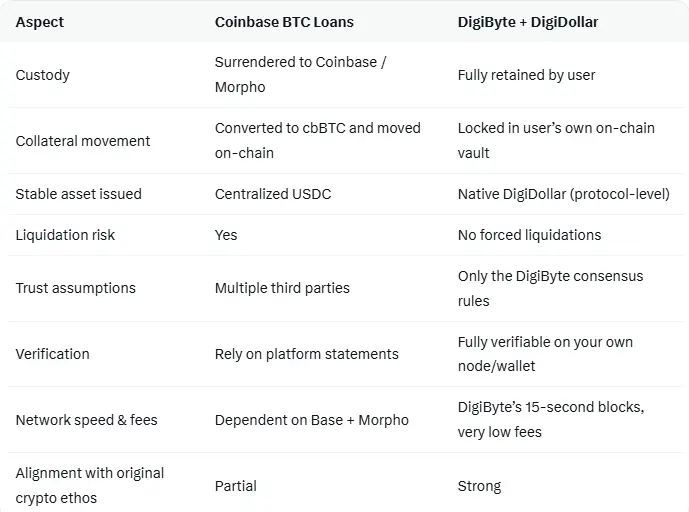
Why DigiByte and DigiDollar Are Superior
DigiDollar delivers the same core benefit — liquidity without selling your crypto — while eliminating the biggest compromises of the Coinbase model. You never give up control of your private keys. There is no centralized issuer that can freeze assets or change the rules unilaterally. There is no smart-contract attack surface of the kind found on EVM chains. The collateral and the stablecoin both live on a battle-tested, multi-algorithm Proof-of-Work UTXO chain that has operated continuously since 2014.
By locking DGB to mint DigiDollar, users also create temporary scarcity in the circulating supply of DigiByte, aligning individual liquidity needs with the broader network’s economics. The system is transparent, auditable by every participant, and free of the counterparty risks that come with centralized platforms and wrapped assets.
Coinbase’s product is a useful bridge for people who prioritize convenience and already keep assets on the exchange. DigiByte and DigiDollar represent the next step for those who value sovereignty. They show that it is possible to unlock stable, spendable value from a volatile asset without surrendering the principles that made cryptocurrency revolutionary in the first place.
In the end, true decentralization means you remain in control at every stage. With DigiByte and DigiDollar, that control never leaves your hands.





