
In the final days of September 2026, another centralized exchange cracked. Attackers drained hundreds of millions—estimates ranging from roughly $350 million to nearly $390 million—from Bitget’s hot and warm wallets across Ethereum, the XRP Ledger, BNB Chain, Avalanche, and more. The exchange said private keys were never taken. A compromised backend had manipulated transaction data and tricked its own systems into approving the transfers. Withdrawals paused. The protection fund was called upon. User funds, they insisted, would be covered.
Then the on-chain trail lit up. Portions of the stolen assets began moving through THORChain, the permissionless cross-chain liquidity protocol that lets anyone swap native assets without bridges, wrapped tokens, or accounts. Bitcoin addresses started filling. The familiar pattern of post-hack flows appeared once again.
Bitget’s CEO did not stay quiet. She publicly demanded that THORChain refuse service to the attacker addresses. Decentralization, she argued, is a design principle—not a shield for moving known stolen funds. The industry, she warned, was watching.
THORChain did not bend.
It could not bend without abandoning what it is. "Permissionless. Neutral. Decentralized" by architecture rather than marketing. Like Bitcoin itself, the protocol has no compliance desk that can freeze addresses on demand. Nodes execute the rules. Liquidity providers supply capital. Swaps occur according to code. That neutrality has always been both its greatest strength and the reason it draws criticism whenever illicit funds pass through. In this moment, THORChain simply held the line that the original vision of crypto always demanded: systems that no single company, regulator, or exchange can unilaterally control.
The Real Problem Runs Deeper Than Hot Wallets
Every major exchange breach exposes the same concentration of risk. Hot wallets, backend systems, and human operators create attack surfaces. When they fail, the pressure immediately shifts outward: freeze the funds, blacklist the addresses, force the decentralized rails to act as recovery agents.
That pressure reveals why most stablecoins still fail the decentralization test. USDT and USDC can freeze addresses. Their issuers answer to banks, courts, and governments. Even many so-called decentralized stables rely on smart contracts with governance keys, upgrade paths, or oracles that can be influenced. On a truly permissionless DEX or cross-chain protocol, those features are liabilities. A stablecoin that can be clawed back mid-swap undermines the very neutrality the system is built on.
DigiDollar: No Issuer. No Third Party. No Clawbacks Ever.
DigiDollar ($DD) is DigiByte’s native, protocol-level USD-pegged stablecoin. It activated on mainnet on July 17, 2026, at block 23,869,440. It is not an ERC-20 token layered on another chain. It is not issued by a company. It is not backed by dollars sitting in a bank account that can be frozen or seized. There is no custodian, no foundation holding admin keys, and no liquidation engine that can seize your position when markets move.
You create it yourself.
You lock your own DigiByte (DGB) inside a time-locked Taproot vault that remains under your private keys the entire time. The protocol applies deliberate over-collateralization based on the lock duration—higher ratios for shorter locks—so the system does not depend on forced liquidations. A decentralized roster of oracles, secured by MuSig2 quorum signatures, supplies the DGB/USD price. Once the lock is confirmed by the network, DigiDollar is minted directly to you. You can transfer it, hold it, or use it immediately. When the time-lock expires (or according to the protocol’s redemption rules), you burn the corresponding DigiDollar and your original DGB returns—still under your control.
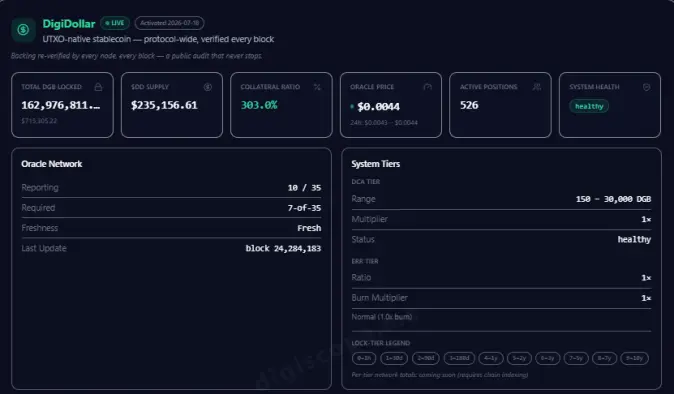
No one can claw it back. No one can freeze the vault. No subpoena reaches a company that does not exist. The rules live in DigiByte’s consensus code the same way Bitcoin’s supply limit lives in its consensus code. Every full node can audit every vault and every DigiDollar in existence, block by block.
DigiByte’s Quiet Strength Made This Possible
DigiDollar did not appear in a vacuum. It sits on DigiByte, a multi-algorithm proof-of-work UTXO blockchain that has run continuously since 2014 without foundation capture, constant hard-fork politics, or the centralization creep that has marked so many other projects. DigiByte was engineered for speed, security, and genuine decentralization long before those words became slogans. Its design allowed a native stablecoin to exist without bolting on an entire smart-contract virtual machine or trusting an external issuer.
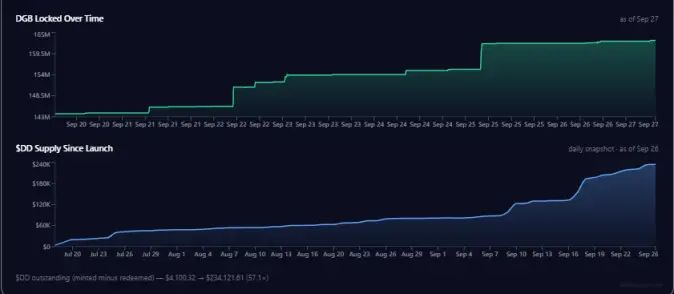
That combination—mature, battle-tested base layer plus a stablecoin with no issuer—is rare. Most of the industry still treats “decentralized stablecoin” as something that lives on top of a chain and still depends on someone, somewhere, who can be pressured. DigiDollar lives inside the chain. Your keys. Your collateral. Your decision to mint or redeem. The protocol simply enforces the math.
The Perfect Match for Permissionless Rails
On THORChain and every other truly open DEX or cross-chain protocol, DigiDollar is more than another stable asset. It is infrastructure that respects the same principles those protocols defend. When an exchange gets hacked and begins demanding that decentralized systems become selective enforcers, DigiDollar remains untouched by the demand. There is no issuer to email. There is no freeze button. There is only locked DGB, transparent collateral ratios, and users who never surrendered control.
This is what crypto was intended for. Not platforms that concentrate risk and then externalize the cleanup. Not stablecoins that can be switched off by a compliance team. Systems where value moves according to code, collateral is visible to anyone who cares to look, and no third party sits between you and your assets.
Bitget’s breach exposed the fragility of centralized custody once again. THORChain’s refusal to become a recovery tool reaffirmed the harder, cleaner path. DigiDollar completes the picture: a dollar that no one can seize, issued by the people who hold the keys, on a chain that has been quietly doing the work of decentralization for more than a decade.
- No issuer.
- No clawbacks.
- No compromise.
That is the standard. DigiByte and DigiDollar are already living it.





