Want to stay ahead of the curve ?
Follow me on X (Twitter) for the latest updates and insights before we dive into today's topic.
What is Timeswap?
Timeswap is a platform where people can lend or borrow digital assets (like ERC-20 tokens). It’s unique because it doesn’t rely on external data sources (called oracles) to function, and all the loans have a fixed term.
Key Highlights:
Multichain Expansion:
- Timeswap has expanded to 5 chains: Polygon PoS, Ethereum, Arbitrum, Polygon zkEVM, and Mantle Network.
- They launched on Arbitrum shortly after the token itself was introduced, thanks to their oracleless design that can price assets without needing a price feed.
Exotic Assets:
- Timeswap has introduced exotic assets like LP tokens which previously didn’t see much uptake in DeFi.
- Their oracleless design allows them to natively price assets without relying on external parties, enabling the integration of any ERC-20 asset without modifying the protocol.
- They also support ERC-4626 assets, leveraging popular Vault products in DeFi, starting with Aura Finance.
Key Features of Timeswap
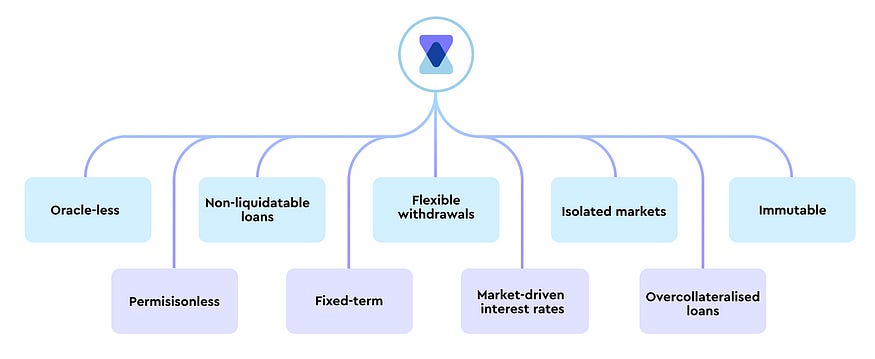
Oracleless:
- Timeswap doesn’t need external data sources to set prices or manage risks. This is like a farmer selling fruits directly at a market without needing to check prices elsewhere.
- Benefit: It’s immune to false data attacks and can support many types of digital assets.
Permissionless:
- Anyone can set up a market for any digital asset on Timeswap. Think of it as setting up a stall in a public market without needing permission.
- Benefit: It’s open for anyone to lend, borrow, or add funds to the pools.
Non-liquidatable loans:
- Borrowers don’t have to worry about their loans being called in suddenly. It’s like taking a loan from a friend who won’t ask for it back suddenly.
- Benefit: Borrowers can be more relaxed, but if they don’t repay on time, they lose their collateral (the assets they put up as security).
Fixed-term:
- All loans have a set duration and interest rate. It’s like borrowing money with a clear agreement on when and how much to repay.
- Benefit: Both lenders and borrowers have clarity.
- Flexible withdrawals:
- Even though loans have a fixed term, participants can exit early. It’s like having a fixed deposit but being able to withdraw early with some penalties.
- Benefit: More flexibility for users.
Market-driven interest rates:
- Interest rates are set by supply and demand, without relying on past data. Imagine a market where the price of apples is set by how many people are buying and selling, not by last week’s prices.
- Benefit: Fair and unbiased interest rates.
Isolated markets:
- Each lending/borrowing pool is separate. If one pool faces issues, it won’t affect others. It’s like having separate bank accounts for different purposes.
- Benefit: More security and less risk.
Overcollateralised loans:
- Borrowers can’t take loans without providing more than enough assets as security. It’s like taking a loan by keeping a gold necklace worth $2000 for borrowing $1500.
- Benefit: Lenders have more security.
Immutable:
- Once a Timeswap contract is set up, it can’t be changed. It’s like signing a fixed contract that can’t be altered later.
- Benefit: Trustworthiness and stability.
Market Participants in Timeswap
Lenders
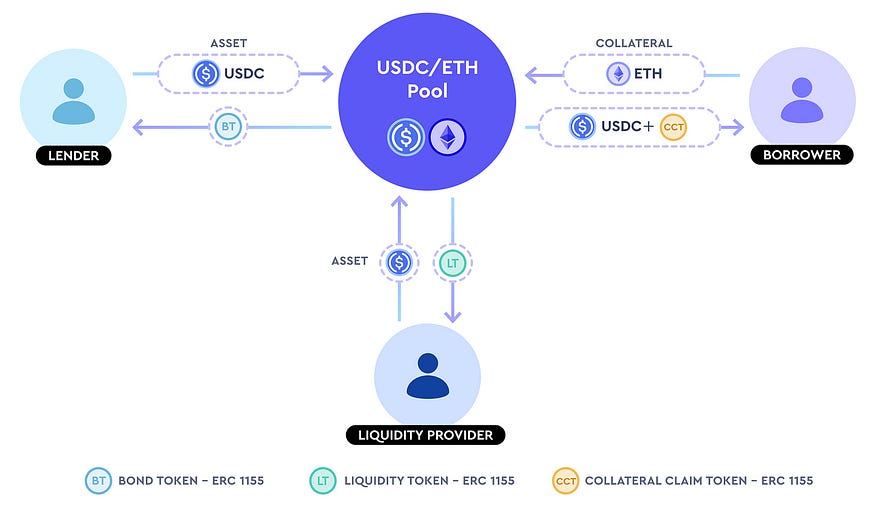
- Role: Lenders are like people who deposit money in a bank. In Timeswap, they fund pools from which borrowers can borrow.
- Benefit: They earn a fixed interest, similar to how you earn interest on savings in a bank. However, a tiny part of this interest goes to the liquidity providers as a transaction fee.
How it Works:
Fixed-Term and Non-Liquidatable Loans: Timeswap loans have a set duration and cannot be suddenly called in (non-liquidatable). When the loan term ends:
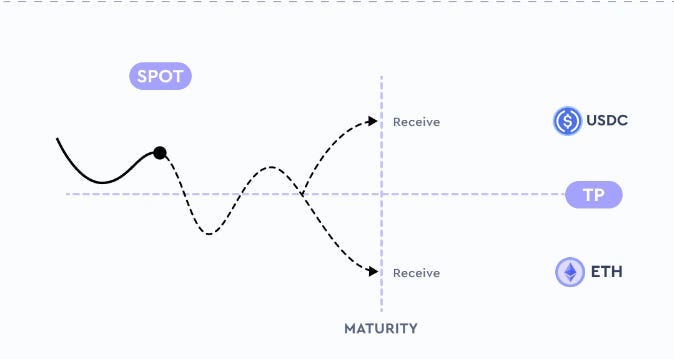
- If borrowers repay their loans, lenders get back the money they lent out.
- If borrowers don’t repay, lenders receive the collateral (like an asset the borrower put up as security) instead.
Think of this as lending money to a friend. If the friend repays, you get your money back. If they don’t, you keep something valuable they gave you as a guarantee.
Transition Price (TP): This is a crucial price level. It determines whether lenders will get back the money they lent out or the collateral. It’s like a threshold that decides the outcome based on borrowers’ actions.
Risk Management: Lending in Timeswap is different from other platforms like AAVE or Compound. In traditional platforms, the system itself manages risks through mechanisms like liquidations. In Timeswap, lenders need to be more proactive in managing their risks. It’s like choosing to lend money on terms you set and understand, rather than relying on a bank’s set terms.
Exiting Early: Even though loans have a set duration, lenders can choose to get out early if they want. However, doing so might come with some costs (slippage). It’s like breaking a fixed deposit in a bank before its maturity date; you might get a slightly lesser amount than expected.
Bond Token (BT): When lenders provide funds, they receive a digital receipt called the Bond Token. It’s a proof of their lending, similar to a deposit receipt you get from a bank.
Real-World Analogy:
Imagine you’re lending money to a friend. You both agree on an interest rate and a date by which they’ll repay. Your friend also gives you a valuable item (like a watch) as a guarantee. If they repay the money by the agreed date, you return the watch. If they don’t, you keep the watch. In this scenario:
- You are the lender.
- The money you lend is the funds you provide to the Timeswap pool.
- The watch is the collateral.
- The agreed date is the fixed term of the loan.
In essence, as a lender in Timeswap, you’re providing funds with the assurance of earning interest. You either get back your funds or the collateral, depending on the borrowers’ actions.
Borrowers
Role: Borrowers are like individuals or businesses taking a loan from a bank. In Timeswap, they borrow from pools that have funds from lenders and liquidity providers.
Benefit: They get the funds they need without the worry of sudden repayments. However, a small part of the interest they pay goes to the liquidity providers as a transaction fee.
How it Works:
Fixed-Term and Non-Liquidatable Loans: Timeswap loans have a set duration and cannot be suddenly called in (non-liquidatable). When the loan term ends:
- Borrowers can choose to repay their loans. If they do, they pay back the borrowed amount plus interest.
- If they don’t repay, they lose the collateral they put up as a guarantee.
Think of this as borrowing money from a friend. If you repay the money by the agreed date, everything is settled. If you don’t, your friend keeps something valuable you gave as a guarantee.
Transition Price (TP): This is a crucial price level. It determines whether borrowers will repay their loans or let the lenders keep the collateral. It’s like a threshold that decides the borrower’s best action based on the value of their debt and collateral.
Risk Management: Borrowing in Timeswap is different from other platforms like AAVE or Compound. In traditional platforms, borrowers need to constantly monitor their loans because of things like liquidations. In Timeswap, borrowers don’t have this concern. They can decide at the end of the loan term whether to repay or not, based on the value of their debt and collateral. It’s like taking a loan with clear terms and no sudden surprises.
Exiting Early: Borrowers can choose to repay their loans before the set duration. However, doing so might come with some costs (slippage). It’s like repaying a bank loan before its due date; there might be some penalties.
Collateral Claim Token (CCT): When borrowers take out a loan, they lock in collateral and receive a digital receipt called the Collateral Claim Token. It’s a proof of their borrowing and the collateral they’ve put up, similar to a loan agreement.
Real-World Analogy:
Imagine you’re borrowing money from a friend. You both agree on an interest rate and a date by which you’ll repay. You also give your friend a valuable item (like a watch) as a guarantee. If you repay the money by the agreed date, your friend returns the watch. If you don’t, your friend keeps the watch. In this scenario:
- You are the borrower.
- The money you borrow is the funds you take from the Timeswap pool.
- The watch is the collateral.
- The agreed date is the fixed term of the loan.
In essence, as a borrower in Timeswap, you’re taking funds with clear terms. You either repay the funds plus interest or let the lenders keep the collateral.
Liquidity Providers (LPs):
Role: LPs are like investors in a mutual fund. They provide funds (liquidity) to Timeswap pools, which then get used by lenders and borrowers.
Benefit: In return for their funds, they earn transaction fees from both lenders and borrowers. It’s like earning dividends or profits from your investment in a mutual fund.
How it Works:
Comparison to Uniswap: In platforms like Uniswap, LPs act as middlemen between buyers and sellers, earning a fee for facilitating trades. In Timeswap, LPs play a similar role, acting as intermediaries between lenders and borrowers, and earning transaction fees.
Fixed Returns: Traditional platforms like AAVE or Compound have variable interest rates based on supply and demand. In Timeswap, both lenders and borrowers deal with fixed rates. This is where LPs come in. They help balance the interests paid to lenders and received from borrowers, ensuring stability in the system.
Outcome at Maturity: Just like lenders, the assets LPs get at the end of a loan term depend on borrowers’ actions:
- If borrowers repay their loans, LPs get back the money they provided.
- If borrowers don’t repay, LPs receive the collateral (like an asset the borrower put up as security).
Divergence Loss Risk: LPs face a risk called divergence loss or impermanent loss. This happens when the value of assets in the pool changes due to market fluctuations. It’s like investing in stocks; sometimes you gain, sometimes you lose.
Exiting Early: LPs, like lenders and borrowers, can choose to withdraw their funds before the set duration. However, this might come with some costs (slippage). It’s similar to selling an investment before its maturity; you might not get the full expected return.
Liquidity Token (LT): When LPs provide funds, they receive a digital receipt called the Liquidity Token. It’s a proof of their contribution, similar to a share certificate in a company.
Pool Creation: The first LP in a pool, like the founder of a marketplace, sets the initial rules and parameters of the pool.
Real-World Analogy:
Imagine a marketplace where:
- Lenders are individuals who have extra money and want to earn interest on it.
- Borrowers are individuals or businesses who need money.
- Liquidity Providers are investors who see an opportunity to earn by providing funds to this marketplace. They act as middlemen, facilitating transactions between lenders and borrowers and earning a commission for it.
In this marketplace (Timeswap), LPs ensure there’s always enough money for borrowers to borrow and lenders to earn interest. They take on some risks, but they also earn fees for their services.
Pool Parameters and Expected Scenarios
Key Pool Parameters
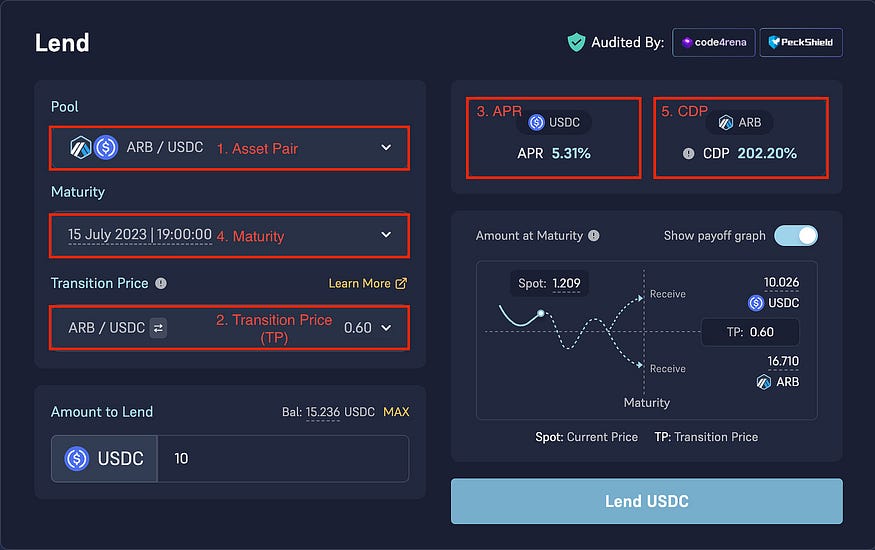
- Asset Pair: Represents the two assets involved, e.g., ETH and USDC.
- Transition Price: A price level that influences the behavior of borrowers and the expected outcome for lenders.
- APR (Annual Percentage Rate): The annualized interest rate for borrowing and lending.
- Maturity Date: The date when the pool expires.
- CDP: A figure to assists borrowers and lenders gauge their loan’s collateral factor and unit coverage respectively.
Scenarios Explained
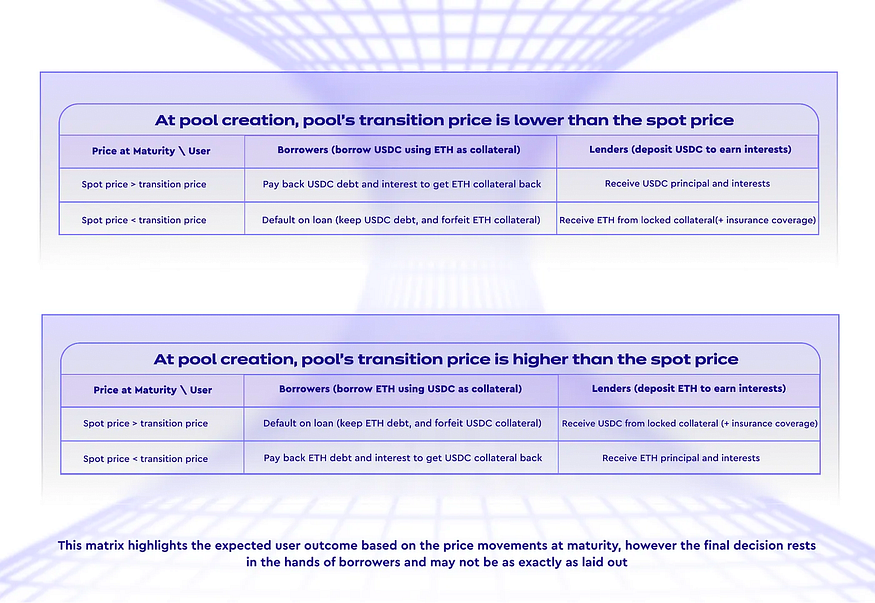
Upward Expectation:
- Assumption: Spot price of ETH is 1,000 and transition price is 800 (ETH/USDC).
- Borrowers borrow USDC using ETH as collateral.
- Lenders deposit USDC to earn interest.
- Outcome if Spot Price > Transition Price: Borrowers repay their USDC debt to unlock their ETH collateral. Lenders get back their USDC principal and earned interest.
- Outcome if Spot Price < Transition Price: Borrowers keep their USDC debt and forfeit their ETH collateral. Lenders receive the forfeited ETH.
Downward Expectation:
- Assumption: Spot price of ETH is 1,000 and transition price is 1,200 (ETH/USDC).
- Borrowers borrow ETH using USDC as collateral.
- Lenders deposit ETH to earn interest.
- Outcome if Spot Price Increases: Borrowers keep their ETH debt and forfeit their USDC collateral. Lenders receive the forfeited USDC.
- Outcome if Spot Price Decreases: Borrowers repay their ETH debt to unlock their USDC collateral. Lenders get back their ETH principal and earned interest.
Links:
Discord: https://discord.gg/timeswap
X (Twitter): https://twitter.com/TimeswapLabs
Medium: https://medium.com/Timeswap
Telegram: https://t.me/Timeswap
For real-time updates and more in-depth analysis, follow me on X (Twitter)





