
The clipping economy has turned manufactured virality into a multimillion-dollar industry, and crypto casinos like Stake, Rainbet, and Kirgo are leading the charge. Here is everything you need to know about the new attention economy.
Somewhere between a live stream and your TikTok For You Page, a small industry rewired the entire logic of how fame, gambling, and brand visibility work online. It is called the clipping economy. And in 2026, it is not a niche trend. It is the operating backbone of the new social media attention machine. And crypto iGaming is at its absolute epicenter.
What Is the Clipping Economy?
The clipping economy refers to the commercial ecosystem built around the act of clipping: taking long-form livestreamed or video content and cutting it into short, punchy, algorithm-optimised segments — typically 15 to 90 seconds — that get distributed across TikTok, Instagram Reels, YouTube Shorts, and X. Clippers are the individuals who perform this work, and they are paid not by the hour, but by the view.
What began as organic fan behavior — the internet's way of sharing funny moments from Twitch — has industrialised. Today, clipping is a structured gig economy with its own marketplaces, Discord servers, sub-contractor hierarchies, per-CPM payout structures, and nine-figure annual cashflow. It is also, increasingly, the primary growth and distribution strategy for some of the most aggressive brands in the world: crypto casinos.
The architecture is simple. A creator, streamer, brand, or casino generates long-form content — a gambling session, a podcast, a challenge. Clippers scan the footage for emotionally charged hooks: a massive slot win, an outrageous reaction, a shocking moment, a funny confrontation. They cut it, add captions, format it for vertical mobile, package it with a compelling opening frame, and post it to multiple platforms under their own accounts. The clip then propagates organically through algorithmic feeds, reaching audiences who may never visit the original stream. If it gets views, the clipper gets paid.
The Origin Story: Andrew Tate and the Industrialisation of Virality
The strategic weaponisation of clipping as an organised marketing operation is widely credited to Andrew Tate's 2022 rise. Rather than relying on his own channel, Tate mobilised a distributed army of clippers to extract provocative, reaction-baiting moments and flood short-form platforms. Clippers were incentivised through affiliate commissions tied to Hustlers University. The results were extraordinary: within months, Tate was one of the most-searched people on the internet, a profile built almost entirely on short-form viral clips rather than long-form programming.
The model was immediately studied, replicated, and scaled. Anthony Fujiwara, who was 23 years old and editing YouTube videos since age 16, recognised the template and built an entire company around it. That company, simply named Clipping, became the infrastructure layer for the new clip economy.

The Numbers: A $100-to-a-Million Industry
The economics of the clipping economy are striking.
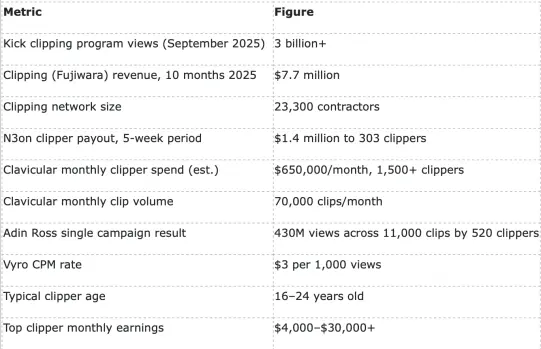
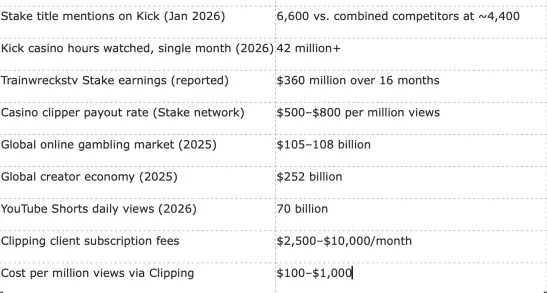
Anthony Fujiwara's Clipping generated approximately $7.7 million in revenue in just ten months of 2025, with a network of over 23,300 contracted clippers operating across the globe. The company charges clients a subscription fee of $2,500 to $10,000 per month, and pays its clippers between $300 and $1,500 for every million views a clip accumulates across all platforms. Generating a million views through the service can cost a brand as little as $100 to $1,000 — a fraction of what a traditional digital advertising campaign at equivalent reach would cost.
MrBeast, whose YouTube channel has surpassed 448 million subscribers, employed Clipping's services and paid $50 for every 100,000 views generated by clips of his content. One clipper in Pakistan reported earning $600 editing MrBeast clips — and had already hired two sub-contractors to share the load, taking a percentage of the payout for himself. A 19-year-old college freshman in suburban Chicago reported making $4,000 a month clipping for influencers and tech founders. The average age of clippers across major networks is between 16 and 24.
MrBeast later launched his own competing platform, Vyro, in October 2025. Vyro connects creators and brands with a network of clippers and pays a flat $3 CPM — meaning $3 per 1,000 views across TikTok, Instagram Reels, and YouTube Shorts. That rate dramatically outperforms platform-native monetisation: YouTube's Partner Program pays roughly $0.50 to $2.00 CPM, and TikTok's Creator Fund pays just $0.02 to $0.04 CPM. Some top clippers on comparable platforms have reported earnings of $20,000 to $30,000 per month. Mark Rober was among the first major creator partners to post campaigns on Vyro.
For a single campaign run by Adin Ross through Clipping, 520 clippers produced 11,000 individual videos that accumulated 430 million views.
The clipping economy has now crossed into politics, mainstream entertainment, and the music industry. Clients of Clipping include OVO (Drake's record label), musicians Ice Spice and Offset, and streamers including IShowSpeed and Plaqueboymax. A campaign for California political candidate Matt Pratt paid clippers to post debate clips to pages with at least 50 percent US-based audiences on Whop, the social commerce platform, with mandatory disclosure for campaign finance compliance.
The streaming industry commentator and former Counter Logic Gaming CEO Devin Nash estimated that Braden "Clavicular" Peters pays clippers approximately $650,000 per month, with over 1,500 clippers producing roughly 70,000 clips distributed in a single month. Kick's own internal platform data showed its clipping program generated over three billion views in September 2025 alone. Kick itself pays clippers to distribute content from its top streamers, acting as its own distribution engine.

Kick: The Platform That Turned Clipping Into a Business Model
Kick was co-founded by Ed Craven and Bijan Tehrani — the same individuals who co-founded Stake.com — alongside Tyler "Trainwreckstv" Niknam, himself a Stake partner and now one of the most-watched streamers on the internet. The architecture of this ownership structure is critical to understanding the iGaming-clipping nexus: the platform that hosts the streamers is bankrolled by the casino that sponsors them. It is a vertically integrated attention-to-conversion machine.
Kick's permissive approach to gambling content, in direct contrast to Twitch's September 2022 ban on unlicensed gambling sites (specifically targeting Stake, Rollbit, Duelbits, and Roobet), positioned it as the dominant home for casino streaming. In February 2025, Kick tightened its own policy to require that gambling streams only feature ID-verified, licensed platforms — a move that professionalised the category without dismantling it.
By January 2026, Stream Hatchet data showed Trainwreckstv leading the platform with 15.6 million hours watched in a single month. Classybeef, the group-format gambling streaming collective featuring members including Espen, Joe, and Nando, placed second with 13.9 million hours. ROSHTEIN, the Swedish slot streamer (real name Ishmael Swartz), consistently pulls the highest peak concurrent viewership, reportedly watching nearly 500,000 hours per week. Kick-backed casino streamers collectively concentrated over 42 million hours watched in a single month in early 2026.
A critical detail from Stream Hatchet's January 2026 analysis: Stake appeared in 6,600 Kick channel titles that month — more than positions two through seven combined (1XBet at 1,800; Betano at 837; Winamax at 653; FanDuel at 597; PokerStars at 270; Bet365 at 214). Every single streamer in the top 10 was partnered with Stake. N3on (558K Kick followers) paid out more than $1.4 million to 303 clippers over a five-week period at a rate of $40 to $50 per 100,000 views. His approximately 1,000-person clipper network is split roughly in half: the first group directly employed by N3on and Adin Ross, who built the network jointly; the second half paid by Kick directly. N3on himself summarised the dynamic plainly: while a live stream might peak at 40,000 concurrent viewers, a single successful clip can reach 50 million people.
Crypto iGaming and the Clipping Machine
The intersection of clipping and crypto iGaming is not coincidental. It is structural. Crypto casinos operate in a permanent tension: they offer a product with massive demand, but face advertising bans across Google, Meta, and most tier-one media. Streaming clips — framed as organic user-generated content, distributed by a decentralised network of anonymous clippers — sidestep every one of those restrictions.
A clip of a $37.5 million slot win lands on your Instagram feed without a "sponsored" label. It looks like something a friend shared. The casino brand appears in the stream overlay. The clip ends with a "use code X for 200% deposit bonus" caption. That is the full funnel, achieved without buying a single ad unit.
Stake is the dominant player in this ecosystem by a significant margin. Trainwreckstv reportedly earned $360 million over 16 months from his Stake partnership — which, if accurate, would make him possibly the highest-compensated content creator in history, eclipsing most conventional media talent. Roshtein's $24 million and $18.75 million recorded wins on Stake have become legendary clips in their own right. Game Rant reported in February 2026 that Stake operates what insiders describe as a "clipping army" of third-party creators paid $500 to $800 per million views to distribute big-win clips across Instagram, TikTok, and X. This strategy turns every dramatic casino moment into a viral advertisement that bypasses traditional gambling ad restrictions entirely, reaching younger audiences who may never otherwise encounter casino content.
Rainbet, launched in 2023 and growing rapidly, has taken a different path to attention. Rather than building its own streamer network from scratch, Rainbet leveraged the existing streaming ecosystem and benefited from remarkable ambient exposure: the crypto casino's logo appeared repeatedly throughout Netflix's Louis Theroux documentary "Inside the Manosphere" — embedded in livestream overlays during scenes featuring influencers, and not blurred or removed by the platform. The documentary's archival footage of influencer livestreams became Rainbet advertising without anyone paying for placement. The streaming service has not addressed this, nor has Rainbet — but observers note that the brand visibility drove measurable site traffic. Tanzanite's March 2026 deposit tracking confirmed Rainbet's growth relative to competitors. Rainbet's product is explicitly designed with content in mind: fast-loading, visually dramatic, with games engineered to produce the kind of extreme variance that makes for compelling clips.
As industry analysis publication iGaming Today noted, Rainbet's product design closely mirrors Stake's blueprint — minimal menus, bold visual feedback, dramatic swing gameplay — and this is entirely deliberate. The platform is built not just as a gambling site, but as a content factory. In the analysis: "Rainbet isn't just a gambling platform. It's a content factory."
Kirgo is among the newer entrants leveraging creator relationships and streamer ecosystems as a core customer acquisition strategy, operating in the same influencer-first model as Stake and Rainbet, targeting audiences already conditioned to crypto gambling content through Kick and clipping channels.
Gamdom and Roobet round out the second tier, each maintaining clipper relationships and appearing in top streamers' titles and overlays, though at volumes well below Stake's category dominance.

Casino Clipping as a Distinct Sub-Economy
Grokipedia defines casino clipping as a discrete practice that emerged around August 2024, in which individuals extract short video segments or memes from gambling streams — often adding casino logos, promotional overlays, or "Gamble Responsibly" disclaimers — and distribute them across social media to drive brand awareness and user acquisition for the sponsoring casino. The primary sourcing platform is Kick. The distribution platforms are TikTok, Instagram, X, and YouTube Shorts.
The Sx Bot Discord infrastructure has made this operationally seamless. Sx Bot maintains an active "Logo Clipping Server" specifically for Stake, Rainbet, Roobet, and other casino brands, where clippers can join campaigns, track their clip performance in real time, see competitive leaderboards, and manage transparent earnings dashboards. Clippers can earn up to $50 per 100,000 views by distributing casino clips across Kick, YouTube, Twitch, TikTok, Parti, Rumble, X, and Instagram — one campaign, multiple distribution channels, tracked and compensated automatically.
The Sx Bot documentation describes the workflow: easy account linking, real-time analytics, transparent earnings tracking, and competitive leaderboards. Personalised campaign recommendations are offered based on active streamers' briefs. The toolset has professionalised casino clipping to the point where it resembles a conventional performance marketing affiliate program — with one significant difference: the "ads" look like organic fan content.
The Clipper Social Media Ecosystem: Pages, Networks, and AI Content
The most visible layer of the clipping economy is the wave of dedicated social media pages that aggregate, curate, and distribute streamer clips. These accounts operate across Instagram, TikTok, and YouTube Shorts and have become significant channels in their own right.
Pages like @streamcreamtv and @streamave on Instagram curate streaming highlights and gambling moments, building large followings by consistently posting the most emotionally charged moments from live streams. These accounts function as passive discovery nodes: a user who stumbles on a jaw-dropping slot win or a streamer's extreme reaction on @streamcreamtv may never have heard of Kick, but the clip plants a seed. The casino brand in the overlay does the rest.
AI-generated content pages represent a newer and more automated layer of the clipping economy. Accounts such as @confederate.ai on Instagram deploy AI-generated visuals, voiceovers, and video formats to produce clipping-adjacent content — aggregating cultural moments, viral sequences, and reaction content through automated pipelines. These AI clipping pages do not require a human editor to sit through hours of a livestream. They pull trending audio, use text-to-video generation, and produce content volumes that manual clippers cannot match. The implication is significant: as AI clipping tools improve, the marginal cost of producing a viral-formatted clip approaches zero.
AI clip generation tools have matured rapidly. Eklipse, which integrates directly with Twitch and Kick accounts, uses AI to detect hype moments automatically, edit them with auto-captions and meme overlays, and format them for TikTok, Reels, and Shorts — described as making content creation "10X faster." StreamGen automates highlight detection from entire Twitch VODs, generates vertical clips with AI captions in over 90 languages, and schedules auto-posting to TikTok and YouTube. VFX AI reported in May 2026 that YouTube Shorts now receives 70 billion daily views. Opus Clip, Descript, Munch, and CapCut have all developed streaming-clip-specific workflows, with AI identifying hook moments, adding captions, reformatting for vertical, and scheduling posts automatically.
The competitive implication, noted by the Vyro review platform Ssemble, is blunt: "Manual clipping won't cut it if you're competing against AI-powered clippers who produce 50+ clips per day."

The Economics for Individual Clippers
The clipping economy has created a new category of gig worker — globally distributed, age-skewed young, and operating without traditional employment structures. The demographic profile of clippers skews 16 to 24 years old, with significant participation from Pakistan, Belgium, Indonesia, South America, Eastern Europe, and the Philippines — regions where $300 to $4,000 per month in USD represents substantial income.
The range of earnings structures across the clipping economy includes:
- Kick's platform-level clipper payments: Clavicular's clippers received $30 per 1,000 views; N3on's clippers receive $40 to $50 per 100,000 views
- Clipping (Fujiwara): $300 to $1,500 per million views, plus client subscription revenue of $2,500 to $10,000 per month
- Vyro (MrBeast): flat $3 CPM ($3 per 1,000 views), processed hourly, withdrawable via PayPal, crypto, or bank transfer
- Casino clipper programs (Stake/Rainbet via Sx Bot): $500 to $800 per million views, sometimes $30 to $50 per 1,000 views
- Independent contracts with streamers: negotiated per-campaign rates
The emergence of sub-contracting within the clipper economy is notable. A single clipper who wins a lucrative campaign brief may hire two or three sub-contractors, paying them a percentage of the ultimate payout and scaling output beyond what a single editor can produce. Clipping has, in this sense, developed its own internal gig market.
Some clipping campaigns also operate through Whop, the social commerce platform, where brands post clipper campaigns as purchasable briefs with specific formatting requirements and audience composition minimums (such as "at least 50% US-based audience").
The Platform Dynamics: Algorithm Flooding and Manufactured Virality
Devin Nash, in his April 2026 YouTube video "Exposing the New Manufactured Viral Content Economy," articulated the core mechanics. The top Kick streamers, he argued, benefit not from organic excellence but from algorithmic saturation: 70,000 clips per month from Clavicular's network means TikTok's, Instagram's, and YouTube's algorithms cannot avoid encountering and distributing the content. The underlying quality of the stream becomes largely irrelevant — what matters is the volume and consistency of distribution.
This has created a feedback loop with troubling structural incentives. Streamers increasingly stage, escalate, or manufacture extreme moments specifically because they are more likely to be clipped. SoaR Gaming VP Mustafa Aijaz told Business Insider that "a lot of [what goes on in streams] is staged" because creators know that the more outrageous the behaviour, the more likely it is to generate millions of views post-stream. N3on admitted he used to do "crazy stuff" on stream in hopes of being clipped, and confirmed he paid clippers to spread negative PR about himself to stay in the headlines.
The logical endpoint of this dynamic is precisely what the Clavicular situation illustrated in April 2026: a streamer who, according to reporting, appeared to suffer a medical emergency during a live broadcast that was simultaneously creating viral content. The clip economy incentivises escalation. Platforms profit from the resulting engagement. Clippers profit from the views. The streamer suffers the consequences.
Digiday's May 2026 analysis captured the broader critique: "The kind of culture that has formed around clipping is worrying: streamers are doing increasingly problematic and often flat-out dangerous stunts while live in the hopes their content will get clipped."
Beyond iGaming: The Industries Adopting the Clipping Model
The clipping economy is not exclusive to gambling or even to streaming. It is becoming standard operating procedure for brand marketing across industries.
Entertainment studios have begun seeding clips of television content specifically designed to be meme-able. A clip from the Apple TV+ series "Your Friends and Neighbors" featuring Jon Hamm dancing was picked up by clipping pages, remixed across Instagram, TikTok, and X, and generated enough organic discourse that Hamm was asked about it on The Tonight Show. The clip outperformed the show's entire marketing campaign.
Technology companies are deeply embedded. Roy Lee, co-founder of AI startup Cluely, hired over 700 clippers and generated tens of millions of views for his product through the clip economy alone. Fixated, an entertainment company that works at the intersection of creator culture and brand marketing, has built a specific practice around helping brands design experiences and moments that are intentionally clip-worthy — events, stunts, or product reveals staged to be captured, distributed, and spread by clipper networks.
Music labels, as noted, have integrated clipping into release strategy. OVO has used Fujiwara's Clipping for campaigns. Independent artists increasingly hire clipper networks as a substitute for radio promotion or traditional digital advertising.
The political application is perhaps the most consequential long-term. Organised clipper campaigns for political candidates represent a form of distributed paid promotion that is difficult to identify, attribute, or regulate — even where disclosure requirements technically exist, enforcement at scale is nearly impossible. The operational overlap between political clipping and the bot-farming infrastructure that already exists for gambling and creator content is significant and largely unexplored from a regulatory standpoint.

Trend Forecasting: Where the Clipping Economy Goes Next
AI completes the automation stack. The current clipper ecosystem still relies primarily on human judgment — a 16-to-24-year-old watching streams and identifying emotionally resonant moments. Within 24 to 36 months, AI models capable of watching livestreams in real time, identifying clip-worthy moments as they happen, cutting, captioning, and distributing automatically will commoditise this entirely. Tools like Eklipse and StreamGen already represent an early version of this. What emerges is a fully automated content distribution pipeline that scales with zero marginal labour cost. For crypto casinos, this means every big win, dramatic reaction, or viral moment on a sponsored stream can be automatically clipped and distributed to 15 platforms within seconds of occurring.
Crypto iGaming expands the clipper affiliate model. The current model — pay clippers per view — is a blunt instrument. The evolution is affiliate-layered clipping: clips that contain affiliate tracking links in captions, bios, or description text, meaning a clipper is compensated both for views and for any deposit conversion that flows from their distributed content. Platforms like Stake and Rainbet are well-positioned to integrate clipper activity directly into their affiliate tracking dashboards, turning clippers into a performance-marketing layer that operates on social media without ever looking like advertising.
Sportsbooks accelerate into the model. While casino streaming dominates the current clipping-iGaming intersection, sportsbooks are the next frontier. Live in-game moments — a last-minute goal, a stunning upset, a real-time cash-out decision — are inherently clip-worthy. A sportsbook that builds a clipper network around live sports moments with embedded affiliate codes is building what amounts to a distributed performance marketing network that bypasses every ad restriction on Meta and Google. Smart Contract Bets, Sportsbet.io, and Whale.io all operate in a space where this model applies directly and compellingly.
Clipper pages become media properties. Pages like @streamcreamtv and @streamave are currently content aggregators. Within a growth cycle or two, the largest of these pages — those with millions of followers and consistent engagement — become media properties in their own right: able to negotiate direct sponsorships with casinos, sports betting platforms, and crypto projects, operating independently of any individual streamer. The casino slot clip page becomes the new sports highlight channel. The monetisation stack for these pages will include direct brand deals, affiliate links, merchandise, and eventually platform monetisation from YouTube and TikTok as they reach eligibility thresholds.
Regulation arrives, slowly. The FTC in the US has begun gesturing toward disclosure requirements for clipping campaigns. The UK's Advertising Standards Authority and Australian regulators have already pursued individual influencers (such as Australian Twitch streamer Dinah, investigated for Instagram posts promoting Rainbet to her 822,000 followers despite Rainbet's classification as an unlicensed offshore gambling site). As the scale of organised casino clipping becomes impossible to ignore — particularly when it appears in mainstream Netflix documentaries — regulatory scrutiny will intensify. The industry's response will likely be to route clipping programs through compliant affiliate structures, maintain plausible deniability on "organic" distribution, and lean further into crypto-native platforms and geographies where enforcement is difficult.
The creator economy and iGaming converge at the infrastructure level. The global creator economy is valued at approximately $252 billion in 2025, projected to reach over $2 trillion by 2035 at a 23.3% compound annual growth rate. The global online gambling market sits at approximately $105 to $108 billion in 2025, projected to reach $286 billion by 2035 at a 10.5% CAGR. The clipping economy is the connective tissue between these two trajectories. Platforms that can operate at that intersection — as Kick does — sit at a structural advantage: they own the content, the distribution mechanism, the payment infrastructure, and the gambling product simultaneously.

What This Means for the Attention Economy
The conventional social media advertising model — pay a platform to show your content to targeted users — is being systematically disrupted. Clipping is cheaper, more native, harder to ignore, and bypasses ad blockers, ad restrictions, and algorithmic suppression of branded content. It looks organic because it spreads through the same mechanics as genuinely organic content. The only difference is that it is orchestrated.
As Fujiwara put it in the Bloomberg interview that broke the story to mainstream attention: "People used to buy commercials on TV, billboards, radio time slots. Clipping is that for the modern era. It's buying space and time on people's phones while they scroll."
The implication for every brand in the digital space — and especially for crypto casinos operating with constrained advertising options — is that the clipper network is now the most cost-efficient mass-reach distribution mechanism available. A $1,000 spend through an organised casino clipper network can generate a million views of branded casino content, distributed to audiences algorithmically selected by the platforms themselves for maximum engagement probability.
For the iGaming industry specifically, the clipping economy is not a trend to monitor. It is the operating reality of customer acquisition in 2026. The platforms that understand this earliest — and build the most sophisticated clipper ecosystems, integrating AI automation, affiliate conversion tracking, multi-platform distribution, and compliance-aware disclosure frameworks — will dominate new player acquisition for the next decade.
Key Data Points at a Glance
Final Word
The clipping economy is not a gimmick. It is the new advertising industry — built on the backs of a global workforce of young, anonymous editors operating from Discord servers and earning per-view commissions for content that drives some of the most lucrative conversions in the digital economy. Crypto casinos were the early adopters because they had no choice: conventional advertising was closed to them. What they built in response — a distributed, performance-based, native-content distribution network masquerading as organic social media — is now being adopted by music labels, technology startups, entertainment studios, and political campaigns.
The clippers who post wins from Stake sessions to @streamave at 2am in Karachi, the Instagram pages that aggregate Kick moments for audiences who will never open the Kick app, the AI systems that are beginning to replace them — all are nodes in the same machine. That machine now controls a significant and growing share of what the algorithm shows you, what brands you encounter, and what gambling platforms you discover.
Understanding it is no longer optional for anyone operating in crypto, iGaming, or the creator economy. It is table stakes.
For affiliate-ready exchange and crypto betting platform links, see our reviews of Sportsbet.io, Whale.io, Smart Contract Bets, Stake, Rainbet, and other leading platforms across Decentralised News.






