
WBTC is an ERC20 token used on the Ethereum blockchain, in a 1: 1 ratio with BTC (a bit like the primordial idea of the stablecoins that would guarantee a 1: 1 ratio with the dollar).
So WBTC has the same value as BTC.
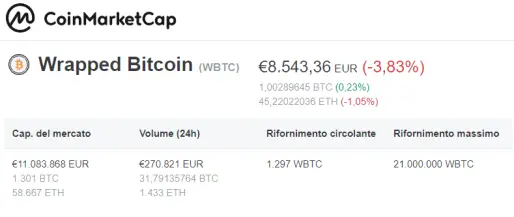
WBTC on Etherscan: WBTC (Etherscan)
Through this token we try to bring Bitcoin liquidity towards Ethereum, in particular in decentralized exchanges (DEX) and financial applications. The WBTC aims to make it possible to use Bitcoin for token trading on the Ethereum blockchain.
In practice WBTC standardizes Bitcoin in the ERC20 format, guaranteeing:
1) Greater liquidity
2) Speed of transactions
3) Facilitating exchanges with ETH and all its ecosystem
The Ethereum network processes transactions faster than the Bitcoin network and moving Bitcoin between exchanges becomes, thanks to WBTC, much faster.
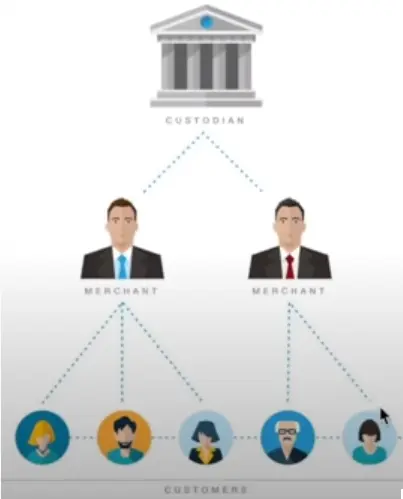
The ecosystem will consist of:
1) WBTC DAO (decentralized organization that manages all the parties
2) Merchants (activities similar to DeFi)
3) Custodians
Customer provides 1 BTC and receives 1 WBTC (of the same value) from Merchants.

Then the Merchant turns the BTC to the Custodian. This operation will be closed by signing a Wrappet Token Contract. Obviously it will be possible to have your BTC back by burning WBTC.
It will be possible to swap between ETH and BTC using the same platform, also reducing fees and exchange times.
MEW allows you to manage ERC20 tokens by integrating them with Ethereum contracts and thanks to partnerships with Changelly, Bity and Kyber Network, it is possible to obtain both BTC and WBTC.
Thanks to this, it will be possible to exploit the liquidity of Bitcoin without moving from the Ethereum blockchain (it is possible to exchange ETH and ERC20 for WBTC via the Kyber network present in MEW).
The end result will be the ETH exchange for WBTC (ERC20 token supported 1: 1 with BTC, without using multiple platforms). Theoretically the system would seem safe even if we must remember that we are entrusting our BTC to an external platform (we will no longer be able to use our private key but the Custodian will also not have possession of our BTC being blocked in the Wrapped Token Contract). The main advantage consists in "blocking" BTC, obtaining WBTC and a stablecoin (DAI) used for various purposes.
In May 2020, 2300 BTC were already blocked.





