We've all once dreamt about going back in time to buy some Bitcoin when it was a fraction of a cent, the easiest road to becoming a billionaire one could imagine. The past always looks like the best time to buy cryptocurrency, but what seems obvious for us today undoubtedly wasn't at the time. To determine the best time to buy cryptocurrency, one needs to understand the fundamental aspects and the most important strategies of this market, all of which we'll cover in this article!
Although attractive to some investors, the high volatility in the cryptocurrency market might make it seem like it's all chaos and confusion. What many don't know is there are clearly defined market cycles in cryptocurrency easily visible on a large scale. They are more intense than in the stock market and repeat with an average frequency of four years. This number doesn't come out of nowhere as Bitcoin, the largest and oldest cryptocurrency, has its "halving" events happening every four years.
Halvings are designated moments when the number of new bitcoins created every block decreases in half, slowing down inflation until the last bitcoin is mined in 2132 to achieve a total of 21 million bitcoins. This precise emission curve allows analysts to apply a model called "Stock to Flow" (S2F) to Bitcoin's price and supply. The essential premise is that when mining output decreases, general scarcity grows, putting upward pressure on the price. Although the argument behind it is solid, S2F in Bitcoin isn't a holy grail due to how few halvings Bitcoin had up until today, which is insufficient to paint the most accurate picture.
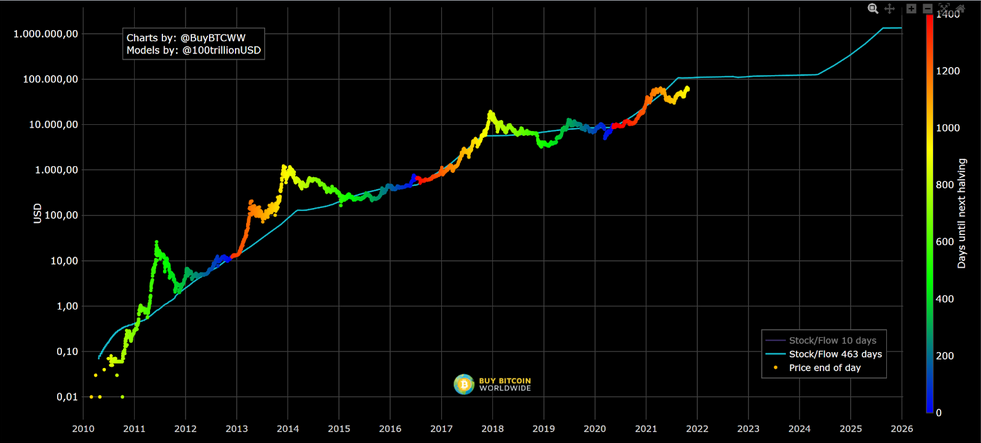
It's crucial to understand that Bitcoin is the "flagship cryptocurrency," and thus, its swings pull the crypto market as a whole in the same direction. Good news for Bitcoin is interpreted as good for altcoins, and gains in Bitcoin partially trickle down to altcoins as investors try to balance their portfolios. Although Bitcoin itself was considered largely uncorrelated with any other asset or index until recently, its correlation with the stock market and gold is apparently increasing due to institutional investors and companies investing in Bitcoin.
These correlations we just mentioned are just that, correlations. Sometimes there are considerable deviations from the mean, and they can't always predict the next step for the crypto market. Bitcoin might rise alongside or against stocks, a botched update might trigger a crypto winter precisely as the next halving is scheduled to happen, or Bitcoin might even lose its place as the number one crypto – "The Flippening," as Ethereum's faithful calls it.
A good piece of advice is to go against the crowd when people are acting too much out of sentiment instead of reason. To assess this exact factor, Alternative.me created the Fear and Greed Index, which gathers information all over the web to determine which sentiment is currently more dominant in the cryptocurrency market. Fear might signal a buying opportunity, while greed might show a good moment to realize your gains and wait for the upcoming market correction.

If you've heard about Technical and Fundamental Analysis, know that they are totally different. The first looks at graphs for patterns indicating short-term buy opportunities, but it's far too unreliable for consistent results. The second one requires careful examination of the aspects that make a project valuable, safe, and reliable, including tokenomics, product-market fit, competition, their teams, etc. Reports by specialized cryptocurrency research firms are worth their weight in gold here, as professionals know best how this market works and the challenges projects may face in their niches.
When it comes to the moment of actually spending your money to buy crypto, we can give you three strategies that you can use in conjunction to optimize your purchases and create a healthy portfolio:
Start by turning investing into a system by applying Dollar Cost Averaging (DCA) in crypto. This avoids the unpredictable highs and lows of the market by spreading out your investment with weekly/monthly smaller purchases. To choose the projects in which to invest, apply the Star Principle: look for the most significant project in a rapidly growing niche, as it can benefit from economies of scale to outpace its competitors.
Last but not least, managing risk – while still being exposed to it, as let's be fair, risk is the bread and butter of investing – with a well-balanced portfolio is always a must. The Barbell strategy, although unorthodox, presents potentialized gains from riskier investments while still enjoying the security offered by low-risk assets. The key is to ignore medium-risk investments and distribute your purchases 90% in "safe" investments (be it index funds or, if that's your framework, Bitcoin) and 10% in unproven but high-potential blockchain projects, which may be your "ticket to the Moon."





