Asides from LUNA's tokenomics, what else should you know before investing in the Terra blockchain?
Terra is a smart-contract enabled blockchain that offers 19 stablecoins tied to the US dollar, the Euro, and other national currencies. Terra addresses the concerns associated with centralized alternatives by building a framework for reliable algorithmic stablecoins. It uses LUNA, their native token, as a volatility-absorbing mechanism.
Stablecoins are a noteworthy cryptocurrency niche, performing an essential role in DeFi and blockchain payments. Companies issue centralized stablecoins, whose value comes from promises of redeemability for "the real thing." Most decentralized alternatives apply the overcollateralized lending model, where assets worth more than the stablecoins they create are locked until the stablecoin loan is paid back. In comparison, Terra's paradigm is distinct, more powerful and efficient than previous solutions.
Terra works by allowing its users to, at any time, burn one dollar worth of LUNA to mint one UST token and vice-versa. The same is valid for each of the other stablecoins. Arbitrageurs are thus incentivized to purchase and burn the stablecoin when it's below its target price to obtain LUNA at a discount. They may likewise buy and burn LUNA in the opposite scenario. LUNA prices are closely monitored through Terra's Oracle module, provided by the blockchain's validators. It's worth noting that LUNA's supply changes dynamically through this mechanism. Staked validators and holders might benefit from a rise in demand for Terra stablecoins as a result.
The Terra blockchain is built with CosmosSDK and the Tendermint delegated Proof-of-Stake consensus mechanism, capable of achieving up to 10,000 TPS with efficient total energy consumption. Validators take turns creating new blocks every 5 seconds and collectively determine their authenticity. LUNA is used not only for minting stablecoins but also to pay for transaction fees, rewarding stakers, and as a governance token.
To understand Terra's tokenomics, we need to look at LUNA's tokenomics and its relationship with the stablecoins. In its genesis, the maximum supply of 1 billion LUNA was minted, a somewhat concerning fact considering the nature of the delegated Proof-of-Stake model. Multiple mechanisms assure the burning of a significant part of LUNA's supply, and thus only 35% of the initial amount circulates on the market. As the popularity of UST rises, the use of Terra's blockchain grows, and its burning mechanism assures LUNA's supply diminishes. This process can only be positive for LUNA's price, so it's essential to direct our attention to possible hindrances to Terra's adoption.
A couple of problematic issues
The first major concern of Terra's critics rests on the similarity with Iron Finance, a catastrophic attempt at an algorithmic stablecoin that completely lost its value. It used TITAN as a "counterweight token" similar to LUNA's role in Terra, but users managed to exploit a delay in its oracle feed to create trillions of TITAN at a cost below market price. Nevertheless, Terra has notable differences from Iron Finance, as its oracle works in a 5-second resolution while the failed protocol's updated every 10 minutes. In addition, LUNA has multiple other uses beyond being a volatility absorption token.
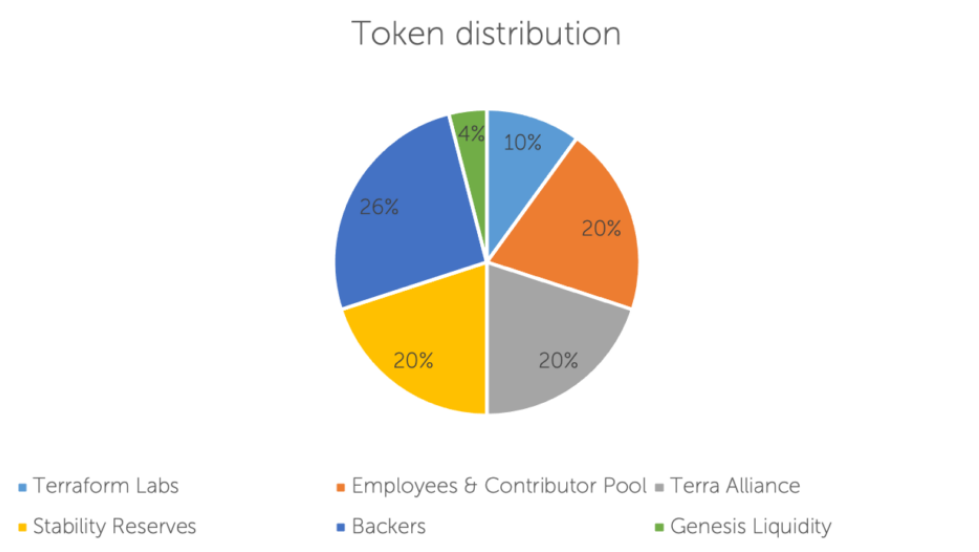
The high concentration of tokens at TerraForm Labs is another significant concern, as they hold about 50% of the total supply of LUNA. The company currently delegates its tokens amongst a few validators, and Terra's Tendermint consensus mechanism means more than 66% of staked LUNA is necessary for a "51%" attack. This scenario makes an attack not imminent, although not far-fetched either.
Terra's payments and DeFi ecosystem
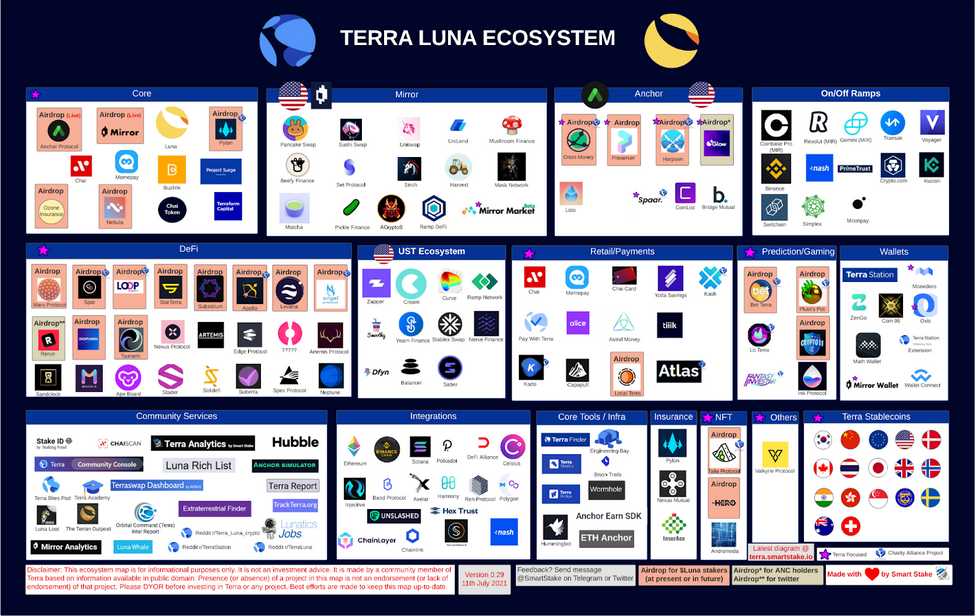
Terra was developed alongside Chai, a Korean payment app with 2.5 million users. Terra is the core of its infrastructure, saving retailers about 1.5% per transaction in credit card processing fees. App users unwittingly contribute to the Terra ecosystem as the transaction fees go to validators. On top of its potential as a payment network, Terra is the key to a decentralized Forex market with no KYC requirements.
Terra stablecoins can be transferred to many other chains using Terra Bridge and Wormhole Bridge, which carry assets to Ethereum, BSC, Polygon, Avalanche, and others. Nevertheless, Terra users can find a robust DeFi ecosystem on-chain, recently taking the number 2 spot in TVL from Binance Smart Chain. The biggest names in Terra's DeFi landscape are:
- Anchor ($ANC): This lending protocol offers 19.5% APY on UST by staking the collateral deposited by borrowers.
- Lido Protocol ($LDO): Lido is a LUNA, SOL, and ETH staking platform offering attractive returns.
- Astroport ($ASTRO) and TerraSwap: Terra's most widely used DEXs.
- Mirror Protocol ($MIR): In Mirror Protocol, users can mint and trade synthetics representing stocks, commodities, or other cryptocurrencies.
- Pylon Protocol ($MINE): Users can invest their funds in safe protocols while their earnings go towards riskier investments in promising projects or paying for subscriptions and services.





