
Pi is a new secured and person-backed social cryptocurrency. It has been developed by Dr. Nicolas Kokkalis, Dr. Chengdiao Fan, Vincent McPhillip and Aurelien Schiltz at Stanford.
Pi can be easily mined on mobile phones with low financial cost, limited battery consumption, and thus a light footprint on the planet.
What is intended is that Pi be a social cryptocurrency so that everyone can benefit.
As they say in their website:
Mining crypto is hard. Investing in crypto is risky. Too many of us are left out of the cryptocurrency revolution. Pi makes crypto mining easy. Breakthrough tech allows you to mine on your phone without draining your battery.
How does it work?
Using Pi is simple, you simply have to download its application from the AppStore or Google Play, install it and register with an invitation code (Pi Network is a huge community accessible via invitation code):
Link: https://minepi.com/PhoenixDev
Invitation code: PhoenixDev
After signup, you will receive your first Pi!
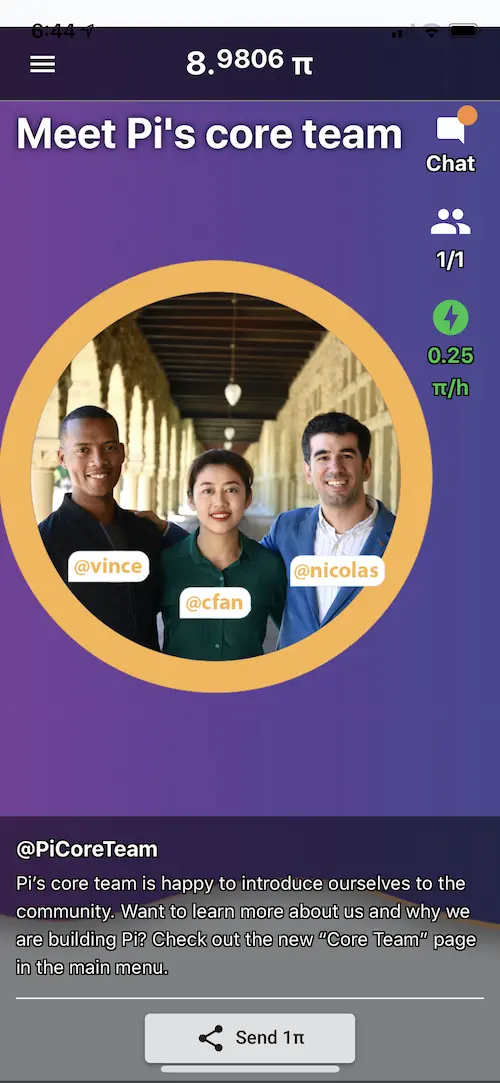
The graphical interface is simple: a presentation screen with 3 icons on the right:
- Chat: In it, people belonging to the Pi Network Community talk about Pi and express their opinions.
- Earning Team: Here we are shown the people we have invited and who are part of our 'Earning Theme'.
- Mining: This button, with a lightning bolt icon, indicates the amount of Pi that we mine every hour. You only have to press it once every 24h to continue mining, and then we can turn off the app.
On the right side, you will find the symbol of a lightning bolt. This is the mining button. You should give it once every 24 hours to continue mining. The power or quantity of pi per hour, depends on the role you have.
In addition, at the top of the interface we find the amount of Pi that we have mined and, on the left, the drop-down menu icon where we will find the application settings and, among other options, information about the Pi Network project.
Types of Pi users
According to its whitepaper, there are four roles Pi users can play, as Pi miners. Namely:
-
Pioneer. A user of the Pi mobile app who is simply confirming that they are not a “robot” on a daily basis. This user validates their presence every time they sign in to the app. They can also open the app to request transactions (e.g. make a payment in Pi to another Pioneer)
-
Contributor. A user of the Pi mobile app who is contributing by providing a list of pioneers he or she knows and trusts. In aggregate, Pi contributors will build a global trust graph.
-
Ambassador. A user of the Pi mobile app who is introducing other users into Pi network.
-
Node. A user who is a pioneer, a contributor using the Pi mobile app, and is also running the Pi node software on their desktop or laptop computer. The Pi node software is the software that runs the core SCP algorithm, taking into account the trust graph information provided by the Contributors.
Very simple, isn't it? But is it worth it?
It is a "cloud mining" system that only needs to be accessed once every 24 hours (the application itself can notify you). The application can be turned off, so you do not consume battery.
And the benefit? It is a project that is still in beta phase (phase 2 of 3) in which we still see how the amount of Pi we have mined increases, but we can not do anything with these cryptocurrencies for now (planned for phase 3). Therefore, it does not make sense for those people who want to trade these currencies and make a quick profit.
But look at it from the point of view of the origin of some cryptocurrencies, such as Bitcoin. At first they were practically worthless, many people got rid of them and then they shot up in price. That is, for now you have more the impression of a cryptocurrency to maintain (and, it seems, it costs practically nothing to obtain it).
Conclusion
My first impression is that it seems like a legitimate project worth paying attention to, not only because it seems very easy to mine a new cryptocurrency, but also because like other projects it is focused on a collective economy, which is a what tends in the future.
Time will show us how Pi Network evolves and what it leads us to.
Thanks for reading this post and, see you soon!
If you like this post, you can consider making a little direct donation to:
Bitcoin: bc1q5rqcqtyqftgyfzfqeks5qm3v8qw2qd6r75fs5x
Ethereum: 0xEF67b8539ff06a390ef5DA7C9c92AA7FfB611699
Litecoin: ltc1qjy76n78utl86u49kaegt6gmxeu6mcuj8kn8ley
Don't forget to give a thumbs up or share this post with other people!You can check out my other posts here: https://www.publish0x.com/@PhoenixDev.
If you want to join Publish0x, feel free to use my link: https://www.publish0x.com?a=KQe1wE4qbJ






