USDC or USD Coin is a type of cryptocurrency known as a stablecoin. It was developed as a joint venture between Circle and Coinbase, two well-known cryptocurrency companies. Circle began as a peer-to-peer payments technology company that now manages stablecoin USDC, a cryptocurrency the value of which is pegged to the U.S. dollar. It was founded by Jeremy Allaire and Sean Neville in October 2013.
Circle is headquartered in Boston, Massachusetts. USDC, the second largest stablecoin worldwide, is designed to hold at or near a stable price of $1. The majority of its stablecoin collateral is held in short-term U.S. government securities. The purpose of USDC is to provide a digital representation of the US dollar, offering stability and compatibility with existing financial systems.
As many will know, in the crypto space there is a clear side that is not quite aligned in opinion and principles with the well-known "know your customer" or more commonly known as KYC verification method. It is mandatory to know how USDC works if you want to hold it on your wallet, here are the key points:
-
Issuance: USDC tokens are created when users deposit US dollars into a regulated bank account. These funds are held in reserve to back the USDC tokens in circulation. For every USDC token in existence, there should be an equivalent amount of US dollars held in reserve.
-
Transparency and Auditing: To ensure transparency and maintain trust, USDC undergoes regular audits conducted by independent third-party accounting firms. These audits verify the reserves and provide public reports on the state of the backing funds.
-
ERC-20 Token: USDC is built on the Ethereum blockchain and follows the ERC-20 token standard. This standard ensures interoperability and compatibility with various wallets, exchanges, and decentralized applications (dApps) in the Ethereum ecosystem.
-
Redeemability: USDC holders can redeem their tokens for US dollars at a 1:1 ratio. This process involves sending the USDC tokens back to the issuer, who then transfers the equivalent amount of US dollars from the reserve to the user's bank account.
-
Fiat-backed Stability: As a stablecoin, USDC's value is designed to be pegged to the US dollar. This stability is achieved by maintaining a 1:1 ratio between the circulating USDC tokens and the USD held in reserves. This helps to reduce price volatility commonly associated with other cryptocurrencies like Bitcoin or Ethereum.
-
Use Cases: USDC has several use cases. It can be used for digital payments, remittances, trading on cryptocurrency exchanges, and as a medium of exchange within decentralized finance (DeFi) applications. Additionally, USDC allows for faster and more efficient transfers of funds across borders compared to traditional banking systems.
-
Compliance and Regulation: USDC is issued by regulated financial institutions and operates under a strong compliance framework. This includes adhering to anti-money laundering (AML) and Know Your Customer (KYC) regulations, which help prevent illicit activities and ensure the legitimacy of transactions.
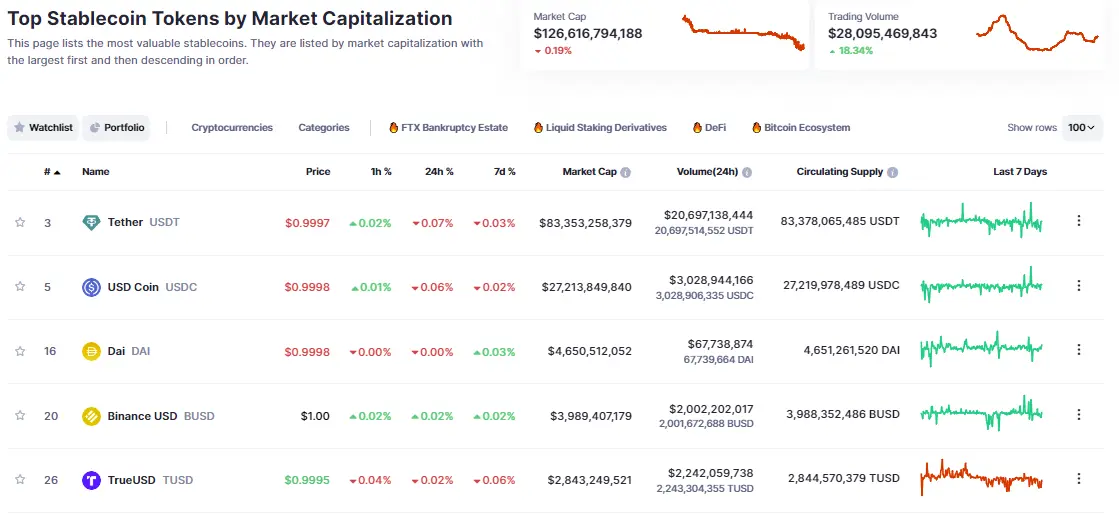
The most relevant competitors to USDC are USDT, DAI & BUSD as you can see on the following image.