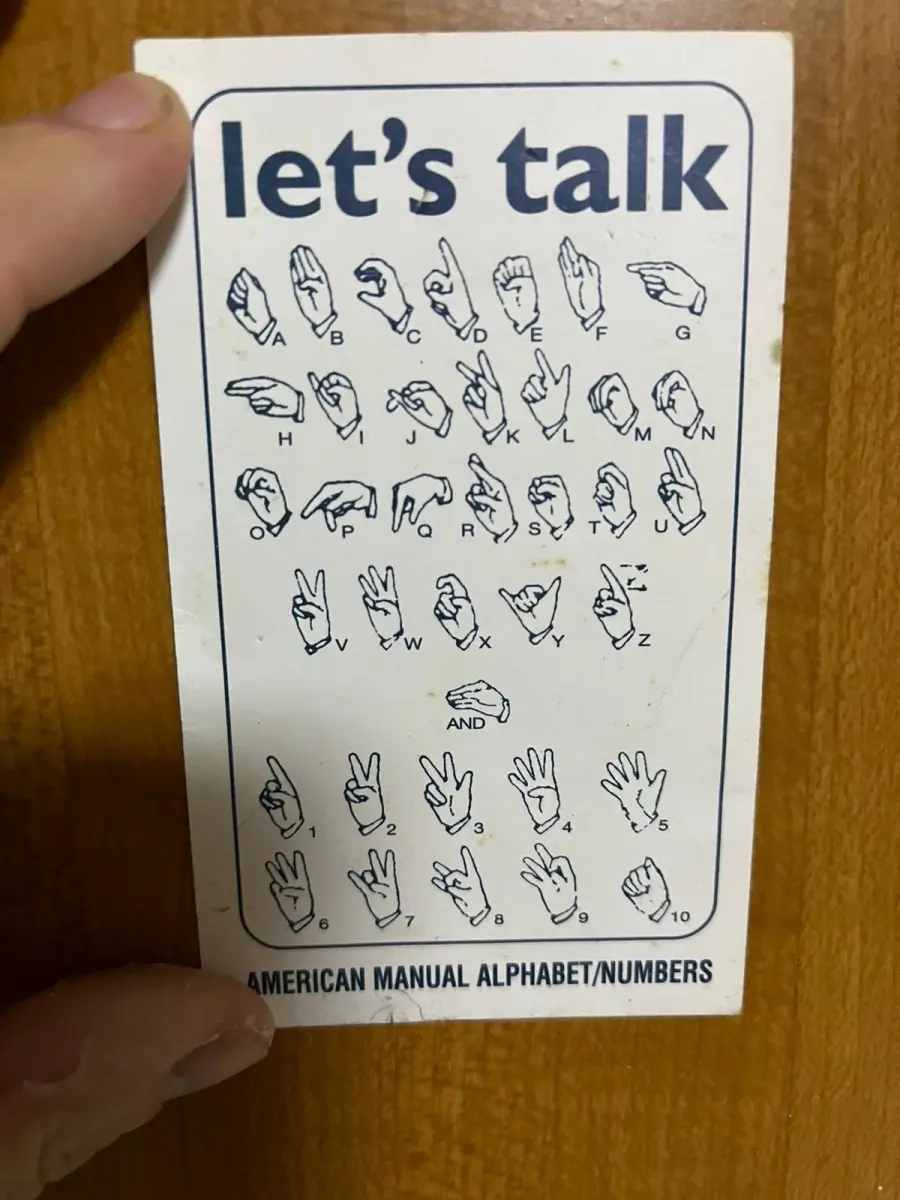
I was going through the answers to the vocabulary in context questions when a brainwave came over me. Spontaneously, I taught the class how to sign A-D in American Sign Language (ASL). This way, I could leverage sign language as a formative assessment tool and force everyone to show me his answer.
The reason why ASL has been salient at the forefront of my consciousness is that a dyslexic person shared on r/dyslexia how finger spelling helped him to spell. Through finger spelling, he learnt to focus on the overall shape of the word, which facilitated his reading. Apparently, he would not look at the individual letters of a word but guess what it was. If he realised that the word he had originally in mind didn’t fit the context a few sentences later, he would replace it mentally with another word whose shape AND meaning would fit the context.
As someone who learns new words by getting people to write them down and memorising the spelling, this was nothing short of a paradigm shift. It’s just fascinating to me how some people can speed read just by zooming out and observing the shapes of words.
This explains the purpose of this post. There’s no reason why I shouldn’t teach my son ASL when I’m badgering my students to learn likewise, right? So I did. Taught him to sign A-D yesterday. Of course, he is not even 3, so he doesn’t have the dexterity required to sign B and D yet. But he seems to have mastered A and C.
It’s amazing how something I picked up for fun during my university years could be so pedagogically relevant and personally rewarding to me all these decades later.