
Almost 10,000 Bitcoin (BTC) left major United States-based exchange Coinbase on Dec. 30 in a sign that investor appetite is returning to the sphere.
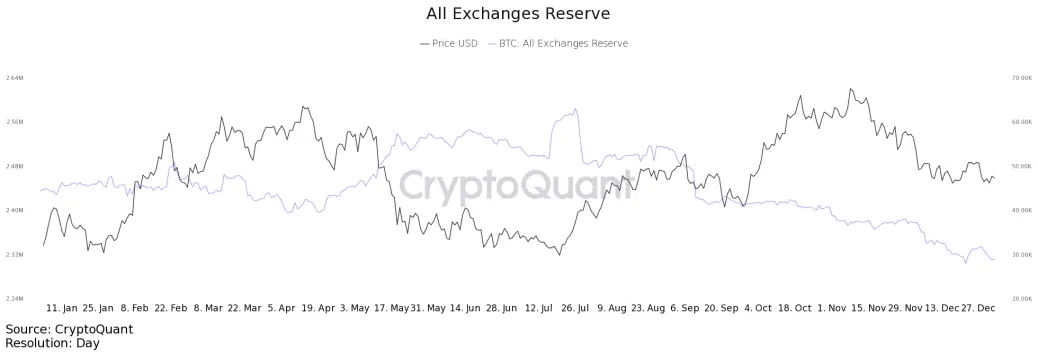
This is what we read in a Cointelegraph article, related to the continued outflow of Bitcoin from the major cryptocurrency exchanges. The outflow of a cryptocurrency from an exchange consists in the flow of the latter from the wallet of the exchange to that of the actual buyer. This is a continuously growing trend from 2020, inversely proportional to the reserves which, on the other hand, are decreasing. Until December 2021, in fact, the main exchanges held only 1.3 million BTC, which is equivalent to 6.2% of the total supply.
Why does this happen?
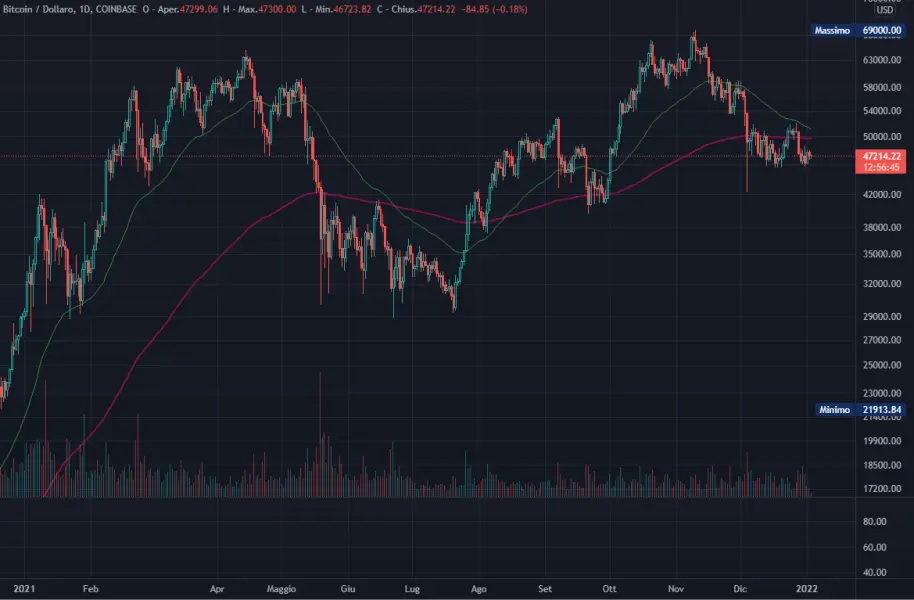
The outflow is the result of an accumulation by investors, who therefore plan to hold Bitcoin for a medium or long period in their wallets. The reserves of the Exchanges, therefore, have been reduced in proportion to the purchases and, now, those wishing to buy Bitcoin again will be able to do so only if there are available at the current price. Furthermore, considering that the price of Bitcoin fluctuated between $42,000 and $50,000 during the month of December just ended, many investors could have accumulated large quantities during the deeps, and then withdraw them at a later time. This would further reduce the estimate of the remaining reserves because until the time of withdrawal, those Bitcoins would remain in charge of the exchange but would not be available anyway.
How many Bitcoins remain?
According to what is established in the Bitcoin code, the maximum amount that can be created is 21 million. Beyond this number it is not possible to create any. Furthermore, it is estimated that around 2 to 3 million have been lost forever due to human errors, such as the loss of their private keys. This brings the maximum currency in circulation to 18 million, which will be reached around 2140. Therefore, considering that about 2 million BTC still remain to be created, it can be said that 80% of the circulating assets are in the hands of the investors who hold them outside the exchanges, and the quantity that can be purchased at this price is really small. For this to rise, investors need to be persuaded to sell them and the only thing that can do that is an increase in the price.
Consequences on the price
We are used to considering the supply of Bitcoin as a fixed parameter, but in the shorter timeframes this varies in relation to the availability on exchanges. Therefore, today we are in a situation of a downtrend of the reserves and this can lead to an increase in the purchase price. If the demand were to remain as such or undergo a slight increase, in fact, a possible scenario called "Supply Shock" could occur, which foresees a sudden leg-up of the price of the asset due to its scarcity.
---> Want to know what a "Supply Shock" scenario is? Read: A Supply Shock Scenario
Not a financial advice. DYOR.
Read Also:
Not yet subscribed to Celsius Network?
Yield your BTC up to 6.20% APY and receive a $50 bonus with this link.
If you liked this article, please support me by following me here and on Twitter, leave me a like or use one of my referral links below. 👇
-Thank you-
➡️ Join Celsius Network using my ref & earn $50 in BTC
➡️Use BlockFi and get up to 4% on Bitcoin. Read here how to do






