
What the COLDCARD entropy incident teaches us about generating, migrating, and physically protecting a wallet backup
Most hardware-wallet security advice begins after the recovery phrase has already been created.
Do not photograph it.
Do not upload it to the cloud.
Do not type it into a website.
Keep it away from cameras, strangers, malware, and customer-support impersonators.
All of that advice remains valid. But the recent COLDCARD security disclosure exposed an uncomfortable truth:
A recovery phrase can remain completely private and still be unsafe if the secret was not generated with enough unpredictable randomness.
That changes the way we should think about wallet backups.
Before asking how well a recovery phrase is stored, we must first ask whether the phrase was securely generated.
What the COLDCARD Incident Actually Revealed
Coinkite disclosed a random-number-generation integration error affecting seeds created by specific COLDCARD firmware versions.
A wallet seed is derived from cryptographic entropy—unpredictable information used to generate the recovery phrase and, ultimately, the wallet’s private keys. When that entropy is weaker than expected, an attacker may have a much smaller search space to investigate.
According to Coinkite’s advisory:
- Mk2 and Mk3 seeds generated on firmware versions 4.0.1 through 4.1.9 may be affected.
- Seeds generated on Mk4, Mk5, and Q devices before the relevant fixed releases are also affected.
- Coinkite estimates that certain later-model seeds contained approximately 72 bits of entropy rather than the intended 128 bits.
- Updating the firmware does not strengthen or repair a seed that was generated previously.
- Users outside the documented dice-entropy exception are advised to create a completely new seed and migrate their funds.
The incident was not simply about someone discovering a recovery phrase written on paper.
The weakness existed earlier—during the creation of the secret itself.
A Hidden Phrase Is Not Automatically a Strong Phrase
Imagine locking a predictable password inside a strong safe.
The safe may prevent someone from reading the paper. It does not make the password less predictable.
The same distinction applies here.
Physical storage protects a recovery phrase against risks such as:
- Accidental disposal
- Fading or damaged handwriting
- Moisture exposure
- Ordinary paper deterioration
- Casual discovery
- Digital copying through cloud services or screenshots
Physical storage does not change the mathematical quality of the phrase.
If the seed was created with insufficient entropy, transferring the same words onto stainless steel simply preserves the same vulnerable secret more durably.
That is why this incident should not be used to argue that physical backups are unnecessary.
It shows that wallet security has several separate layers—and each layer has a different job.
The Three Layers of Recovery-Phrase Security
1. Secure generation
The wallet must create the seed from sufficiently unpredictable entropy.
This happens before the user writes down the first word. A backup product cannot inspect or improve this process.
2. Secure preservation
The valid recovery phrase must remain complete, legible, correctly ordered, private, and available when recovery is needed.
This is where paper cards, metal backup systems, secure storage locations, and inheritance instructions become relevant.
3. Secure use
The owner must avoid exposing the phrase during setup, restoration, migration, or troubleshooting.
A correctly generated and perfectly preserved recovery phrase can still be stolen if it is later typed into a phishing page.
These layers should not be confused.
A strong metal backup cannot repair weak entropy. Strong entropy cannot prevent someone from photographing the words. Neither protects a user who signs a malicious transaction.
Why Installing New Firmware Is Not Enough
Firmware controls how a hardware wallet behaves, but the recovery phrase represents an existing wallet secret.
Once a seed has been created, installing corrected software does not retroactively replace its original entropy.
Coinkite’s migration guidance therefore requires more than an update:
- Install the fixed firmware for the exact model and release track.
- Generate a completely new seed.
- Record and verify the new backup.
- Confirm the new wallet fingerprint and a receiving address.
- Send a small test transaction.
- Confirm that the test arrived correctly.
- Move the remaining funds.
- Keep the old backup until the migration has been fully confirmed.
Importing the affected recovery phrase into another hardware wallet does not solve the problem.
It changes the device used to sign transactions, but it preserves the same underlying seed.
The funds must be transferred on-chain to addresses controlled by a genuinely new recovery phrase.
Do Not Rush the Migration
Security advisories create pressure, and pressure causes mistakes.
A user who believes their wallet may be vulnerable could easily:
- Download firmware from an unofficial link
- Enter the recovery phrase into a fake migration website
- Send funds to an unverified address
- Confuse the old and new wallet fingerprints
- Transfer the full balance before testing the destination
- Destroy the old backup before confirming migration
Proceed methodically.
Use only the official manufacturer’s advisory and firmware source. Verify every receiving address through the trusted wallet workflow, and send a small test amount before moving the main balance.
No legitimate migration process requires entering a recovery phrase into an ordinary webpage, online form, cloud tool, support chat, or messaging application.
Where a Physical Seed Backup Fits
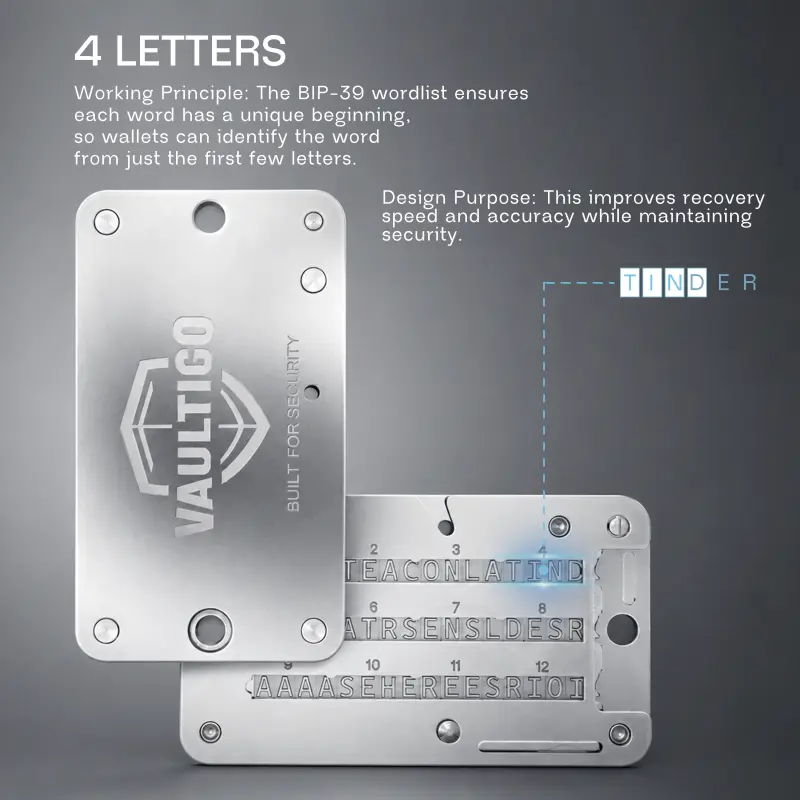
Once a new seed has been generated through corrected firmware and its receiving address has been verified, the next question is physical preservation.
A paper backup is simple, but it depends on ink, handwriting, and a relatively fragile material. For long-term storage, some users prefer a stainless-steel system that remains completely offline.
At CryptoSafeKit, one option we provide is the VAULTIGO 4-Letter Metal Seed Phrase Backup System. It uses reusable metal letter tiles to record the first four letters of each word from a standard English BIP39 recovery phrase. The product does not generate keys, connect to a blockchain, or repair a compromised seed; its purpose is limited to preserving an already-valid recovery phrase offline.
That limitation is important.
A responsible security product should solve a clearly defined problem rather than imply that one accessory protects against every threat.
Why Only Four Letters?
The English BIP39 word list is constructed so that each recovery word can be uniquely identified by its first four letters.
For example:
ABANidentifiesABANDONABILidentifiesABILITYABOUidentifiesABOUT
This allows a compatible physical backup to store four characters per word instead of the full word while preserving the information needed to reconstruct a standard English BIP39 phrase. CryptoSafeKit’s product documentation limits the VAULTIGO 4-letter system to this standard English BIP39 use case.
The word order still matters.
The selected letters must still be accurate.
A four-letter backup should therefore be assembled privately and checked carefully against the original phrase before it is placed into long-term storage.
It should not be assumed to work with:
- Custom recovery words
- Non-BIP39 formats
- Every language-specific word list
- SLIP39 shares
- Proprietary wallet backups
- An optional BIP39 passphrase
Confirm the exact recovery standard used by the wallet before recording anything permanently.
What a Metal Seed Backup Can—and Cannot—Do
It can help with:
- Keeping the recovery data offline
- Avoiding cloud and screenshot exposure
- Reducing dependence on paper and ink
- Keeping word positions organized
- Preserving a standard English BIP39 phrase in a compact format
- Correcting setup errors when a reusable tile system is used
It cannot:
- Increase the entropy of an existing seed
- Repair a recovery phrase generated by affected firmware
- Detect a malicious hardware wallet
- Stop someone who obtains physical access from reading the backup
- Prevent coercion or theft
- Protect a weak or reused optional passphrase
- Reverse an incorrect transaction
- Determine whether a smart contract is safe
The device and backup should also be stored separately.
Keeping the hardware wallet beside its complete recovery phrase can allow one theft, fire, search, or access event to compromise both normal access and emergency recovery.
The Passphrase Exception Is Not a Repair
Coinkite notes that a strong, unique BIP39 passphrase creates an additional barrier for an affected wallet.
However, the company still recommends migration because the passphrase does not strengthen the underlying recovery phrase. A short, reused, patterned, quoted, or predictable passphrase may itself be guessable.
A BIP39 passphrase also introduces a serious recovery dependency.
Every different passphrase—including one containing a typing error—creates a different valid wallet. Losing the exact passphrase can permanently remove access to the intended account.
Never store a passphrase casually beside the seed without first considering the resulting threat model.
Do not type it into a website or untrusted device.
A Better Hardware-Wallet Checklist
Before funding a new hardware wallet, ask:
About seed generation
- Which entropy sources are used?
- Has the complete seed-generation path been independently reviewed?
- Does the manufacturer document security incidents openly?
- Which firmware version generated the wallet?
About recovery
- Which backup standard is used?
- Is the phrase BIP39, SLIP39, or proprietary?
- Can the recovery process be tested safely?
- Is an optional passphrase involved?
- Does a trusted person know how to identify the correct backup during an emergency?
About physical storage
- Is the backup legible?
- Is the word order unambiguous?
- Is it stored separately from the wallet?
- Can unauthorized access be detected?
- Is the storage location protected from casual discovery?
- Has the phrase ever been photographed or digitized?
About migration
- Can the new wallet fingerprint be verified?
- Can receiving addresses be confirmed on trusted hardware?
- Has a small test transaction been completed?
- Has the old backup been retained until migration is fully confirmed?
The checklist may feel less exciting than comparing screen sizes or supported coins.
It is also much closer to the decisions that determine whether self-custody survives a real failure.
The Lesson Is Not “Never Trust Hardware Wallets”
The easy reaction is to conclude that hardware wallets cannot be trusted.
The opposite reaction is equally weak: assuming another brand must be immune because this incident involved COLDCARD.
No device provides absolute security.
Hardware wallets can reduce private-key exposure and create a trusted transaction-confirmation process. Their security still depends on firmware quality, entropy generation, recovery design, supply-chain integrity, user verification, and incident response.
The more useful lesson is to stop treating “offline” as the end of the security discussion.
Offline storage protects against specific risks.
It does not automatically prove that the secret was securely generated.
The Backup Must Preserve the Right Secret
A physical backup has one essential purpose:
Preserve an accurate and valid recovery secret without exposing it digitally.
The COLDCARD incident does not make that purpose less important.
It makes the sequence clearer:
- Generate the seed securely.
- Verify the wallet and receiving address.
- Preserve the recovery phrase accurately.
- Store it offline and separately.
- Review official security advisories.
- Replace—not merely update—a seed when the seed itself is affected.
A metal recovery system such as the VAULTIGO 4-Letter Metal Seed Phrase Backup belongs in step three.
It is not a substitute for secure generation.
It is the physical preservation layer that begins after secure generation has been established.
Would this incident change the questions you ask before initializing a new hardware wallet?
Share your view in the comments. The most useful outcome of this event would be a self-custody community that asks harder questions before the first deposit—not after the first loss.
This article is for educational and security-awareness purposes only. It does not constitute financial, legal, investment, or personalized cybersecurity advice. Users who may have generated a seed using affected COLDCARD firmware should follow the latest official Coinkite advisory. Never enter a recovery phrase, private key, wallet PIN, or optional passphrase into an unknown website, cloud service, support form, messaging application, or remote-access session.






