
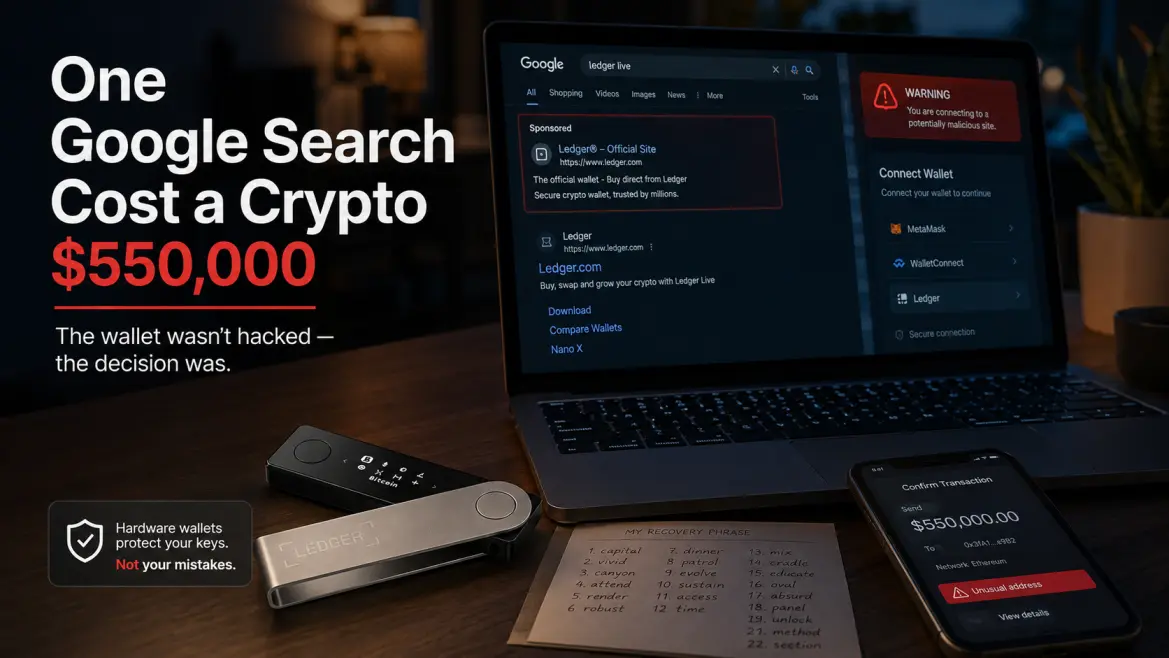
A fake Hyperliquid ad reportedly drained 550,019 USDC. The uncomfortable lesson is that better key storage cannot fix a bad signing decision.
Most crypto scams begin somewhere that already looks suspicious.
A random Telegram message.
A fake support account.
A strange email.
This one reportedly began somewhere millions of people trust every day:
Google Search.
A Hyperliquid user searched for the platform, clicked a sponsored result, landed on a website impersonating Hyperliquid and ultimately lost approximately 550,019 USDC.
Blockchain records cited by investigators showed three transfers of roughly 440,015 USDC, 82,503 USDC and 27,501 USDC to addresses identified as controlled by the attacker. Google later suspended the advertiser.
But the most interesting part is what happened next.
This Wasn’t a Hyperliquid Hack
That distinction matters.
There is currently no indication that the Hyperliquid protocol itself was compromised in this incident.
The victim was reportedly redirected through a malicious Google advertisement to a counterfeit website and then interacted with the malicious environment.
In other words:
The attacker didn’t need to break Hyperliquid.
They only needed to become Hyperliquid for a few minutes.
That is a very different security problem.
And one crypto users increasingly need to understand.
The Scam Became More Interesting This Week
On August 24, blockchain-security firm Salus published additional investigation into the case.
Salus linked the infrastructure to services associated with the Inferno Drainer ecosystem—a professionalized wallet-draining operation.
According to the investigation, the infrastructure offered capabilities including:
- malicious phishing scripts,
- approval-command generation,
- automated wallet draining,
- cross-chain withdrawals,
- token swapping,
- automatic fund consolidation,
- and automated revenue sharing between operators.
Think about that for a moment.
This is no longer simply:
“Someone made a fake website.”
It increasingly resembles a business.
Someone provides the drainer.
Someone buys the ads.
Someone creates the fake interface.
Someone attracts the victim.
Software handles the theft.
And the proceeds can automatically be divided afterward.
Crypto phishing is industrializing.
The Most Dangerous Button Was Probably the One That Looked Normal
This is why I think the incident matters more than the dollar amount.
A sophisticated crypto user probably knows:
Never give someone your seed phrase.
But DeFi introduces another security boundary:
signing.
The victim doesn't necessarily need to reveal a recovery phrase.
A malicious website may simply convince the wallet owner to authorize something they did not fully understand.
And once the legitimate owner authorizes a harmful transaction or approval, the blockchain doesn't know it was a mistake.
To the network, it can look like a perfectly valid signature.
“But I Use a Hardware Wallet”
That helps.
But it doesn't solve everything.
A hardware wallet such as a Ledger, Trezor or another dedicated signing device can keep private keys isolated from the browser and general-purpose computer.
That is an important security layer.
But suppose your screen says:
Approve
and you approve it.
The hardware wallet knows that the legitimate key signed something.
It doesn't automatically know whether:
you actually understood what you were signing.
This is why I increasingly dislike the phrase:
“My crypto is safe because I use a hardware wallet.”
A better statement is:
“My private keys have better isolation because I use a hardware wallet.”
Those are not the same promise.
This Is Why I Wouldn’t Use My Long-Term Wallet for Everything
Imagine one wallet holds:
- your long-term BTC,
- ETH,
- stablecoins,
- NFTs,
- DeFi positions,
- experimental tokens,
- airdrops,
- and every dApp you have tested since 2022.
Now every new website you interact with is sitting one authorization decision away from assets you may intend to hold for years.
That is unnecessary concentration of risk.
I prefer thinking in roles.
Long-Term Wallet
Rarely interacts with dApps.
Used primarily for assets intended for longer-term self-custody.
Active Wallet
Contains only what is needed for normal activity.
Experimental Wallet
Used for new protocols, mints, airdrops and higher-risk interactions.
This doesn't make attacks impossible.
It limits the blast radius of one bad decision.
Hardware Wallet + Offline Backup Are Different Layers
There is another distinction worth making.
A hardware wallet protects signing keys.
Your recovery backup protects your ability to restore those keys if the hardware is lost, damaged or replaced.
Those are different jobs.
For longer-term self-custody, I prefer thinking about the setup as:
Hardware signer → transaction control
Offline recovery backup → recovery resilience
Separate active wallet → dApp exposure control
At CryptoSafeKit, this is also why we don't treat a hardware wallet as the entire security system.
Our store covers Ledger, Trezor and Tangem hardware wallets, while the VAULTIGO metal backup system addresses a different problem: keeping BIP39 recovery information offline and physically durable.
Neither product category can protect someone who knowingly approves a malicious transaction.
That distinction matters.
For readers comparing a mobile hardware signer, I recently put together a detailed 2026 review of the Ledger Nano X, including what it can—and cannot—protect against.
One Rule I’m Changing After This Incident
I already avoid obvious phishing links.
Now I would add another rule:
I don't enter important crypto platforms through advertisements.
If I regularly use a service:
bookmark it.
Type the known address directly.
Use the official application.
Do not assume:
Sponsored = verified.
Security Alliance had already reported blocking hundreds of malicious crypto-related Google ad URLs during 2026, including impersonation campaigns involving major crypto platforms.
The advertisement may be legitimate advertising infrastructure.
The advertiser may not be legitimate.
The $550,000 Lesson Is Surprisingly Simple
The wallet wasn't necessarily broken.
The blockchain wasn't broken.
Hyperliquid wasn't necessarily broken.
Google Search wasn't “hacked.”
The security boundary failed somewhere between:
Search → click → trust → connect → approve.
And that is what makes modern crypto security difficult.
We keep trying to protect keys.
Attackers increasingly target decisions.
A hardware wallet is still useful.
Cold storage is still useful.
Offline recovery backups are still useful.
But none of them replace the moment when a human has to ask:
“Do I actually know what I’m approving?”
One Question for the Comments
Be honest:
Do you ever click sponsored Google results when accessing a crypto exchange, wallet or DeFi platform?
And another one:
Is the wallet you use for DeFi the same wallet where you keep most of your long-term assets?
I’m curious whether this incident changes anyone’s setup.
Please don't post wallet addresses, balances, seed phrases, private keys or recovery locations in the comments.
Security disclaimer: This article is for educational purposes only. The reported Hyperliquid incident was attributed by security researchers to phishing rather than a confirmed Hyperliquid protocol exploit. Hardware wallets and physical backups reduce specific risks but cannot prevent every malicious transaction, phishing attack or user-authorized contract interaction.






