
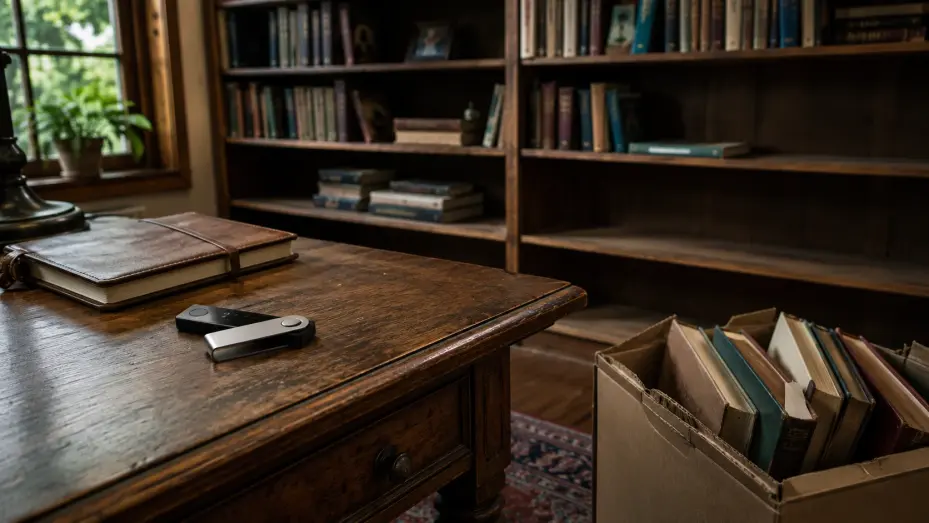
I used to think I had found a clever place to hide my recovery phrase.
Not online.
Not in a photo.
Not in my email.
Not inside a cloud drive.
I wrote the words carefully on paper, folded the sheet, and placed it inside an old book on a shelf at my parents’ house.
The logic seemed perfect.
Nobody would look there.
The book wasn’t valuable.
It wasn’t something a burglar would specifically search for.
And unlike a safe with an obvious purpose, it blended into an ordinary bookshelf.
For months, I barely thought about it.
Then I went away on a business trip.
And my parents decided to clean the house.
The Message That Made My Stomach Drop
It started with a completely ordinary conversation.
My mother mentioned that they had finally cleaned out some old shelves.
Boxes of books had been sitting there for years. Some were dusty, some had not been opened in a decade, and nobody seemed interested in reading them again.
So they did what many families would do.
They gathered the old books together and sold them by weight to someone collecting used paper and recyclables.
I remember staring at my phone when I read the message.
Then one thought appeared:
The book.
I called immediately.
“What books?”
“The old ones from the shelf.”
“All of them?”
“Most of them. Why?”
I asked her to describe which shelf.
Then which books.
Then whether there were any left.
The more she answered, the more certain I became.
The book containing my recovery phrase was gone.
Not stolen.
Not hacked.
Not photographed by malware.
Sold for recycling with a pile of old paper.
My “Secret Hiding Place” Had One Huge Problem
Until that moment, I had thought primarily like someone trying to defend against a thief.
Could someone remotely access the backup?
No.
Could malware scan it?
No.
Could a hacker retrieve it from cloud storage?
No.
Could someone searching my computer find it?
No.
From that perspective, the setup looked good.
But I had ignored a completely different threat:
What happens when somebody who does not know the object is valuable throws it away?
My parents had done nothing unreasonable.
To them, it was an old book.
They had no idea that a folded piece of paper inside it could represent the recovery path to a cryptocurrency wallet.
And that was entirely my mistake.
I had made the backup secret.
I had also made it indistinguishable from rubbish.
A Recovery Backup Has Two Jobs
This incident changed the way I think about seed phrase storage.
Most crypto security advice focuses on confidentiality:
Can an unauthorized person get the recovery phrase?
That is obviously important.
But there is a second requirement:
Can the legitimate owner still find and use it when recovery becomes necessary?
Those goals can conflict.
Hide something too obviously, and someone may steal it.
Hide something too cleverly, and it may eventually disappear because nobody—including your future self—understands what it is.
A good recovery system therefore needs to protect against both unauthorized access and accidental destruction or loss.
My book method handled the first problem reasonably well.
It failed badly at the second.
The Hardware Wallet Was Still Working
Fortunately, I had not lost access to the wallet itself.
That detail changed everything.
The device was still in my possession, the PIN still worked, and I could still access the accounts.
But I no longer considered that wallet suitable for long-term storage.
Why?
Because the recovery path was gone.
If the device failed tomorrow, was reset, became damaged, or disappeared, I would be depending on a backup that no longer existed.
The device had effectively become a single point of failure.
So I treated the situation seriously.
I did not wait for the hardware wallet to fail.
I created a fresh wallet with a new recovery backup through a trusted setup process, verified the receiving address carefully, sent a small test transaction first, and then migrated the remaining assets.
The old wallet could still function.
But without a verified recovery path, I no longer wanted meaningful assets depending on it.
That was the real lesson.
Losing the Device and Losing the Backup Are Very Different Problems
A hardware wallet is replaceable.
That is one of the reasons recovery phrases exist.
If the device disappears but the correct recovery information remains available, the wallet can generally be restored through an appropriate compatible recovery process.
But reverse the situation:
The hardware wallet still works today.
The recovery phrase is gone.
Now everything depends on the continued operation and availability of one electronic device.
That is not where I want long-term self-custody to end up.
The physical wallet is not the permanent object.
The recovery capability is.
Paper Wasn’t Really the Only Problem
It would be easy to finish this story by saying:
“Paper is bad. Use metal.”
But I don't think that is the full lesson.
A metal backup hidden inside a box that somebody throws away can disappear too.
A stainless-steel seed backup accidentally sold during a house clearance is still gone.
A fire-resistant backup placed somewhere nobody can remember is still useless.
Physical durability solves one category of risk.
It does not solve poor recovery planning.
What my paper backup exposed was a larger problem: I had confused hiding with preserving.
Those are not the same thing.
I Started Thinking About “Accidental Adversaries”
We usually imagine an adversary as someone malicious.
A hacker.
A burglar.
A scammer.
A thief.
But long-term self-custody also has what I now think of as accidental adversaries.
People who are not trying to steal anything.
They may even be the people you trust most.
A spouse cleaning a drawer.
A parent selling old books.
A roommate throwing out an envelope.
A moving company packing the wrong box.
Someone handling your belongings after an emergency.
Your future self forgetting why a random piece of metal is hidden somewhere strange.
Nobody needs malicious intent for a recovery system to fail.
Sometimes ordinary life is enough.
The Question I Ask Now
Whenever I look at a recovery setup, I no longer ask only:
“Would a thief find this?”
I also ask:
“Could this disappear because somebody doesn't know what it is?”
That changes the design considerably.
A useful recovery plan should think about things like:
- whether the backup can remain physically readable for the intended storage period,
- whether it could be accidentally discarded,
- whether wallet and recovery backup share the same physical failure point,
- whether the legitimate owner can still identify the backup years later,
- whether anyone who may eventually need to handle the estate understands that a recovery process exists,
- and whether the system remains recoverable without unnecessarily exposing the actual secret.
Notice that none of those questions involve hackers.
That is exactly why they are easy to overlook.
“Hidden Forever” Can Become “Lost Forever”
There is a strange instinct in crypto security to make recovery phrases almost disappear.
Hide them better.
Make them less obvious.
Put them somewhere nobody would ever look.
But there is a point where secrecy becomes fragility.
If your backup looks like meaningless rubbish, there is always a chance somebody will eventually treat it like meaningless rubbish.
If only one person knows a recovery system exists, that information itself can become another single point of failure.
And if a system depends on remembering a clever hiding place ten years from now, memory becomes part of the security architecture.
That makes me uncomfortable.
Why I Think Physical Recovery Deserves More Attention
Most people spend far more time choosing a hardware wallet than designing the recovery system behind it.
They compare:
Ledger.
Trezor.
Tangem.
Screens.
Secure elements.
Connectivity.
Firmware.
Then the device arrives and the most important backup may end up on a small piece of paper stuffed into whatever hiding place seems clever at the time.
That seems backwards.
At CryptoSafeKit, this is one reason I have become increasingly interested in physical recovery design—not just hardware wallets themselves.
Metal recovery backups, including the VAULTIGO systems we work with, can address some physical durability problems associated with paper.
But I would never describe a metal backup as a complete solution.
The bigger job is designing a recovery system that survives:
time, physical damage, accidental disposal, device failure, and human misunderstanding.
Material is only one part of that.
The Most Embarrassing Security Mistakes Are Often the Most Useful
I'll admit something.
This story isn't impressive.
There was no sophisticated exploit.
No attacker.
No zero-day.
No blockchain investigation.
No dramatic phishing operation.
I put an important piece of paper inside an old book.
Someone sold the book.
That's it.
But maybe that is exactly why the story matters.
Security failures often happen in ordinary moments.
The expensive hardware wallet works perfectly.
The encryption works.
The private key never leaks.
And the recovery plan fails because somebody cleans a bookshelf.
Try the “Parents Cleaning Your House” Test
Here is the test I wish I had used earlier.
Imagine you leave for several months.
Someone you trust decides to clean and reorganize your belongings.
They are not trying to steal from you.
They are simply trying to help.
Could they accidentally:
throw away your recovery backup?
move it somewhere you cannot find?
sell the object containing it?
destroy an envelope they assume is unimportant?
place the hardware wallet and recovery backup together?
If the answer is yes, that is a real threat model.
Not a theoretical one.
Self-Custody Means Planning for Boring Disasters
Crypto security discussions naturally focus on attackers.
But attackers are only one reason access can disappear.
Sometimes the enemy is:
water.
Fire.
Moving house.
Old electronics.
Faded paper.
Forgotten instructions.
A cleaning day.
Or a parent wondering why you still have so many old books.
Self-custody means accepting responsibility for all of those boring possibilities too.
That is harder than buying a hardware wallet.
But it is also what makes the difference between possessing a device and actually having a recovery system.
The book is probably long gone now.
Maybe it was pulped.
Maybe it passed through several hands before being recycled.
I will never know.
What I do know is that the experience permanently changed one question for me.
I no longer ask:
“Where can I hide my seed phrase so nobody finds it?”
I ask:
“How do I protect this backup so the wrong person cannot use it—but the right person can still recover it years from now?”
Those are very different problems.
And long-term self-custody needs to solve both.
Now I’m curious: what is the strangest place you have heard someone use for a recovery backup?
A book?
Under a floorboard?
Inside a safe?
Somewhere much stranger?
Please share the method, not your actual location—and obviously never post recovery words, private keys, passphrases, or wallet balances.
Security disclaimer: This article is for educational purposes only. Never enter a recovery phrase, private key, PIN, or passphrase into an unsolicited website, cloud document, customer-support form, or messaging application.






