
Now that we have had a look at various definitions, and various concepts of risk, let us have a quick look at how real humans (you and me) handle it.
Us, humans, we hate uncertainty (yes? / no?). Where there is any uncertainty, we will immediately sense a risk is involved. Uncertain outcomes (and most outcomes in our lives are uncertain) are inherently perceived as RISKY. Life IS a risky business.
What will tomorrow bring? Which career path to chose? Should I buy some BTC/ETH/etc.?
Basically, any life decision that leads to a fork (dentistry or law degree ?) or contains a time factor (which of my boyfriends will make the best husband ?) has uncertainty in it. And us humans are very unhappy, and clumsy, handling uncertainty.
However, some of us are unhappier and clumsier than others.
And this is so because every person has their own and unique preference for how very risky their life should be. While few persons will be extremely risk averse, and just as few will be extremely risk seeking, most of us will fall somewhere in between. So the important thing here is that our risk preference is located on a line, on a SPECTRUM - we are, most of us, anything between extreme risk lovers and extreme cowards.
An intriguing fact No1 : unlike many other properties of the human animal, risk-preference is NOT normally distributed - by this we understand that most people are NOT risk neutral. Instead of a pretty bell curve, we have what is called a skewed distribution, where most of as are moderately to seriously risk-averse. In plain words, we are mostly cowards.
Spoiler : your risk preference is a genetic thing, it may evolve, but you cannot manipulate it. You cannot 'make yourself braver'.
An intriguing fact No2 : If we drew a graph with one axis to represent risk and the other axis to represent reward, risk preference of a risk-neutral girl or boy will be a straight line, BUT preferences of risk-lovers and risk-averse people will be CURVES. And they will be curved in opposite directions (see link for the graph).
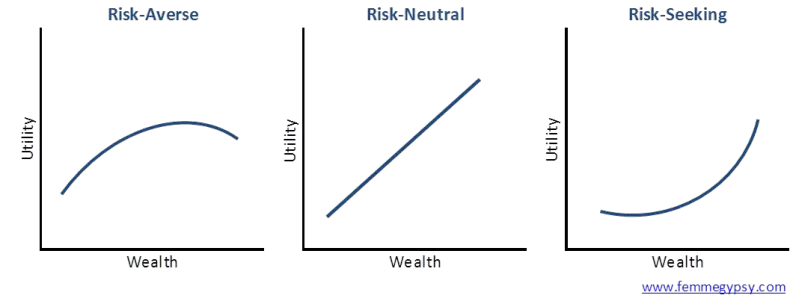
(image source: seekingalpha.com)
And why is this? Why are the lines curved?
Because a risk-seeking person is seeking mostly risk - and the more risk, the happier the person. In an extreme case, a risk-seeking person is becoming, in fact, a suicide waiting to happen, a ticking bomb. The good news - only very few people are extremely risk-seeking (see my earlier comment - we are mostly cowards).
Now the risk-averse person is the opposite - the more risk, the more unhappy the person. Now at a given point of risk, such a guy will simply accept no more of it - will 'forget' about higher potential rewards (be it millions or billions of promised dollars). These people will NEVER take on risk beyond a point. This is why societies that are made mostly cowards are so easy to rule.
But all the above is the kind of psychology voodoo that you can learn in 5 minutes by googling.
Let us take one step further.
Is there anything else in our psychology that will dictate our job choices, investment choices and partner choices?
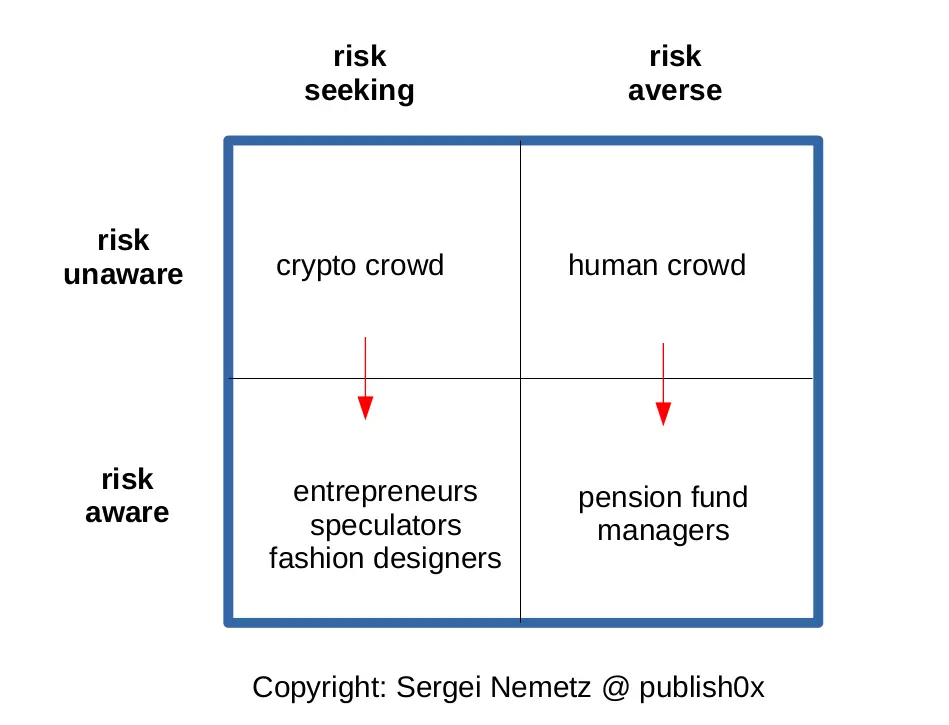
Yes. There is. It is our knowledge. This is to say: our risk preferences are one thing, and our ability to define, measure and judge risks is another. And this fact adds another dimension to our risk unlove story. With this new factor, with knowledge (=education+experience), we are no longer individuals scattered along the 'risk - no risk please' line. Now we are pawns placed on the 'risk board'. This is how the life game is played.
Have a look at my illustration and note I made sure to include you in the picture :
A-ha !
So now we have something more dimensional. We have a board of life and a game, with us as pawns.
Please note the little red arrows. They are there for a good reason. These arrows represent the LIKELY direction of your migration. These arrows tell you that you are less likely to become a coward if you are already adventurous. You are just as unlikely to become an adventurous person if you are an average person (as noted earlier, we are mostly cowards).
Because your risk preference is ... yes, a genetic thing. And it may evolve, but you cannot manipulate it ...
However, neither the coward not the crypto freak are stuck - with some investment in our education, we can learn about risk, learn about how we handle uncertainty, and we can move onwards - to places like entrepreneurship and fashion design, to places like investment fund management and fire fighting.
Now, please do not tell me you are not into fashion, and that you never wanted to be a firefighter. I will understand your fire-aversion perhaps, but I will not like you more for wearing boring country style lingerie.
Learn. Grow. Shine.
(yes, it is a psychology blog ;-)
post cover image artist : Jorge Gonzales via Unsplashd






