
I found a great way to help the world by doing almost nothing, and it's non-political. You can help significant research facilities simulate protein folding while doing nothing. If you have a loved one affected with cancer, infectious diseases, neurological diseases, and more, you can do something!
There is a project out there called "Folding@home" which studies major diseases much faster than previously conceivable. The usual method for researching protein folding involves supercomputers and laboratories. However, computing power is never enough to speed up results. The Folding@home (FAH) project uses volunteers' home computing power, in the background, while the computer is on. By linking multitudinous amounts of volunteers' computing power together, the result is much more power than supercomputers. As long as your computer is on, it's working. You can have your browser open with an interface for you, or you can close everything and let it go.
According to an engrossing article about the project, F@H currently produces 2.5 exaflops! That's more computing power than the top 500 supercomputers combines. Quoting a friend of mine, "This is some next level ‘stuff'’ !" You can participate in getting cures for cancers, HIV, and even COVID 19 before it’s too late.
**ExaFLOPS? If you haven't seen this word before, it's not that important and won't change your life, for now. Simply put, this term refers to computing systems working at 1018 floating-point operations per second. Scientists believe that this is close to the ability of the human brain. This level of computing should bring our understanding of complex biological functions into our reach. It will also bring us the seeming impossible accurate weather forecasts. This goal hasn't been reached from one single machine, but FAH has surpassed it. If this interests you, check out the human brain project.
How much energy and CPU power will it use? That is up to you. You have control to turn your contribution up or down. You can even set it to work while idle. According to their site, the average CPU uses about 400 watts. Higher-end Pentium computers are around 100 watts with the monitor off. According to their calculations from PG&E in California, running FAH on a PC costs about $0.36 per day. If you monitor your power consumption and figure out how much it cost you, please let me know the usage, computer type, and location.
Why is protein folding so important? Proteins are not just for building muscles and weight-loss diets; they are the building blocks of life and the keys to biological functions. Our technology has sequenced the human genome, but we don’t understand how it does what it does. Proteins self assemble by folding- taking on a particular shape. If everything goes as it should, you live a healthy life and hopefully don't get hit by a bus after winning the lottery. However, when your proteins don't fold correctly, you start to develop problems.
When it comes to viruses, researchers want to find out which proteins are used to suppress our immune system. If we can understand the components (atoms) of the protein and how they fold, then we can work on therapeutics to stop them.
This process is so complicated that only massive supercomputers could manage it. Thanks to FAH, this is now manageable with millions of PCs. FAH is responsible for a breakthrough in treatment for the Ebola virus. Before that, the virus was labeled as 'undruggable'- there were no identifies spots for drugs. Using the collaborative computing power of 30,000 volunteers, a druggable place was found through simulations. As a result, we have an opportunity to find cures for the incurable. After COVID 19 hit, the numbers of volunteers exploded, leading to record-breaking computing speeds.
I want to help, but I worry about my computer.
If you would like to help, but you feel unsure about allowing a program to work in the background, that fine. Maybe you think your computer isn't on enough to do any good, no problem. You can also help in other ways. You can donate directly to their cause. These donations are tax-deductible and should be made to the Washinton University in St Louis-a non-profit 501(C)(3) entity. You can share this with your friends. Your community, social groups, churches, and schools can create groups to combine computing power for the good of humanity. Some major corporations will match donations. You can even donate as a gift for friends and family member that are hard to buy presents for.
Warning!
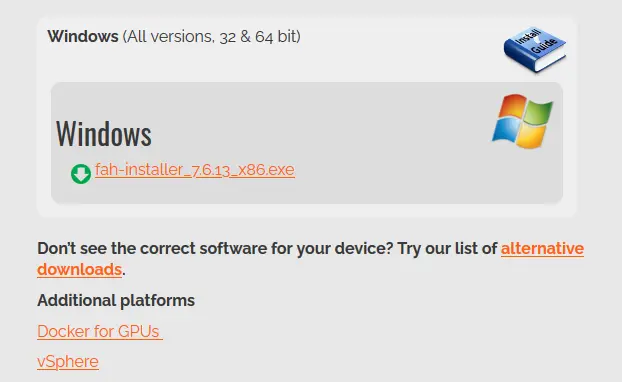
Greedy people always have to ruin everything. Only download the install file from the original website or a website you trust, i.e., CNET, Wikipedia. There are already crooks out there with their targets set on your computer. Please go through the links below or find it from a trusted website. Don’t just click on the links from a search. The below image is copied directly from their website. Please check before downloading.
Where’s the beef- the crypto connection? FAH offers points for your contributions. You can donate them to charity or keep them as a badge of pride. I found out about this program through banano (BAN). If you haven’t heard of this cute, free coin, here is a connection to their site. They are a fungible cryptocoin that can cheer you up on a bad day with their puns about their currency being edible and other cute memes. So there are groups out there offering rewards, and I’m sure there are more cryptocurrencies offering rewards similar to a faucet or “PC mining programs”.
Below are some of the significant contributors using the information. You can find more detailed information on their website.
BOWMAN LAB, WASHINGTON UNIVERSITY IN ST. LOUIS
CHODERA LAB, MEMORIAL SLOAN-KETTERING CANCER CENTER
VOELZ LAB, TEMPLE UNIVERSITY
CSELS, WASHINGTON UNIVERSITY IN ST. LOUIS
HUANG LAB, HKUST
SHUKLA GROUP, UNIVERSITY OF ILLINOIS
DELEMOTTE GROUP, KTH ROYAL INSTITUTE OF TECHNOLOGY.
LINDAHL LAB, STOCKHOLM UNIVERSITY






