The Next Stage of On-Chain Finance
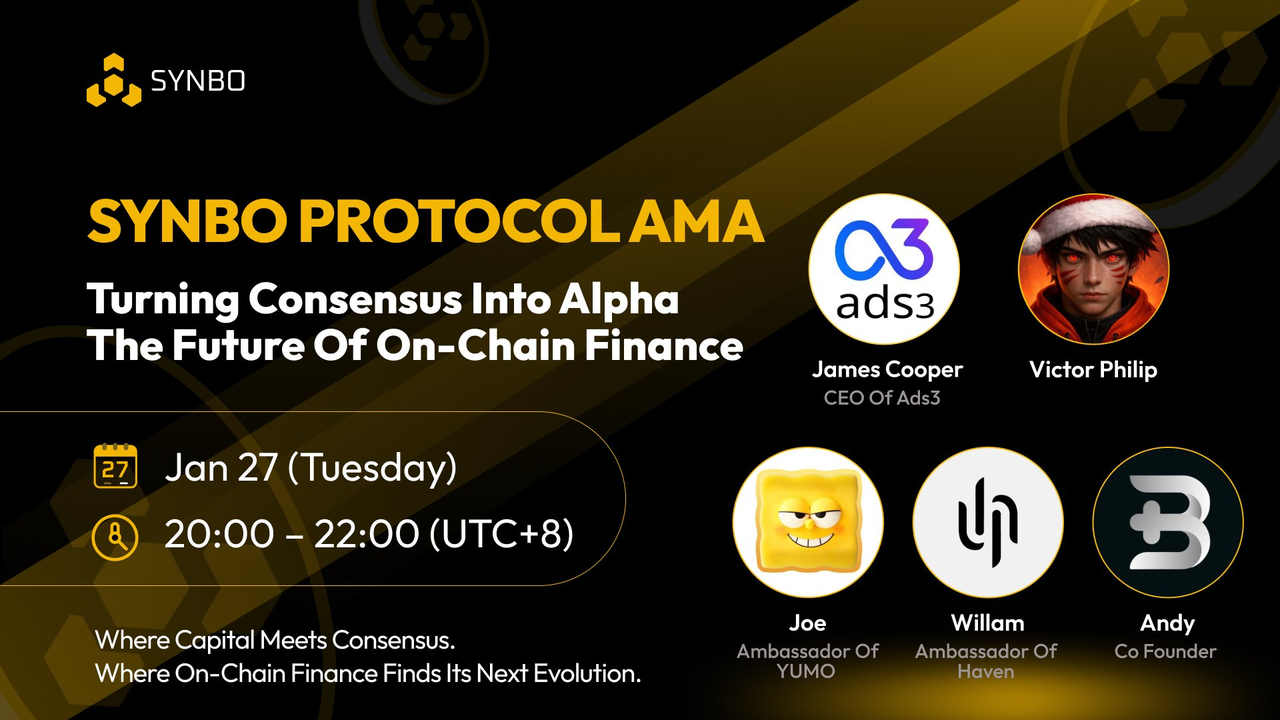
On January 27, 2026, SYNBO hosted a global online AMA on X (Twitter Space) titled “Turning Consensus into Alpha: The Future of On-Chain Finance.”
This session invited ecosystem partners and builders from various Web3 sectors to discuss a core question reshaping the industry landscape:
“In a gradually maturing on-chain market, where does true Alpha actually come from?”
🎙️ AMA Guest Lineup
- James Cooper — CEO, Ads3
- Victor Philip — Ambassador, InitVerse
- Joe — Ambassador, YUMO
- William — Ambassador, Haven
- Andy — Co-founder, Bit Health
The guests shared their judgments on the future of on-chain capital from diverse perspectives, including Infrastructure, AI, RWA, Community Ecosystems, and On-Chain Finance.
Q1 | In today’s on-chain market, what is “Real Alpha”?
In the opening discussion, the guests reached a highly unanimous conclusion:
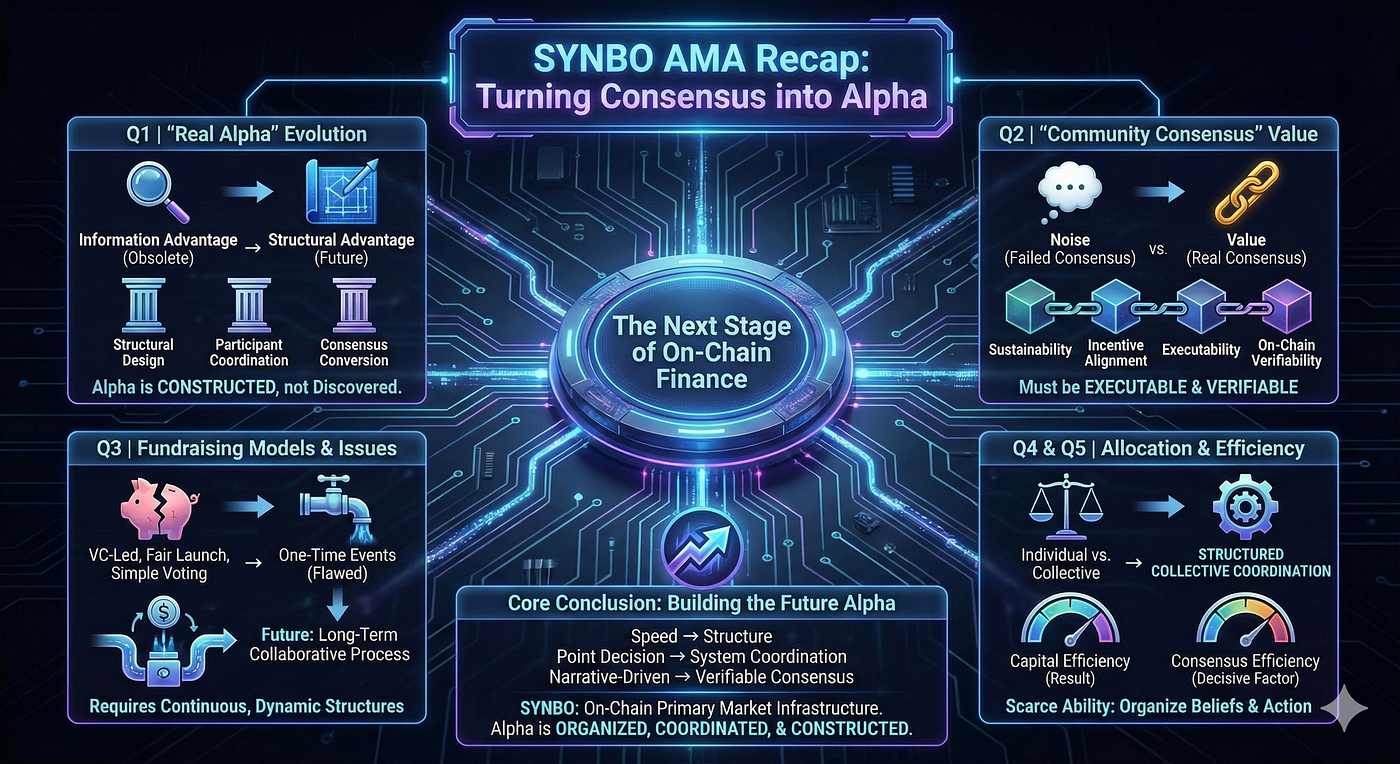
Alpha is shifting from “Information Advantage” to “Structural Advantage.”
As on-chain data becomes increasingly transparent and the cost of information dissemination continues to drop, advantages based on early info, insider news, or front-running are rapidly becoming obsolete.
They are being replaced by three abilities that are more long-term and scarce:
- Structural Design Capability
- Participant Coordination Capability
- Consensus Conversion Capability
Insight: In the new cycle, Alpha is no longer a result of “discovery,” but is “constructed” through mechanism design and system collaboration.
Q2 | Why does most “Community Consensus” fail to create real value?
Almost every project talks about community, but very few can translate community into financial results. The AMA repeatedly emphasized: Not all consensus has value.
Consensus that creates value typically possesses key characteristics:
- Sustainability: It is not short-term sentiment, but long-term judgment.
- Incentive Alignment: Participants bear risks and share results.
- Executability: It can influence fundraising, governance, or resource allocation.
- On-Chain Verifiability: It doesn’t just stay on social media.
When consensus cannot be translated into coordinated economic behavior, it is often just “noise.”
Insight: Only consensus that can be executed and verified has the potential to become Alpha.
Q3 | What are the structural problems with existing fundraising models?
When discussing common models like VC rounds, Fair Launches, and simple community voting, the guests pointed out shared flaws:
- VC-Led Rounds: High concentration of early power; passive community participation.
- Fair Launch: Fair on the surface, but difficult to identify long-term commitment.
- Simple Voting Mechanisms: Unable to distinguish between “conviction” and “casual action.”
The common issue with these models is that they treat fundraising as a one-time event rather than a long-term collaborative process.
Insight: Future on-chain fundraising requires structures that can continuously absorb real participation, dynamically reflect consensus changes, and encourage long-term alignment.
Q4 | Should on-chain capital allocation be led by individual decisions or collective coordination?
On this issue, the discussion did not devolve into a binary opposition. The view closest to consensus was:
The future lies not in “Individual vs. Collective,” but in “Structured Collective Coordination.”
Relying entirely on individual judgment leads to capital fragmentation. Conversely, collective decision-making without mechanism design leads to inefficiency or manipulation.
Insight: The truly effective path is to use on-chain rules and mechanism design to guide optimal collective results while retaining individual judgment.
Q5 | In the next cycle, is Capital Efficiency or Consensus Efficiency more important?
The guests generally agreed: Both are important, but Consensus Efficiency may be the decisive factor.
Capital itself is not scarce in the Web3 world. What is truly scarce is:
- The ability to organize fragmented beliefs.
- The ability to transform long-term judgment into continuous action.
Consensus efficiency determines whether capital can be correctly guided, retained for the long term, and kept stable through cycles.
Insight: From this perspective, capital efficiency is often the result of high-quality consensus, not the starting point.
Core Conclusion | Turning Consensus into Alpha
This AMA delivered a clear signal:
- Alpha is moving from Speed ➟Structure.
- From Point Decision➟System Coordination.
- From Narrative-Driven ➟ Verifiable Consensus.
What SYNBO is building is precisely this kind of on-chain primary market infrastructure that takes consensus as its core signal.
The Alpha of the future is not discovered.
It is organized, coordinated, and continuously constructed.