I. Background & Core Theme
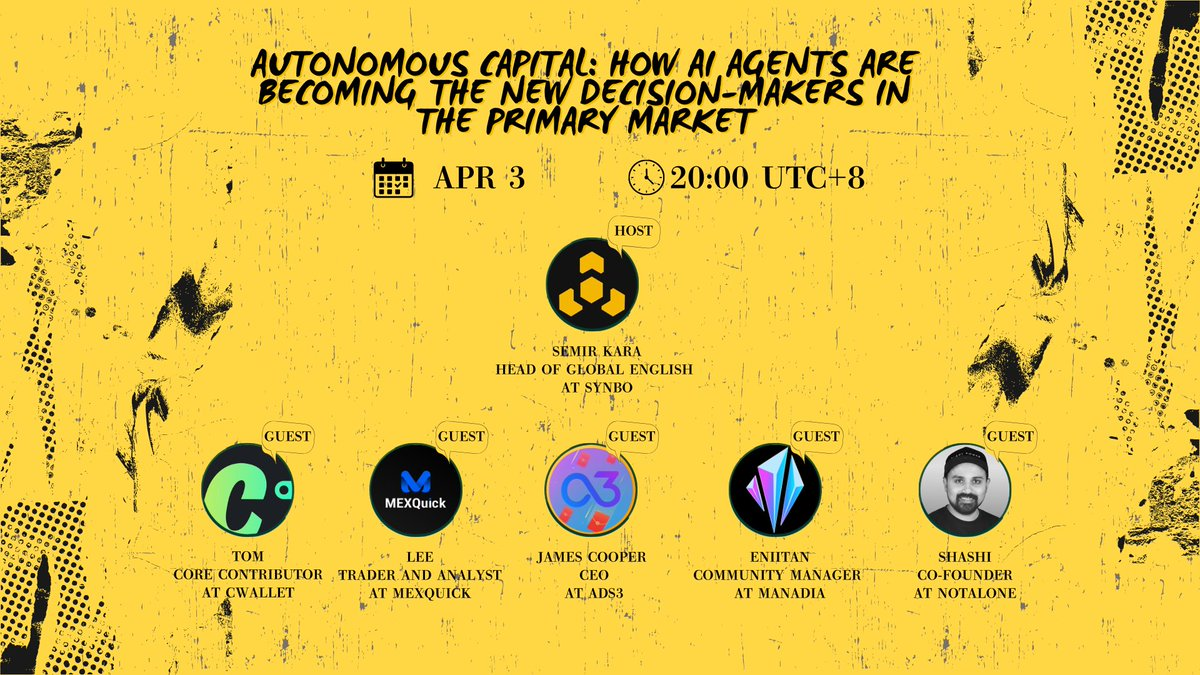
On Friday, April 3 at 8:00 PM (UTC+8), SYNBO hosted an online AMA themed “Autonomous Capital: How AI Agents Are Becoming the New Decision-Makers in the Primary Market.”
In today’s Web3 primary market, AI is no longer just a chatbot; it is evolving into an “economic participant” capable of autonomously discovering, evaluating, and even allocating capital. Centered around this trend, we invited several frontline industry builders — Tom (Core Contributor), Lee (Trader & Analyst), James Cooper (CEO of Ads3), Eniitan (Community Manager), and shashis132 (Co-Founder of NOTALONE). Together, we sat down to break down and deeply explore the concept of AI participating in investments.
II. Guest Perspectives: A Comprehensive Breakdown from Q1 to Q4
During the hour-plus discussion regarding the changes, risks, and future infrastructure brought about by AI, the guests shared rich, grounded, and practical experiences:
Q1: How are AI agents changing the way primary market investors discover and evaluate projects?
- Lee: Times have changed. We used to manually scroll through Twitter and Discord for early projects. Now, AI handles this in real-time. AI can even auto-track Github code commits and push early alerts. Opportunities now belong to those who can spot good projects first at the lowest cost, and AI is the tool that gives you that head start.
- James: AI does the heavy lifting of “filtering data” for us. We used to spend hours digging through LinkedIn and code repositories, but no more. You can train a dedicated AI to find projects for you 24/7. This frees humans up to focus on how to build proposals and collaborate with these filtered, high-quality projects.
- Eniitan: AI reads whitepapers way faster than humans. They can efficiently scan documents, track various metrics, and compare them. Driven by AI, the evaluation standards in the primary market are relying more and more on real data rather than just good storytelling.
Q2: Can community models like CCO (Community Consensus Offering) perfectly integrate with AI?
- Lee: Absolutely, they are a match made in heaven. AI can highly efficiently run data simulations on tokenomics and even gauge market FOMO (Fear Of Missing Out) sentiment. Introducing AI into community consensus can vastly improve fundraising efficiency and fairness.
- James: Integration is possible — for instance, having AI objectively analyze a token model. However, “when asking for money, a real person must step up.” You can use AI to write a proposal, but you should never rely entirely on AI to complete the whole fundraising process. When funds are involved, there must ultimately be a genuine human connection and trust.
- Eniitan: AI and communities complement each other perfectly. AI handles trend analysis and filters the noise, but the community (humans) must act as the “gatekeeper.” People shouldn’t blindly follow AI’s orders; the correct approach is: AI does the work, and the community validates it.
Q3: What new risks and opportunities emerge when AI truly participates in investment decisions?
- Lee: The risks are critical. First is the “herd effect” — if everyone’s AI uses the same logic, they might all dump at the same time, leading to flash crashes and instant liquidity evaporation. Second is “data poisoning”; if hackers pollute the data, AIs will collectively misjudge. But the opportunities are equally massive: AI can execute truly 24/7, emotionless trading. More importantly, it gives retail investors the same data processing power as top-tier VCs, democratizing investment opportunities.
- James: The biggest risk is AI “hallucinations” — it can confidently spout nonsense. Blindly letting AI make decisions for you is a huge mistake. The opportunity lies in AI helping you process complex math and valuation models that exceed your professional scope.
- Eniitan: If you don’t know the space, an AI’s highly confident but incorrect advice will lead you off a cliff. Investing should never be a blind following of algorithms. However, undeniably, AI opens the door to “automated capital.” As long as you do your basic due diligence, AI will be your strongest assistant.
Q4: What infrastructure needs to be built for humans and AI to successfully “co-invest”?
- Lee: We need three core pieces of infrastructure. First, the ability to verify the AI agent’s identity and its wallet, making every on-chain action auditable. Second, a standardized “human-machine co-signing” mechanism to allocate permissions proportionally. Third, real-time cross-chain data. Only then can humans confidently hand over money to AI for strategy stress-testing.
- James: Current infrastructure is still too early. The most fundamental issue is cost; utilizing highly capable AI APIs like Claude or GPT is still quite expensive. We need cheaper, better training infrastructure.
- Eniitan: We need trustworthy on-chain data sources; good decisions cannot be made without good data. Furthermore, we need a clear identity reputation system and “permission-limited risk control” — there must be a mechanism allowing real humans to step up and “pull the plug” at any time. Decision-making must be shared between humans and machines, not handed over to AI unilaterally.
III. Guest Consensus: AI for Compute, Humans for Trust
After deeply debating these four questions, all guests reached a very clear and pragmatic consensus:
AI will never fully replace human investment decisions, but it is an incredibly powerful “lever.” In the future primary market, AI agents will take on the “heavy lifting” such as data collection, whitepaper analysis, code monitoring, and trend simulation. However, when it comes to final capital allocation, trust building, and “pulling the plug” during a crisis, control must remain in the hands of real humans and the community.
IV. Conclusion: Reshaping On-Chain Capital via Decentralized Human-Machine Collaboration
This AMA highlighted an irreversible trend: AI is flattening the information gap in the primary market. Data analysis teams that only top VCs could afford in the past will soon be accessible to every ordinary investor via AI agents.
This perfectly aligns with SYNBO’s vision of breaking capital monopolies and promoting “equal opportunity.” We believe that since AI can help everyday users discover projects earlier and more accurately, the underlying mechanisms of the primary market must upgrade accordingly.
The on-chain primary market structure SYNBO is building is designed exactly to welcome this new era of “human-machine collaboration.” Our championed CCO (Community Consensus Offering) mechanism perfectly fits the best practices mentioned by our guests: Project teams can use AI to optimize token models, and investors can use AI to filter noise. Yet, the final investment actions, the crystallization of consensus, and the flow of funds all operate under SYNBO’s transparent, auditable smart contracts and genuine community validation.
Facing the high efficiency and new risks brought by AI, SYNBO will continue to build a more transparent data feedback mechanism and a more robust on-chain risk control layer.
Let AI be the eyes that discover value, and let community consensus be the ruler that validates it.