
You've heard the stories: a trader buys a token on one exchange and simultaneously sells it for a higher price on another, pocketing the difference instantly. It sounds like a myth—a glitch in the matrix of the financial world. But these glitches are real, and they happen every single day. While powerful tools like ArbitrageScanner are built to automatically find these discrepancies across crypto exchanges, understanding why they exist is the first step to exploiting them. This is the world of cryptocurrency arbitrage.
The Basic Law of Arbitrage
At its core, arbitrage is the act of capitalizing on a price difference for the same asset across different markets. It’s not about predicting the future price; it's about exploiting a temporary inefficiency that exists right now. You buy an asset where it's cheap and sell it where it's expensive, all in a matter of seconds. The net result, in a perfect world, is a risk-free profit.
Why Do These Glitches Even Happen?
If markets were perfectly efficient, arbitrage wouldn't exist. But they aren't. These profitable glitches are created by real-world friction:
- Information Speed: A major news event can cause a price surge on a high-volume exchange like Binance a few seconds before a smaller, regional exchange reacts.
- Liquidity Gaps: One exchange might have a huge sell order that temporarily pushes the price down, while others haven't yet caught up.
- DEX vs. CEX Delays: Decentralized exchanges (DEXs) often have different pricing mechanisms than centralized exchanges (CEXs), creating natural, fleeting price differences.
The Hunter's Traps: Why 99% of Manual Arbitrage Traders Fail
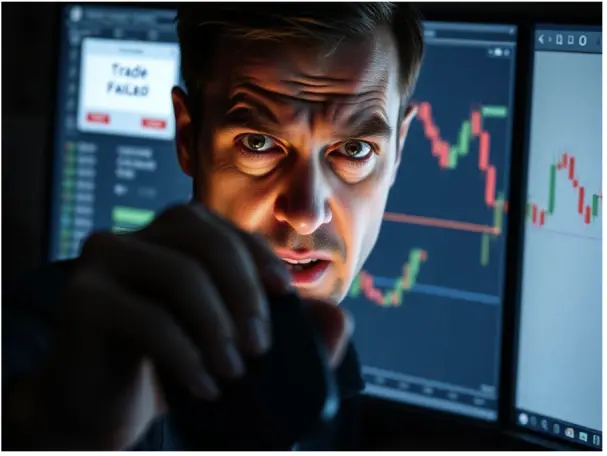
If arbitrage is "free money," why isn't everyone a millionaire? Because the path from spotting a price difference to banking the profit is filled with hidden traps. The market glitch is real, but catching it is a race against time and technology—a race that manual traders almost always lose.
Trap #1: The Speed of Light (And Blockchains)
The moment an arbitrage opportunity appears, thousands of bots and professional traders see it too. You have milliseconds to act. While you're busy logging in and placing your buy order, a high-frequency trading bot has already completed the entire trade. Your "guaranteed" profit vanished before you could even click.
Trap #2: The Mirage of Profit (Fees & Slippage)
You spot a juicy 2% spread. But after you factor in the trading fees on both exchanges, the network withdrawal fee, and the potential "slippage" (the price changing slightly because of your own order's size), that 2% can shrink to 0.1% or even a loss. What looked like a gold nugget was just a mirage.
Trap #3: Human Limitation (You Can't Watch Everything)
There are hundreds of exchanges and thousands of tokens. A profitable spread might appear for just 15 seconds between two obscure assets on exchanges you've never even heard of. No human can monitor all of this information simultaneously. Trying to find these opportunities by manually flipping through charts is like trying to find a specific grain of sand on a beach.
The Professional's Arsenal: How to Actually Win the Arbitrage Game

Successful arbitrage traders don't work harder; they use smarter tools. They treat arbitrage not as a casual activity, but as a high-speed, information-driven hunt. And every hunter needs the right gear.
Weapon #1: The All-Seeing Eye (An Automated Arbitrage Finder)
The single most important tool is a high-speed scanner. Instead of manually searching, pros use an arbitrage finder that monitors thousands of pairs across dozens of CEX and DEX exchanges simultaneously. A tool like ArbitrageScanner doesn't just show you a price difference; it calculates the potential net profit after fees, shows you the liquidity, and sends an instant, ready-made alert the moment a viable opportunity emerges. It solves the problem of human limitation.
Weapon #2: A Need for Speed (Fast Execution)
Once the scanner sends an alert, speed is everything. Pro traders have accounts pre-funded and ready to go on multiple exchanges. While automated arbitrage bots that trade for you carry security risks, a manual system powered by instant scanner notifications gives you the best of both worlds: the bot's speed in finding the trade, and your control and security in executing it.
Weapon #3: Advanced Tactics (Futures & Funding)
The hunt goes beyond simple buy-sell trades. Pros also engage in spot-futures arbitrage, exploiting the gap between the spot price and the futures price. This often involves collecting funding rates—regular payments made between traders that can add an extra layer of profit on top of the arbitrage itself, a strategy easily tracked with the right tools.
Conclusion: Stop Chasing Ghosts, Start Hunting Glitches
Arbitrage in cryptocurrency is real, and it can be highly profitable. But it is not the simple, risk-free game many believe it to be. It is a high-stakes competition where speed, data, and technology determine the winners.
Trying to compete manually is setting yourself up for failure. The difference between the frustrated trader who is always too late and the professional who consistently profits lies in their toolkit. By equipping yourself with a powerful crypto arbitrage finder, you stop chasing ghosts of profit and start systematically hunting the real, actionable glitches in the market matrix.






