
This whole thing started in the most casual way possible, the way most crypto investigations begin, which is by scrolling through CoinGecko and checking what the current Top 20 looks like. I use CoinGecko regularly, not because I believe it is the absolute truth of the market, but because it is fast, clean, and gives a decent overview of what is supposedly “big” in crypto at the moment.
Bitcoin, Ethereum, the usual stablecoins, some familiar Layer 1 names, but nothing surprising. And then I saw WhiteBIT sitting at spot number twelve.
Number Twelve
Top 12 in the entire crypto market, and I had honestly never paid serious attention to it before. Now, I am not claiming to know every token in existence, because that would be ridiculous in an industry that prints new tickers faster than memes. But if something is ranked #12 globally by market cap, you would expect it to be widely discussed, heavily traded on major exchanges, and constantly mentioned across Crypto Twitter and YouTube thumbnails.
That was not the case here. So naturally, I clicked.
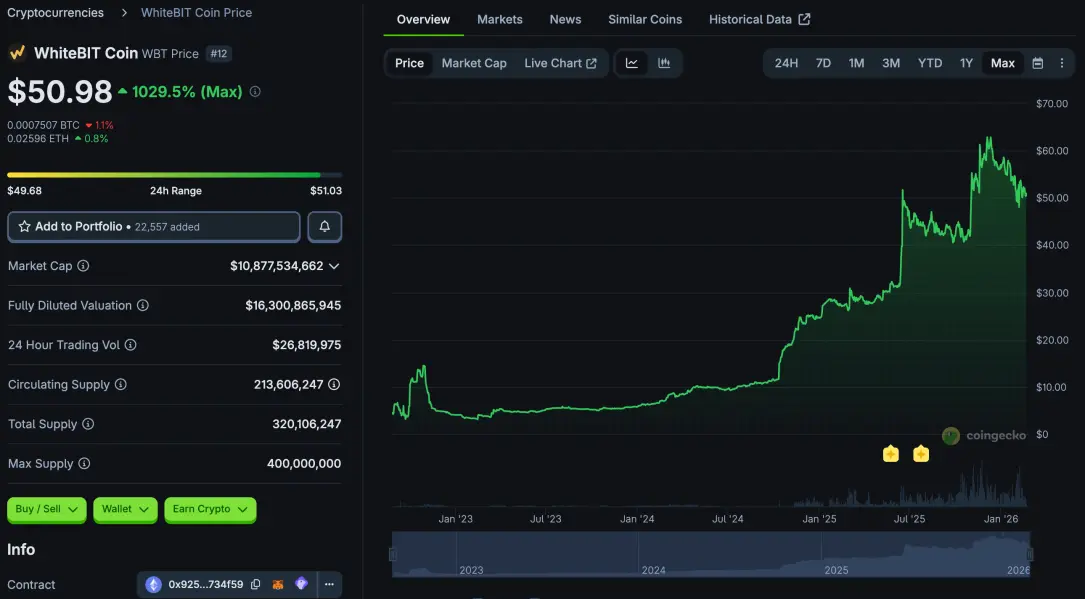
From “Who?” to “Okay, Interesting”
WhiteBIT Coin, ticker $WBT, turned out to be an exchange token. That immediately made it more interesting because exchange tokens have historically been strong ecosystem plays. $BNB became a monster and is one of my biggest holdings. $OKB had its moments. Even $FTT, before it imploded spectacularly, was once considered a premium exchange token with real utility.
So at first glance, this did not look like some random low-liquidity meme coin sneaking into the rankings. It was attached to an exchange, and exchange tokens can absolutely accumulate serious value if the platform behind them grows aggressively.
I even checked out the exchange itself and briefly considered signing up just to see what kind of ecosystem they were building, because if something is Top 12 by market cap, you at least want to understand what you might have missed.
But then I kept digging.
The Markets Page Didn’t Match the Ranking
When I looked at the markets tab, I noticed that most of the trading volume was concentrated on WhiteBIT itself, with additional volume on HTX and MEXC and a few other mid-tier venues. What I did not see were listings on the largest global exchanges like Binance, Coinbase, Kraken, or OKX.
Now, to be fair, not every legitimate token is listed everywhere. That alone is not suspicious. However, when we are talking about something ranked in the Top 12 by global market cap, you would typically expect broad exchange coverage and deep liquidity across multiple tier-one venues.
The other tokens sitting in that ranking range are traded everywhere. They have derivatives markets, institutional exposure, strong retail penetration, and massive awareness. WhiteBIT did not appear to have that same footprint.
At this point, I was not accusing anyone of anything. I was simply confused, and confusion in crypto usually means it is time to cross-check.
Two Aggregators, Two Different Realities
So I opened CoinMarketCap to see how $WBT was ranked there, and that is when things got genuinely interesting.
WhiteBIT was not sitting at #12 on CoinMarketCap. In fact, it was ranked dramatically differently, and the page included a small but crucial note that changed the entire context of this story. CoinMarketCap ranks this token on #3723, and explicitly states that it has not verified the project’s market cap and that the circulating supply is self-reported.
That detail is everything. Because market cap is supposed to be simple. It is just price multiplied by circulating supply. But if the circulating supply is self-reported and not independently verified, then the resulting market cap is partly dependent on declared numbers rather than strictly audited figures.
CoinGecko and CoinMarketCap clearly apply different methodologies and verification standards. One platform may accept the circulating supply as presented by the project itself under its internal rules, while the other may flag it as unverified or treat it differently within its ranking logic.
And once the circulating supply differs, the market cap differs. Once the market cap differs, the ranking differs. Suddenly, the Top 20 is not a universal truth. It is an outcome of methodology.
The Holder Count and Watchlist Gap
Another detail that caught my attention was the relatively low number of holders and watchlist interest compared to other Top 20 tokens. Most coins in that range are being tracked by hundreds of thousands of users and have broad distribution across wallets and exchanges. WhiteBIT’s metrics, by comparison, suggest a much narrower distribution.
Again, this does not prove anything malicious. It simply highlights a structural mismatch between perception and ranking. If something is one of the twelve largest crypto assets in the world, you would normally expect massive awareness, widespread listings, and strong community engagement.
When those signals are not as strong as the ranking suggests, it becomes reasonable to ask how that ranking was constructed.
This Is About Structure, Not Conspiracy
Let me be very clear: this is not an accusation of manipulation. It is an observation about how data aggregation works.
CoinGecko and CoinMarketCap are not mirrors of each other. They apply different supply verification processes, different listing standards, and different internal rules. Even subtle differences in methodology can create significant ranking shifts.
But what this situation demonstrates is something bigger than one token.
It shows that the “Top 20” in crypto is not a fixed, objective hierarchy. It is a representation shaped by formulas, policies, and verification standards.
And most investors never think about that. They scroll, see a ranking, and assume legitimacy. But legitimacy in crypto is often an algorithm away from being different.
My Final Conclusion
WhiteBIT may be a legitimate exchange token building a strong ecosystem, and perhaps over time, it will prove that its valuation is justified. That is not the central point here.
The real takeaway for me is that even something as basic as market cap ranking is not absolute. It depends on circulating supply definitions, verification standards, liquidity distribution, and how aggregators interpret the available data. If you base your investment decisions purely on rankings without understanding how those rankings are constructed, you are essentially trusting someone else’s methodology without questioning it.
For me, this was simply another reminder that in crypto, perception is powerful, but perception is often built on assumptions most people never examine.
Always compare sources. Always dig one layer deeper. And never confuse algorithmic ranking with unquestionable truth.
If you enjoy this kind of structural deep dive into how the market actually works behind the dashboard numbers, follow me on Publish0x and Medium for more. I do not just look at charts and price action; I try to understand the mechanics behind them.
And if you are actively positioning yourself in this market and need solid infrastructure to trade, rotate, or hedge properly, make sure you are using a reliable exchange. If you are not on Binance yet, you can use my link to sign up and stay ready for whatever the next rotation brings.
In crypto, understanding the structure behind the numbers is often more valuable than the numbers themselves.






